



Versatile class for PNG liner trade
The four vessels of the 22,000dwt Chief-class, delivered between April and August this year, represent a further major investment by CNCo in its Swire Shipping liner division following the commissioning of the eight vessels of the 31,000dwt S-class over the past two years.
Led by the Coral Chief and followed by the Highland Chief, New Guinea Chief and Papuan Chief, the latest series emanates from Zheijiang Ouhua Shipbuilding, located on Zhoushan Island, southeast of Shanghai. Developed by Rostock-based Neptun Ship Design and Neptun China Ship Design, the new type incorporates many of the features and concepts embodied by the S-class multipurpose carriers, constructed by the Ouhua yard in 2013/2014. Optimisation studies were performed by Hamburg Ship Model Basin (HSVA).
Scrupulous attention to operating efficiency, cargo handling speed and long-term trading flexibility is manifest in the latest project, and characteristic of CNCo‘s fleet development policy. While required to serve an extremely wide cargo mix, every aspect of the design, equipment and engineering reflects considerations of energy usage across the operating profile – in the drive for the lowest possible fuel consumption per ton-mile – with corresponding competitive and environmental benefits.
Pacific services
Coral Chief and second-of-class Highland Chief have been assigned to Swire Shipping’s scheduled service linking Port Moresby and Lae (PNG), Honiara (Solomon Islands) and Santo (Vanuatu) with Melbourne, Sydney and Brisbane. The subsequent pair, New Guinea Chief and Papuan Chief, have been introduced on the North Asia Express (NAX), calling at Taichung (Taiwan), Ningbo, Shekou and Shanghai (China), Lae (PNG), and Townsville (Australia). The new NAX service has expanded Swire Shipping’s network coverage across the region, offering the fastest transits to date between Shanghai and Lae, and between the Australian port and Shanghai.
The versatility of the Chief-class stems from the variety of cargo stowage options afforded by the nature and configuration of the hold spaces, coupled with the adoption of heavy-duty, fully-electric deck cranes. The arrangements cater for an extremely wide range and mix of freight, including dry and refrigerated containers, general cargo, heavy-lift plant, machinery and equipment, project shipments and agricultural commodities in bulk parcels.
Three of the five holds are cellular, while two are flush-sided for bulk goods and are equipped with tweendecks and a centreline girder. Underdeck provision for containers is complemented by the slots on the weatherdeck hatches, giving an overall nominal capacity of 1,617 teu. The box payload can include up to 160 reefer units of 40ft (feu) carried on deck.
Self-sufficiency in cargo handling is conferred by three 60-tonne, variable frequency drive (VFD) MacGregor cranes arranged on high pillars along the ship’s centreline, plumbing the five holds and the cargo-bearing weatherdeck hatches. The cranes located between holds one and two, and between two and three, can be paired to provide for 120-tonne tandem lifts.
Electric lifting
The fully-electric cranes are claimed to use approximately 30-35% less power than equivalent, closed-loop electro-hydraulic models. They also achieve substantially faster cycles as well as more accurate load positioning, to reduce turnaround times in port. CNCo pioneered the use of MacGregor VFD crane technology in multipurpose cargo vessels, and the latest application endorses the efficiency attractions of the all-electric option.
In addition, there are fewer moving parts and the life expectancy of the components is greater than with electro-hydraulic cranes. A further benefit is the absence of hydraulic oil for system actuation, obviating the risks of oil leakage. All the hatch covers, cell guides and fixed fittings were also supplied by Cargotec under its MacGregor brand.
Accessed through non-sequential, folding hatch covers, flush-sided bulk holds two and three are the largest, and each incorporates a tweendeck. The cellular holds one, four and five are served by non-sequential, liftaway pontoon-type hatch covers and swing seals. Tanktop strength is greatest in holds two and three, at 22 tonnes/m2, such that the vessel can load over 12,000-tonne of steel coils using these spaces plus the after section of number one hold. The two bulk holds afford a grain-equated bulk cargo intake potential of around 12,300m3.
Each of the class has been specified with a Wärtsilä 5RT-flex58T-D main engine, which employs fully electronically-controlled common-rail fuel injection, exhaust valve actuation and starting.
Derated efficiencies
Although the five-cylinder model has a nominal maximum continuous output of 11,300kW, CNCo has opted for installations derated to 10,000kW at 105rpm so as to achieve the lowest possible fuel consumption at the design speed of 15.25 knots in a fully-laden state. Operating at just 6,000kW, or 60% of the contracted maximum continuous rating, anticipated main engine consumption is 22 tonnes/day.
The common-rail system allows the optimum injection pressure, fuel injection timing and exhaust valve timing for all engine loads and speeds to be calculated, ensuring efficient combusting across the operating profile. Other advantages include stable low running speeds (in the range of 10-12% nominal speed), smokeless operation and improved control of exhaust emissions, and lower cylinder oil lubricant usage.
Hydrodynamic efficiency has been enhanced by a rudder bulb immediately abaft the propeller. Furthermore, a special flap-type rudder has been chosen to minimise rudder movement on passage and improve manoeuvring in port in conjunction with the 1,000kW Nakashima bow thruster, reducing dependence on tugs.
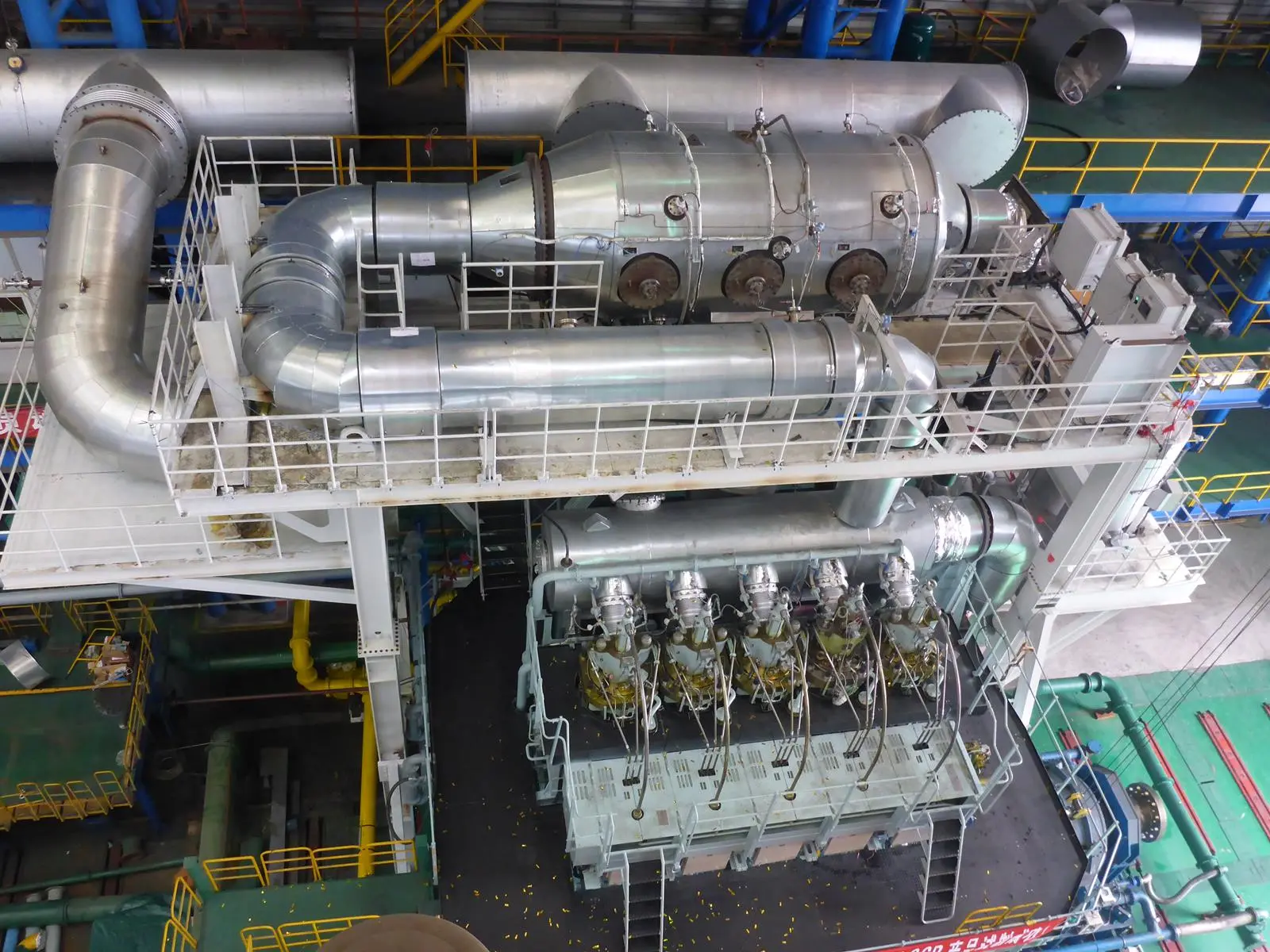
The fourth and last vessel of the series, Papuan Chief, has an additional component of environmental engineering in the shape of a selective catalytic reduction (SCR) plant, conferring the ability to comply with IMO Tier III limits on NOx emissions while burning heavy fuel oil. The engine is the first Wärtsilä two-stroke with a high pressure SCR system manufactured in China. Both the diesel and the SCR reactor were produced by licensee Hudong Heavy Machinery Co.
NOx abatement
Wärtsilä’s track record in high-pressure SCR systems goes back to the late 1990s when installations were fitted in three ro-ro freight vessels powered by two-stroke plant. Drawing on the Wärtsilä design concept, the SCR system for Papuan Chief was developed by Winterthur Gas & Diesel (WinGD), the joint venture of Wärtsilä and China State Shipbuilding Corp, in conjunction with Hudong Heavy Machinery Co. Installations of this kind have to be tailored to each individual vessel or ship design, and require a close working partnership between the engine licensor, engine manufacturer, SCR supplier and shipyard.
The cylindrical reactor unit is located in the exhaust duct from the engine cylinders to the turbocharger turbine inlet, making for compactness and efficiency in a high-pressure process. Urea solution is dosed into the exhaust gas flow to react with and eliminate the NOx emissions by reducing them to nitrogen and water. Three bypass valves enable the SCR system to be open or closed for operation in Tier III and Tier II waters, respectively.
The testbed trials for the high pressure SCR set-up were approved by Lloyd’s Register. “These trials show that the technology to produce IMO Tier III compliant engines is actually available and hence give confidence that Tier III certified engines will be ready for 1 January 2016,” said LR’s principal technical specialist John Bradshaw. The urea/water solution required is a 40/60 mix, and WinGD anticipates that urea consumption with a 10,000kW two-stroke engine would be approximately 4.3m3 per day.
Heat recycling
In keeping with the bid to reduce power consumption in all areas of the ship, heat from the exhaust gases of the main engine and two of the auxiliaries is used to make steam for heating the fuel. The speed of the main seawater pumps and engine room fans are automatically adjusted to suit main engine power, and regenerative heat is used to reduce heating for the fuel purifiers.
CNCo’s nomination of the five-cylinder RT-flex58T-D for the four ships of the Chief-class has followed the use of six-cylinder engines of the same type in the company’s eight Shansi-class, 31,000dwt multipurpose cargo carriers. The Wärtsilä marque and technology, in the form of five-cylinder RT-flex50-B low-speed diesels, was also chosen for the group’s new generation of handysize bulkers.
Certain elements of the ShipRight package, a comprehensive set of procedures aimed at ensuring the highest standards of safety, quality and reliability at the design and construction stages, are reflected in the Lloyd’s Register classification of the Coral Chief series. For instance, the array of class notations includes ShipRight ACS(B), acknowledging the use of an approved protective coating system in the seawater ballast tanks as an anti-corrosion measure. In addition, the descriptive notes ShipRight MCM, SCM and SERS have been assigned.
MCM (Machinery Condition Monitoring) signifies that the owner operates an approved planned maintenance scheme as part of the Continuous Survey Machinery (CSM) cycle, and that appropriate monitoring techniques and equipment are employed to record condition against agreed acceptable limits. SCM (Screwshaft Condition Monitoring) indicates that equipment and procedures are in place to determine the physical and operational condition of the shaft line.
SERS denotes the adoption of the optional Ship Emergency Response procedure, which reflects the shipowner’s awareness of the need for immediate operational guidance in the event of a ship emergency. This assists towards compliance with MARPOL and OPA requirements.
PRINCIPAL PARTICULARS—‘CORAL CHIEF’
|
Length overall |
175.20m |
|
Length b.p. |
166.35m |
|
Breadth |
27.60m |
|
Depth |
14.00m |
|
Draught, design |
9.60m |
|
Deadweight |
21,980t |
|
Holds |
5(3 cellular; 2 bulk) |
|
Cargo cranes |
3 x 60t |
|
Containers, nominal |
1,617 TEU |
|
Containers @14t homogeneous |
1,191 TEU |
|
Reefers, maximum(on deck) |
160 FEU(40ft) |
|
Steel coil, maximum |
12,120t |
|
Bulk cargo, maximum(two holds) |
12,310m3(grain equiv.) |
|
Cargo capacity, overall |
Approx. 32,000m3 |
|
Passenger berths |
8 |
|
Crew complement |
24 |
|
Main engine power, contracted MCR |
10,000kW |
|
Speed, @6,000kW(60% MCR); @9.60m draught; 18% sea margin |
15.25 knots |
|
Class |
Lloyd’s Register |
|
Class notations |
100A1, Container Ship, Holds 2 & 3 strengthened for heavy cargoes, ECO(BWT, EEDI, IHM), +IWS, L1, ShipRight(ACS/B), +LMC, UMS, NAV-1 |
|
Class descriptive notes |
General cargoes in all holds, ShipRight(MCM, SCM, SERS) |
|
Flag state |
Hong Kong |
Related Articles
 PROPULSION
 GENERAL NEWS
 HYDROGEN