



VERSATILE COASTAL TRADER FOR NORWEGIAN OWNER
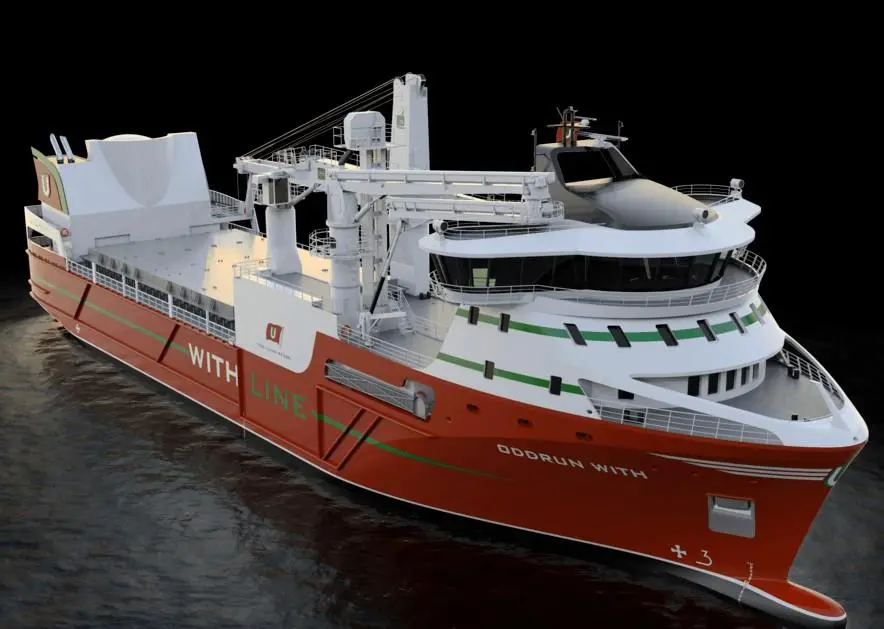
Construction of the 3,500dwt newbuild has been assigned to Tersan Shipyard, at Yalova, on the Sea of Marmara. Tersan currently ranks as one of the leading lights in Turkish shipbuilding, orientated to technically-challenging, specialised vessels and which is already established on the Norwegian market through a succession of newbuild contracts.
The Ulvan ship will be based on a design developed by the owner in conjunction with compatriot consultancy Multi Maritime of Forde, which has drafted many of the owner’s existing vessels, and whose designs have been chosen for Norwegian ferries built and on order at Tersan.
Scheduled for delivery during the fourth quarter of 2020, the latest newbuild will be named Oddrun With, to become the eighth ship in the Ulvan fleet.
The Norwegian predilection for self-reliant cargo handling capabilities and a combination of lo-lo and pallet sideloading modes, plus substantial cargo compartmentalisation and freezer capacity, is embodied in the nascent vessel. The ship will be powered to primarily run on LNG fuel, supplemented by a battery pack, and the hull form has been hydrodynamically-optimised in the interests of cross-profile and through-life efficiency.
Within a compact hull envelope of 86m x 24m main dimensions, five cargo spaces will provide an underdeck load capacity of about 6,500m3, of which 4,000m3 will be accounted for by cold rooms to accommodate refrigerated goods. In addition, containers will be carried on the weatherdeck as well as underdeck.
A full-automated double-pallet elevator of 2 x 5t capacity for freight handling along the coast will be complemented by a 120t main crane and 20t auxiliary crane. The unloading system for fish feed in conjunction with dynamic positioning arrangements have been devised to render efficient and non-contact direct discharge at the fish farms.
The vessel will be installed with propulsion machinery that will allow operation mainly on LNG bunkers, so as to meet exacting Norwegian standards and significantly cut greenhouse gas emissions. The ship’s carbon footprint will be further reduced by installing a battery pack, which will accomplish peak-shaving and load levelling and provide a spinning reserve.
The battery system will also be sized to enable the vessel to operate in full-electric mode for certain periods, as when manoeuvring and berthing, for instance. Battery-only running where feasible would result in negligible noise and vibration levels, a significant factor for local communities in the various ports and areas served.
The main crane and pallet lift will feature energy recovery arrangements feeding into the batteries, which will normally be recharged when alongside through connection to the shore grid. Another innovative aspect of the specification is the planned use of cold air, from the LNG fuel system, in the coolers for the freezer rooms.
Related Articles
 PROPULSION
 GENERAL NEWS
 HYDROGEN