



Versatile, gas-fuelled design for northern waters
It has also fostered the development of bespoke designs suited to the particular economic and operational challenges of serving relatively small-volume flows of disparate cargoes and a multiplicity of ports along a fjord-indented coastline of nearly 3,000km. The country’s own very tough environmental requirements and controls, including the NOx tax on engines over 750kW, and the prospect facing Norwegian coastal and short-sea of meeting IMO Tier 3 NOx criteria within emissions control area (ECA) waters, have spurred new fleet investment projects using leading-edge gas engine and propulsion technology.
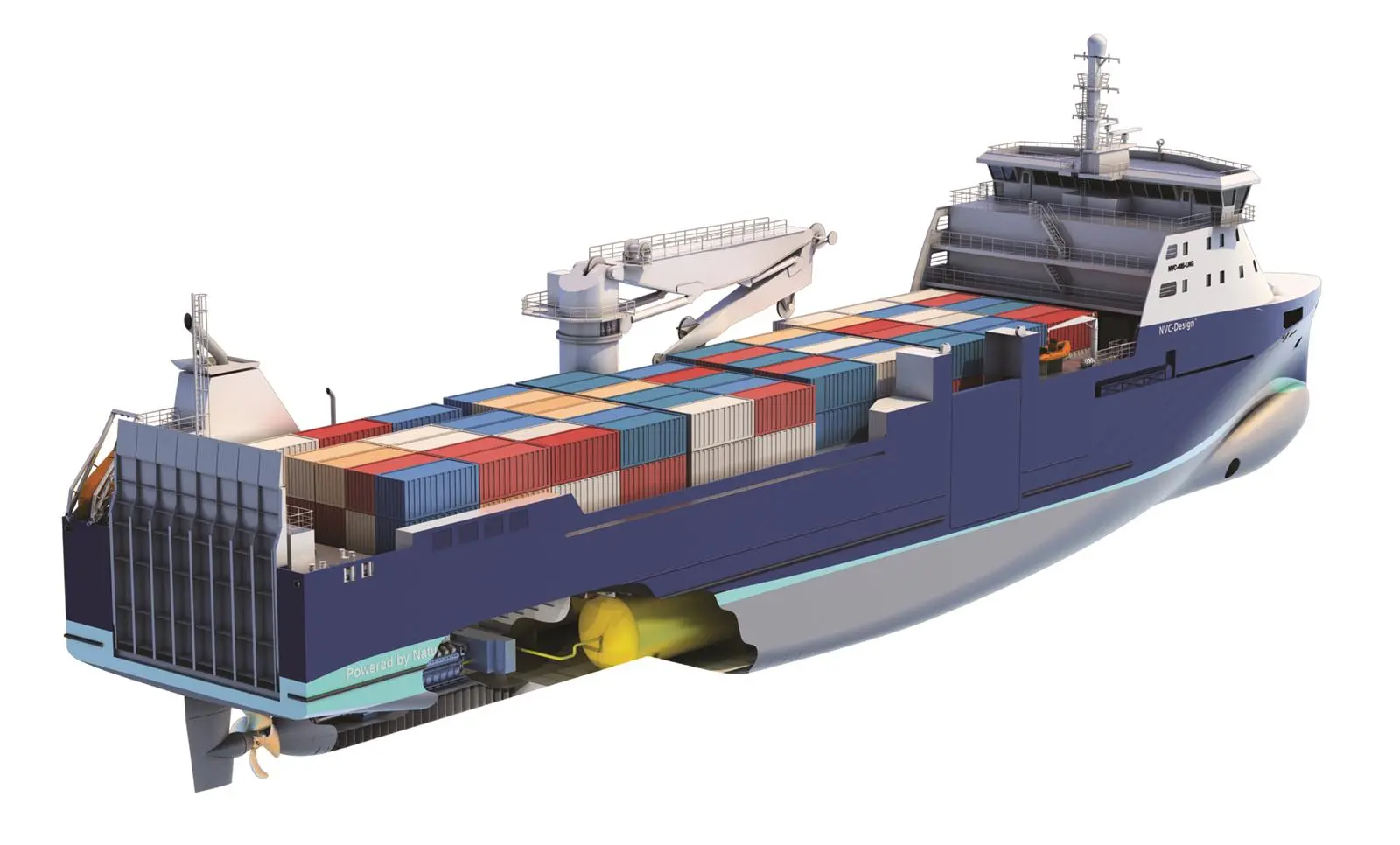
Integrated transport operator Nor Lines, currently deploying 11 coastal and short-sea cargo ships and responsible for cargo capacity on 11 coastal express (Hurtigruten) vessels, is planning to implement a new stage of fleet modernisation by ordering two versatile freight ships of about 5,000dwt. The proposed design combines ro-ro, container and palletised cargo carrying capabilities with natural gas-fuelled propulsion and advanced solutions for raising efficiency. The common link in all main aspects of the concept and its engineering is the recourse to home-grown technology, including Rolls-Royce Bergen lean-burn engine know-how.
The NVC405 LNG design prepared by Rolls-Royce in western Norway employs a single Bergen B35:40 V12 gas engine developing 3,930kW, and claimed to reduce NOx by over 90% compared with liquid fuel engines. In addition, the plant will produce negligible SOx and particulate matter. IMO Tier 3 compliance is achieved by this type of machinery without the need for additional exhaust aftertreatment.
Moreover, a combination of design and engineering measures to ensure long-term operating efficiency offers companion environmental benefits. Through the adoption of a gas propulsion system, patent-pending new bow design, integrated Promas propeller/rudder configuration, and innovative hybrid shaft generator, it is anticipated that CO2 emissions will be reduced by around 40% relative to a conventional vessel.
As exemplified by the Nor Lines fleet, Norwegian cargo ships in the coastwise and north European trades are often of distinctive type, using side doors and side pallet-handling systems, deck cranes and ro-ro handling methods within very compact hull dimensions. The envisaged NVC405 LNG generation for Nor Lines gives new form to such a modal mix, incorporating a very wide stern door/ramp on the main deck threshold, a starboard side door and double pallet lift, heavy-duty deck crane on the port side, and temperature-controlled, insulated cargo compartments.
Within the short-sea sphere, Norwegian operator Sea-Cargo is set to put down a new marker for the industry by introducing two 5,900dwt multipurpose ro-ro vessels powered by natural gas-ingesting machinery. As with the system developed for the nascent Nor Lines tonnage, Sea-Cargo’s prospective north European traders will employ a gas prime mover in a mechanical rather than electrical drive system. Two such newbuilds are to be constructed in India by Bharati Shipyard, with the first now due this year.
Another Norwegian company, NSK Shipping, has endorsed lean-burn gas engine technology in application to a project for a 70m coaster ordered on the strength of a long-term charter to BioMar, a supplier of fish feed to the aquaculture industry. Dimensioned for the transportation of 2,000t of fish food pellets, and equipped with a pneumatic-handling system, the vessel is to be delivered by the Tersan Shipyard in Turkey during 2012.
New designs of natural gas-fuelled, coastal cargo carrier have resulted from a research initiative backed by the government through the Research Council of Norway. Managed by Marintek, the NyFrakt project draws in some 20 participants from the shipowning, shipbuilding, shipper, marine equipment and academic communities, and has focused on the development of a new coastal bulker concept, the pilot scheme involving a vessel of 90m length overall for stone transportation.
Design and market studies led the NyFrakt team to opt not only for gas-fuelled propulsion machinery, but also for an optimised, low-resistance hull form so as to improve the power-to-cargo capacity relationship relative to other modern designs. Rolls-Royce Marine prepared the 90m design, of some 4,000t carrying capacity, and has also applied the concept to a smaller, 70m type with a 2,400t cargo intake. The hatch and shipboard excavator arrangements have been the responsibility of TTS.
Related Articles
 PROPULSION
 GENERAL NEWS
 HYDROGEN