



VLSFO MAY STILL ADD TO NEW FUELS’ DISRUPTION
“There will be very exciting years to come in terms of looking at different pathways,” says Søren Høll, CEO of marine energy services provider KPI OceanConnect. “We have now overcome the 2020 mountain, and we can see the 2030 mountain and 2050 mountain ahead of us.”
However exciting the future, he warns that shipping may have some disruptive years ahead of us. Through 2020, only 55 cases of 0.50% compliant fuel being unavailable had been reported in IMO’s Global Integrated Shipping Information System, and there have been fewer quality issues than many analysts predicted. However, potential issues may have been partly masked by the pandemic and depressed oil prices. More challenges may arise once the world starts to recover from Covid-19 and distillate demand and prices increase in other industries besides the bunker industry – and if unscrupulous suppliers start using cheaper components for blending, says Høll.
Bharath, Technical Manager for Singapore-based bunker testing house Maritec, says that around 95% of VLSFO samples tested on a monthly basis are within ISO standards. “Of late, there are quite a number of cases where the fuel, despite meeting ISO specifications, is still found as unstable due to the nature of the blend or chemical contaminants/deleterious substances that were detected. For the latter it is worrying to the vessel operator, as there are few countermeasures available to combat the issue.” He says one option is to dilute the fuel with a suitable bunker. “We have seen vessels suffer excessive wear to fuel injection components, total breakdown of fuel purifiers, sludging of fuel system filters and pipes, to name a few. In worst case scenarios we have seen the vessel debunker the fuel.”
MEPC75 has clarified the 0.5% sulphur cap by defining the sulphur limit according to the specific sampling location. The MARPOL delivered sample will continue to have a sulphur test result limit of 0.50% maximum. “Due to the inherent variance in the test results, suppliers now need to have a lower blend target with respect to sulphur content (ideally below 0.47% m/m),” says Bharath. There is a leeway to the in-use and on board samples to have the sulphur test result limit of 0.53% maximum.
“We advise not to accept any argument from suppliers with regards to the 95% confidence boundary of 0.53% when tested sulphur content of lab samples sourced at the manifold exceed 0.50% m/m,” says Bharath. “Your MARPOL delivered sample may very well be above the limit when it is from the same primary source during future verifications by the administration. Moreover, a higher sulphur content at the manifold inlet will raise the probability of in-use and on board samples testing above the 0.53% limit.”
NOT JUST VLSFO
Bharath foresees potential challenges with microbial growth and the oxidative and long-term stability of biofuels. “Biofuels may require a cleaner environment and to be kept away from moisture sources (of which there is plenty at sea.) There might be a need to periodically test the fuel as long as it is in storage to check its viability either by onshore lab tests or onboard test kits.
“Like any clean fuel, biofuels have the tendency to flush out the previous fuel in use, and this will be an issue when changing over the plants. It has a higher wax forming temperature than conventional diesel oil which might pose some risk to the fuel gelling at lower temperatures. Due to the acidic nature of the fuel, there might be compatibility issues with the materials used throughout the fuel systems. Specialised tank and pipeline coating might be required. Fuel injection and combustion equipment materials will need to be assessed if they can sustain long term contact with the fuel.”
THE GOOD NEWS
Dirk Kronemeijer, CEO at sustainable biofuel company GoodFuels and sustainable supply chain advisory GoodShipping, says there have been only a few filter clogging problems during fuel switchover in the last couple of years, and the root cause is linked to the fossil fuels used before. “Once the fuel system is clean, no sediments can be soaked off anymore and no problems will occur.”
Regarding higher wax forming temperature, he says that some biodiesels have cold flow properties that meet the winter quality requirements of certain countries, for example the Netherlands. Meanwhile, some biodiesels have cold flow properties that are well above zero degrees Celsius.
Fuel injection and combustion equipment materials will need to be assessed to ensure they can sustain long term contact with the fuel. “There are indeed compatibility issues with some materials. However, this is not per se linked to the acidic nature of biodiesel. The acidity of biodiesel can even be lower than the acidity of mineral diesel. The parts in the fuel system that are incompatible with biodiesel are often small components like rubber seals. Most of our customers did not have to replace anything in their fuel system to be compatible with biodiesel.”
Typically, when using GoodFuels’ biofuels, the CO2 footprint of a voyage is reduced by between 80-90% (well-to-propeller). The biofuels are not considered to be 100% carbon neutral as the calculation includes emissions generated by the transport and production of the biofuels, according to the Intergovernmental Panel on Climate Change’s definition. GoodFuels uses waste and residue streams that would be otherwise burnt as feedstock.
“As we produce biofuels that are sustainably sourced and completely derived from sustainable waste and residue products, we continue to work to scale up biofuel production. We are confident that with targeted growth, we can ensure that the maritime industry has all of the sustainable biofuel that it needs, as part of an alternative fuel mix towards decarbonisation,” says Kronemeijer.
“It’s a genuine triple-win for shipowners at the moment, as biofuels are the fossil-free equivalent and virtually sulphur free (therefore offering compliance for IMO 2020),” he says. They are competitively priced and eliminate carbon thereby setting up shipowners/operators to meet the 2030 and 2050 targets. “Other future fuels are important, but advanced biofuels are a ‘today’ fuel, allowing instant decarbonisation impact.”
EYES ON AMMONIA
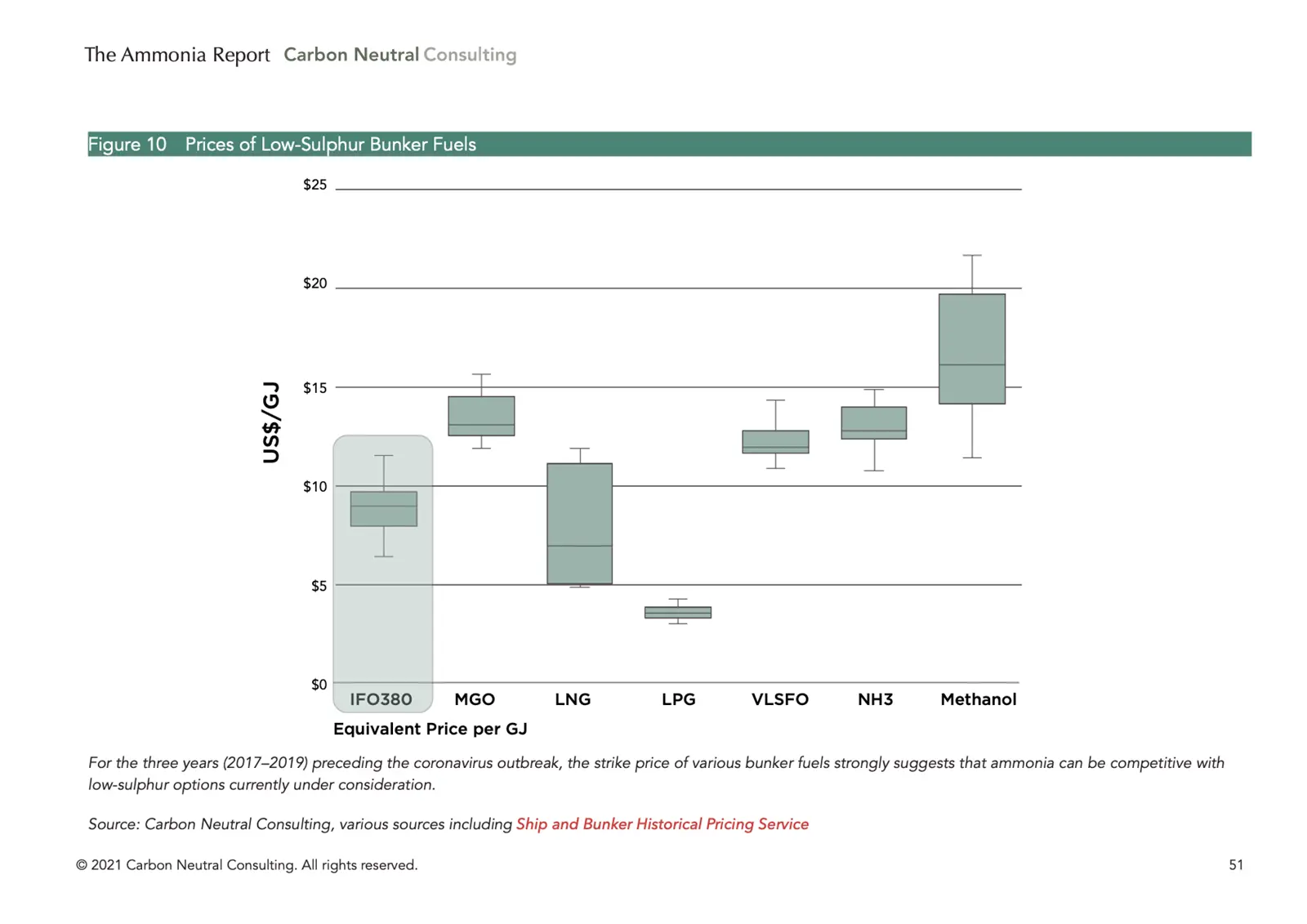
Carbon Neutral Consulting (CNC) has said it believes ammonia is a game-changer for the maritime industry. Principal Milton Bevington says: “In game theory, a ‘dominant strategy’ is a strategy that leaves you better off no matter what your competitors do in response. Dominant strategies are rare in business contexts because we’re usually faced with options that have an upside if our competitors react one way and a downside if they react in another. Right now, for companies in the maritime sector, an ammonia-oriented action plan comes very close to being this kind of ‘dominant strategy,’ a business plan that enables commercial success across a period of intense disruption regardless of the actions of your competitors.”
Like LNG, ammonia is a good transition fuel in that it meets all current IMO2020 requirements for emissions and is priced competitively with cleaner burning distillates like MGO, says Bevington. “Once IMO-mandated emissions tighten, electrolytic ammonia can be produced using carbon-free renewable energy (wind, solar, hydro), and vessels equipped with ammonia propulsion systems can simply switch from conventionally produced ammonia to green ammonia without any further capital investment or risk of stranded assets. Ammonia has the singular virtue of being both a viable transition fuel and a long-term zero-emission solution, and investing in it early protects the asset value over its full economic life, which can be 30 or more years in many cases.”
Availability is already being increased. In February 2021, Yara International signed a Letter of Intent with Statkraft and Aker Horizons to establish Europe’s first large-scale green ammonia project in Norway. The partners will target green hydrogen and green ammonia opportunities within shipping, agriculture and industrial applications by electrifying Yara’s existing ammonia facility in Porsgrunn.
Shipping currently accounts for 2% of global GHG emissions, of which long-distance shipping represents 80 percent. Yarra anticipates that converting all long-distance shipping to ammonia would require approximately 500-600 million tonnes of ammonia annually, 3-4 times the current world production.
Integrated energy company, Mabanaft is ramping up its stake in ammonia as a future marine fuel. The company will be marketing 500,000 metric tons ammonia per year from a production plant in Texas. “We see ammonia as the best zero carbon fuel in shipping, building on existing infrastructure and existing merchant ammonia trade flows. There is not enough biomass and not enough e-fuels production capability soon enough to play a role for ocean transportation,” says Oleksandr Siromakha, Head of Sustainable Fuels.
“The availability of green ammonia (produced from renewable electricity) will substantially increase in the future. However, already today grey and blue ammonia (produced from natural gas, and in case of blue ammonia carbon emissions are captured and stored) represent a feasible alternative to substantially reduce the emissions from shipping and to speed up the decarbonization of ocean transportation.”
Yet, challenges remain. A panel discussion held by the Ammonia Energy Association late last year acknowledged that ammonia users face relatively high fuel costs and a lack of infrastructure in the short-term. Despite this, when polled, the audience and panellists expected rapid development of the fuel resulting in around 30 ammonia-powered vessels being in operation by 2030.
Related Articles
 ALTERNATIVE FUELS & LUBRICANTS
 FUELS & LUBRICANTS