



WALLENIUS SOL RAISES ITS GAME IN BALTIC TRADE
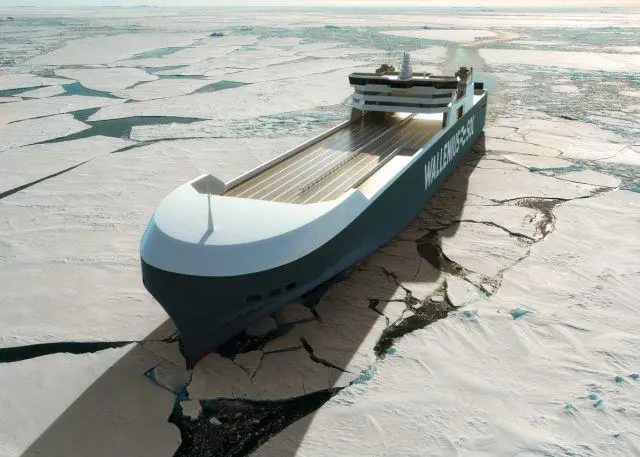
As a coalition of two august names in Swedish shipping, Wallenius SOL is poised to implement a new stage in the development of capacity to serve year-round industrial traffic between the northern Baltic and European markets.
Four dual-fuel trailerships in the ‘mega’ size category under construction and on order at a Chinese yard have been specified to Finnish/Swedish ice class 1A Super standard, so as to ensure access throughout the winter period to ice-bound ports in the Gulf of Bothnia.
At a length of 242m, and accommodating 5,800 lane-metres of freight on a deadweight capacity of about 27,000t, the design tops the scale in terms of Baltic ro-ro traders. Long-term agreements with pulp and forestry product groups will underpin the vessels’ employment.
The newbuild programme was landed by Yantai CIMC Raffles Offshore, consolidating its drive in the ro-ro sector, and Wallenius Marine is superintending the project on behalf of the shipowners. The concept was developed by Danish naval architectural consultancy Knud E. Hansen, entrusted with contract and basic design. Input has been provided by the shipbuilder’s Offshore Engineering Institute(OEI) and by the CIMC Group’s Gothenburg subsidiary Bassoe Technology.
The lead vessel is expected to enter service during the autumn this year, to be followed at three-to-four month intervals by the sisterships.
The Wallenius SOL combine’s route network entails a nine-port itinerary, calling for flexibility and rapidity in loading and discharge. The type of goods brought out of the northern Baltic also poses an additional hydrodynamic challenge, since the vessels will typically have up to 2.5m more draught on the southbound voyage than on the return trip.
Each vessel has been specified with a pair of WinGD two-stroke, LNG-capable dual-fuel main engines and in-line PTI/PTO permanent magnet (PM) shaft generators. The primary power concentration will be just over 21,000kW, and direct drive will be made to twin, controllable pitch propellers, for a service speed of 20 knots.
Notwithstanding the considerable expansion of the dual-fuel offering from engine makers and licensors over the years, in both the low-speed and medium-speed categories, Wallenius SOL has opted for models of the first design of two-stroke, low-pressure DF propulsion machinery, the RT-flex50DF. Originally a Wartsila product, in turn born out of the Sulzer RT low-speed diesel series, the RT-flex50DF is well-proven, and remains competitive as regards consumption and power output in relation to dimensions and weight. In gas mode, Tier III emission requirements are met without the need for external exhaust gas aftertreatment.
The installation in each of the Swedish newbuilds will comprise two RT-flex50DF units in eight-cylinder format, at a contractual maximum continuous rating (CMCR) of 10,500kW at 117rpm. The continuous service output, denoting the intended, efficient transit setting, equivalent to 60% of CMCR, is 6,300kW at 98.7rpm. At its nominal MCR, the 8RT-flex50DF can deliver 11,520kW on a crankshaft speed of 124rpm.
The Chinese yard contracted Ingeteam of Spain to develop and supply the hybrid electric propulsion element, featuring two Ingedrive LV400 multidrive frequency converters, and the two Indar PM generators. In PTO mode, the latter will deliver 2,200kW at 85-122rpm, and produce 1,000kW at 122rpm in PTI mode. The system has been prepared, in terms of space, wiring and ventilation, for future adoption of battery hybrid arrangements and incorporation into the vessel energy management system.
During port calls, the intention is that the ships will primarily draw energy from the shoreside electric grid, while the alternative reliance on gensets will also chime well with environmental edicts and expectations since the nominated engines are of LNG dual-fuel type.
Each of the two auxiliaries will be based on a nine-cylinder model of L28/32DF design from MAN Energy Solutions. The latter’s subsidiary MAN Cryo is providing the complete LNG fuel gas supply systems, embracing each shipset of two 685m3 Type C vacuum tanks, including tank connection spaces with LNG fuel pumps, plus bunker stations with a capacity of 500m3 per hour, and automation, emergency shutdown and gas detection arrangements.
MAN Cryo claims that the tanks mounted under-deck with air locks will minimise the amount of ambient air drawn into the tank rooms. This is an important consideration in the tough winter conditions to which the ships will be exposed, whereby the amount of very cold air introduced needs to be kept to a minimum.
Wallenius SOL commissioned the Swedish Environmental Research Institute (IVL) to quantify the advance in energy performance and emission curtailment promised by the nascent tonnage. A comparison was made with the 2006-built, 190m Thuleland, which plies the Baltic/Continent/UK route and is ranked best-in-class as regards environmental impact.
While the newbuild type’s significantly higher energy efficiency reflects upscaling with a greater load capability, design measures including the hydrodynamic characteristics of the hull, the design arrangement, weight reduction solutions and choice of machinery have enhanced efficiency to a similar degree. Despite embodying four cargo decks, the centre of gravity has been lowered, reducing the amount of water ballast needed. It was found that fuel consumption per freight unit will be halved, greenhouse gases will be reduced by 63%, sulphur and particulate emissions will be negligible, and NOx will be cut by 85%.
Finnish paperboard company Metsa Board’s shipping agreement with Wallenius SOL entered force at the beginning of 2021. The producer’s goals for the next 10 year include fossil-free mills and 100%-sustainable supply chains, such that it was attracted to the environmentally-sensitive transport concept offered by the shipowners.
Other long-term industry customers include paper and packaging maker StoraEnso, and Wallenius SOL has recently included Vaasa in its regular liner network, to serve the logistic needs of industrial firms located there.
PRINCIPAL PARTICULARS – Wallenius SOL ro-ro
|
Length overall |
241.70m |
|
Length bp |
234.25m |
|
Breadth, moulded |
35.20m |
|
Depth, to main deck |
11.10m |
|
Draught, summer |
8.70m |
|
Draught, design |
8.50m |
|
Deadweight, maximum |
c.27,000t |
|
Ro-ro freight capacity |
5,800 lane-m |
|
Container capacity |
800TEU |
|
Propulsion system |
Dual-fuel two-stroke |
|
Main engine power |
2 x 10,500kW |
|
Speed, service |
20kn |
|
Class |
LR |
|
Class notations |
+100A1, Ro Ro Cargo Ship, |
Related Articles
 PROPULSION
 GENERAL NEWS
 HYDROGEN