



Wallenius Wilhelmsen MeOH-fuelled roros will be NH3 ready
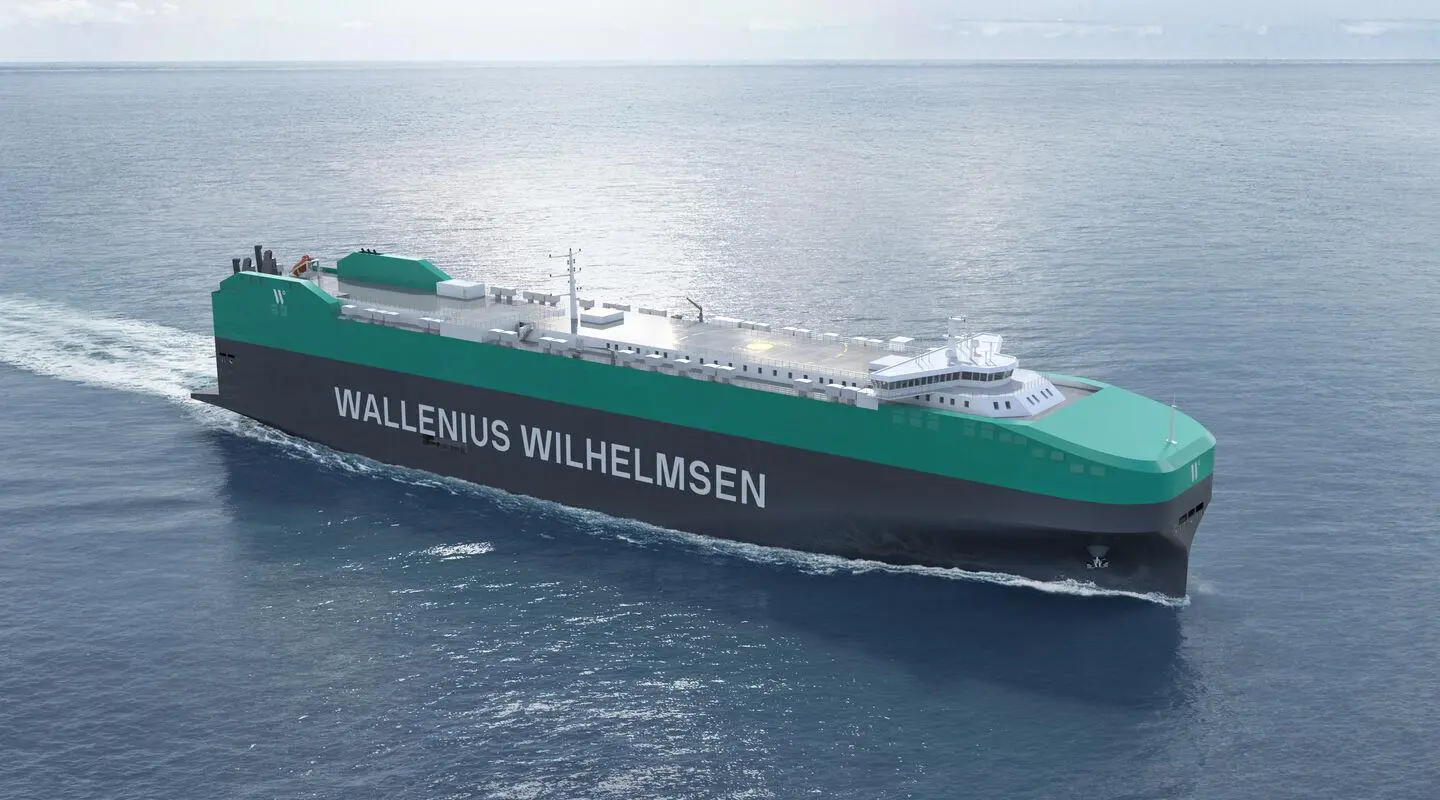
All new investments will contribute to Wallenius Wilhelmsen’s net-zero agenda, and in line with that ambition, the company has signed a letter of intent for delivery of four 9,350 CEU MeOH-capable and NH3-ready vessels along with individual options for an additional eight vessels. Designed in collaboration with Deltamarin, the vessels will be delivered from mid-2026 by Jinling Shipyard (Jiangsu).
Wallenius Wilhelmsen envisages three waves of change. The first will involve biofuels, followed by MeOH and then NH3 after its probable scaling which is expected to happen about 10 years from now.
“We believe ammonia will take some time as engines are not yet developed. There are also safety and operational issues related to ammonia that need to be addressed first. If these are overcome, we expect ammonia to become available at scale 2030 to 2035. In the meantime, it is likely that we will see a number of vessels testing the technology, infrastructure and operations in the second half of this decade,” says Lars Dessen, VP Newbuilding & Projects, Wallenius Wilhelmsen.
The first four vessels will be fitted with MAN B&W 7S60ME-C10.5-LGIM dual-fuel engines capable of running on green MeOH. Dessen says the series is designed for operation on methanol for propulsion and power generation through a shaft generator. The auxiliary engines are single fuel (conventional diesel). Shore power capability will be included in the design.
The inclusion of battery storage was discussed but not included, although it’s still an option. “The size of the battery needed to cover the energy demand during a port call would be enormous and not a viable solution anyway. Auxiliary engines could run on bio-fuel to reduce emissions,” says Dessen. Solar power and air lubrication were also considered but not included.
The vessels have 5,000m3 of MeOH capacity, 2,100m3 of VLSFO capacity and 550m3 of MGO capacity. The MeOH and VLSFO tanks are divided between aft and fore locations and below deck 3 for aft part and deck 5 for forward part. A fuel supply system will be provided for handling the MeOH. “The vessel will be NH3-ready from the design point of view, but in order to convert to NH3 a different tank (C-type or membrane type) has to be installed if operation changes from MeOH to NH3. Additionally, the main engine and the fuel supply system will need to be changed to accommodate NH3,” says Dessen.
Emissions reductions will of course depend on the fuel and whether they are calculated well-to-wake or tank-to-wake. “On a tank-to-wake basis, we expect some 10-15% reduction in GHG emissions when comparing with existing designs on VLSFO, while on a well-to-wake basis, reductions of up to 80%-90% when green methanol is used,” he says.
EEDI will be phase III, which is a 30% reduction from the original reference line. Additionally, the design is suited to the transport of EV’s which are heavier than conventional cars, so there has been special focus on fire safety with increased CO2 capacity.
Wallenius Wilhelmsen doesn’t have customers committed to these particular vessels yet, and the nature of the business is not to have dedicated vessels to dedicated customers. However, the company is having good dialogue with customers about decarbonisation and the importance of new assets and new energy sources. “We are comfortable that we will have customers onboard these vessels when they come. And already today we have several customers purchasing our Reduced Carbon Service, where customers get emission reductions based on the use of biofuel on our vessels, and the use of green methanol will be the natural next step on this journey.”
Wallenius Wilhelmsen is the world’s largest RoRo vessel operator and has set a strategy to maintain a fleet of 125-135 vessels. New vessels are an integral part of the fleet strategy, and the key to accelerating the journey towards net-zero emissions.
Xavier Leroi, EVP & COO Shipping Services, adds: “We are securing our position as our customers’ first choice in shipping and delivering on our strategy to provide a net-zero emission free end-to-end service by 2027. We believe that methanol is the fastest way to net-zero emission.”
Related Articles
 2-STROKE & 4-STROKE
 2-STROKE & 4-STROKE
 2-STROKE & 4-STROKE