



WAP IS READY TO MEET FIRST IMO CO2 REDUCTION TARGETS
The updated 2023 IMO Greenhouse Gas (GHG) Strategy identifies levels of ambition for the international shipping sector noting that technological innovation and the global introduction of alternative fuels and/or energy sources for international shipping will be integral to achieve the overall ambition. The strategy targets net zero GHG emissions by 2050 with new indicative checkpoints, including a 20-30% reduction in total annual GHG emissions by 2030 and a 70- 80% reduction by 2040, compared to 2008 levels.
The OceanWings® wingsails from French manufacturer AYRO have become the first amongst a swathe of wind assisted propulsion technologies in development to be deployed on a commercially operational vessel.
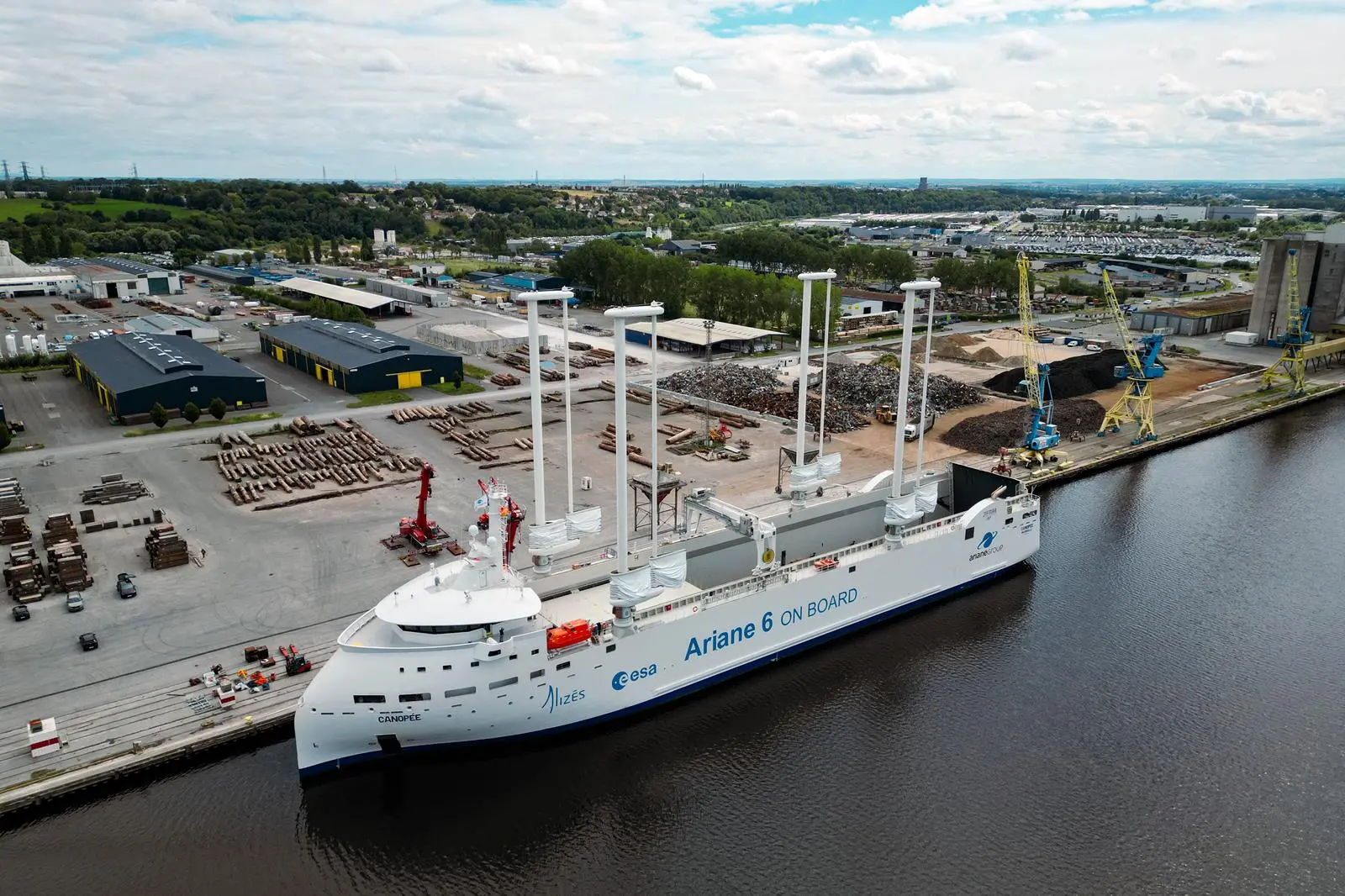
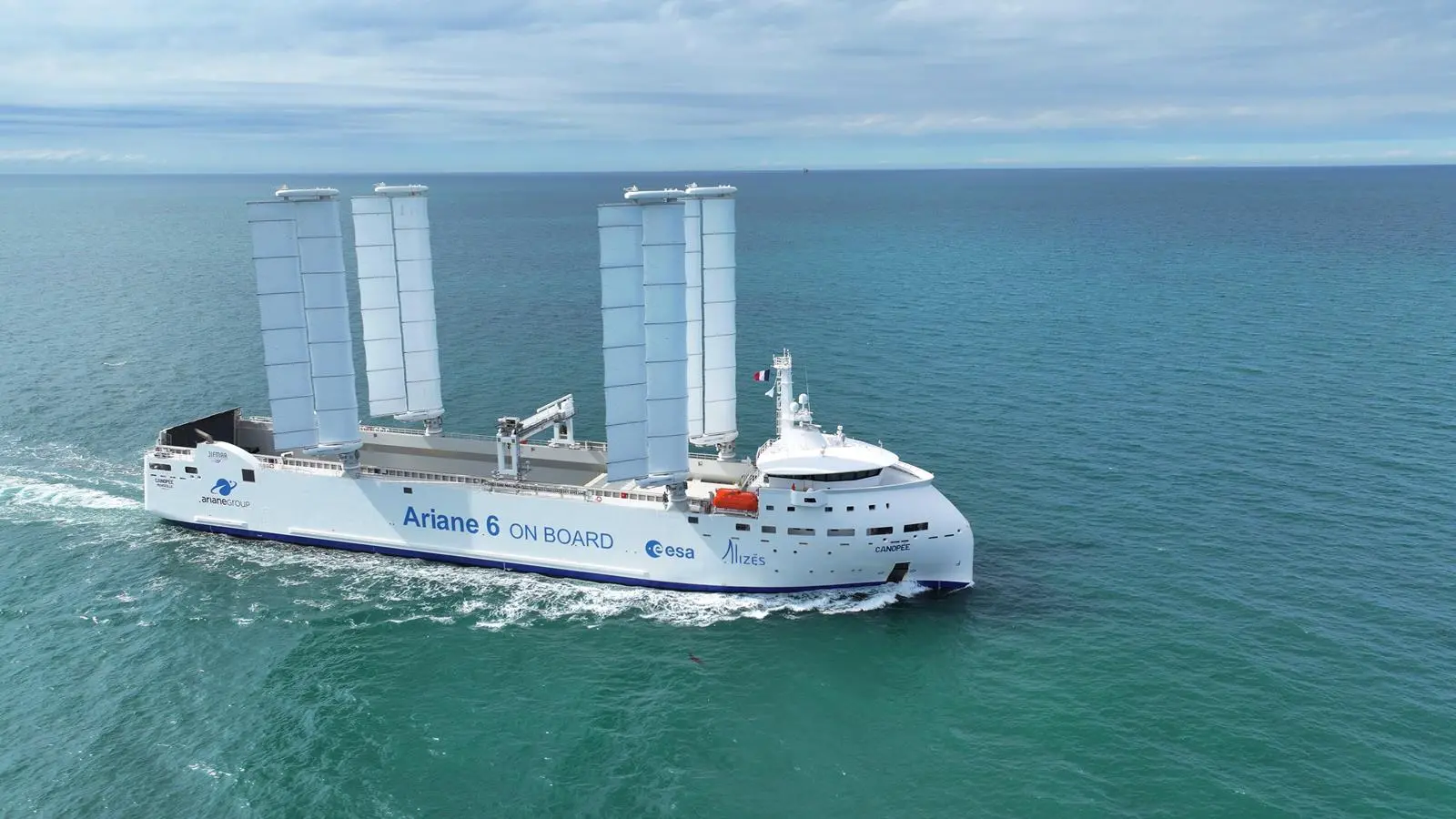
Owned by Jifmar, and operated by Alizés for the Ariane Group, the Canopée is a newbuild open-deck RORO, and the world’s first fully operational commercial ship with wind-assisted propulsion. At 121 metres long and with a width of 22 metres, Canopée features four state-of-the-art, 37 metre high OceanWings® 363 (the figure denotes the surface area in square metres of each wingsail). The ship was built from the ground up by Dutch yard Neptune Marine, and its design parameters enable the wing-sails to cut fuel and emissions by 30% on its regular trans-Atlantic route.
The Canopée embarked on a maiden commercial voyage to deliver Ariane 6 rocket components to the launch site in French Guiana in October 2023, a milestone that positions it as the most advanced wind-powered ship in modern history. It has taken 13 years to get to this point, with the unique OceanWings® wingsail design first turning up in the form of a rigid mainsail on BMW Oracle Racing’s 2010 America’s Cup trimaran and delivering the team one of the largest wins in the history of the race.
Two-element design
While several wind-assisted propulsion solutions are in development globally, the AYRO wing-sails differ as they leverage the geometry and interaction of main and secondary sail elements. Through this unique architecture, OceanWings® generate far more power than conventional sails or, for example, single element wingsails. Inspired by the way aircraft wings operate at high lift, a slot allows the air to flow between the two elements, which accelerates the flow at the extrados of the wing, i.e., its leeward part, and thus increases the maximum lift capabilities.
The design allows for two main adjustments. Firstly, the angle of incidence of the wings, which turn 360 degrees in relation to the ship and then the rear sail element, which can pivot around the secondary mast to create a camber in relation to the front flap. The two-element design ensures that OceanWings can be used when the apparent wind angle is as low as five degrees, meaning they are available to assist propulsion in around 95% of wind conditions that a vessel should encounter at sea.
AYRO wingsails on ships are equipped with sensors that continually measure wind conditions in real-time. The vessel’s onboard computer, powered by the AIUTO algorithm developed by AYRO, utilizes this data to command electric actuators on the wingsails. These actuators adjust the wingsails’ angle of incidence and camber in real-time, optimizing their performance for maximum efficiency and propulsion. The automated system ensures the accurate adjustment of each wingsail, enhancing the aerodynamic thrust to achieve peak efficiency at all times. This entire process operates seamlessly without any crew intervention, with crew members or operators only required for monitoring and oversight.
Validating the concept
The Canopée is the first commercial vessel to operate with OceanWings®, but their first application took place in 2019 on the Energy Observer catamaran, which combines electric propulsion using fuel cells, photovoltaic energy and two OceanWings® wingsails. Fitted with two OceanWings® wingsails each with a surface area of 32 m², this 30-metre catamaran made its first transatlantic crossing between Brittany and Martinique, with an average speed of 6 knots over 5,000 miles, validating the concept of a zero-emission boat.
Energy Observer has since sailed around the world for over four years, reaching the North Sea while assessing the performance and reliability of OceanWings®. The data produced in over 20,000 nautical miles under wind propulsion has been combined with hydrodynamic modelling to validate the fuel and emissions savings that the Canopée’s OceanWings® will deliver. In fact, VPLP Design and AYRO have made significant advances in the world of Computational Fluid Dynamics (CFD) techniques using the data from Energy Observer, particularly in evaluating the performance of the wingsail systems against the backdrop of real-world data acquired.
Double digit emissions reduction
This work puts the Canopée in the position of being one of the most fuel-efficient cargo ships ever built. The 30% fuel consumption and GHG emission reduction figures are based on its fixed route, but the data also points to potential savings of up to 50% based on a vessel’s design profile and the routes it may take. Certainly, even at the lower end of the savings potential, the Canopée is perhaps the only ship sailing today already in line with the IMO’s 2030 checkpoint, though this will change soon with several new OceanWings projects coming out of planning and into production in the next few years.
These include a concept design to install OceanWings on a 197m-long 2,500 TEU container ship. Here, OceanWings will contribute up to 35% of a 57% total reduction of CO2 emissions. Further, as part of the European Community funded project Whisper, AYRO is designing an OceanWings configuration for bulk carriers. These projects will present their own challenges of course, not least how to navigate a ship with 37-metre-high wingsails dock side, with crane gantries and other infrastructure overhead. And while the final designs for each ship have not been publicised yet, AYRO’s solutions for tilting and lowering the OceanWings are well into the development process.
Whatever solution is decided upon, the Canopée has already demonstrated that wind can deliver double digit emissions reductions, cementing its appeal as the maritime industry heads towards 2050 and the ultimate target of net zero.
Related Articles
 ENERGY SAVING DEVICES
 ENERGY SAVING DEVICES
 AMMONIA