



Wärtsilä Refines its Hybrid FPP Concept For LNGCs
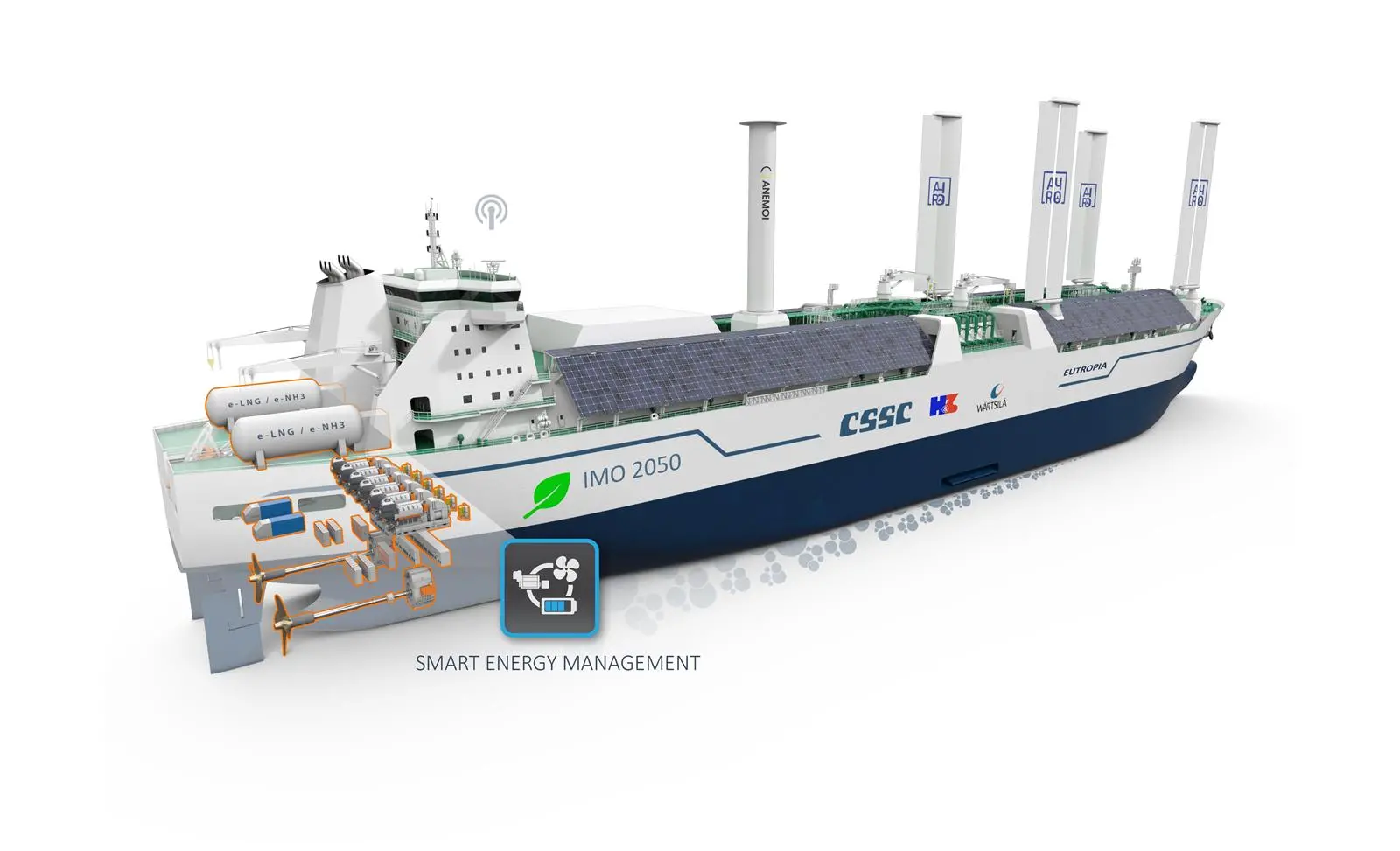
Wärtsilä is collaborating with Hudong-Zhonghua and ABS to co-develop a next-generation LNG carrier design with Hybrid Electric propulsion, as previously reported by The Motorship in October 2021. Wärtsilä unveiled further details of the design concept for LNG carriers during June’s Posidonia Exhibition, and one of the novel features included in the concept’s propulsion arrangements was a pair of large fixed-pitch propellers (FPPs) with a hybrid electric power train.
The Motorship reported on the project on 7 July, highlighting a number of design and management innovations, which include one of the first ‘’Performance Based’ service contract concepts in the LNG sector and a plan for class society ABS to supply a full lifecycle Digital Twin for the ship.
Speaking during the briefing at Posidonia, Grant Gassner, Director, Integrated Systems & Solutions at Wärtsilä, said that with electric propulsion there is additional freedom to further optimize the vessel propulsive efficiency. The main propeller characteristics (propeller diameter, rotational speed) are selected based on the unique combination of the electric motor and the propeller. “There is no engine power and torque limitation curve and this can result in a larger and lower nominal rotational speed”.
Electric propulsion effectively separates the power distribution and thrust generation from the power supply. The addition of a battery package within the multi-engine hybrid electric propulsion arrangement creates a useful energy storage that can also provide instant power on demand. This arrangement enables the multi-unit power generating assets to operate with optimal efficiency independent of the power demand while being able to provide effectively instant power to support dynamic loading events. This separation of power production and power consumption with an energy buffer in between is the fundamental feature of a hybrid electric system which enables a wide range of optimisations, including the need to rethink the FPP design in accordance to the new and more flexible boundary conditions.
Higher propulsive efficiency
In an exclusive interview for this publication, Mr Gassner and Dr Elias Boletis, Director of Propulsion R&D at Wärtsilä, provided more detail about this aspect of the ship’s design, which is still in development. The propeller design and the electric motor are designed as integrated components of the shaftline, which in turn allows higher propulsive efficiency. In addition, vessel and propeller hydrodynamics are considered together. The optimisation of the aft hull lines is under work and the inflow to the propeller is taken into account. At the time of our conversation in late July, CFD work to achieve the ideal arrangement was in its early stages. “We will know the results better in November”, Mr Gassner said. An important parameter that is yet to be specified is the size of the propellers. Dr Boletis pointed out that an increase in the propulsive efficiency can be reached by using somewhat larger and slower rotating propellers relative to the conventional diesel mechanical applications.

As the propeller and the electrical machinery are designed in parallel, the propeller tip speed remains the same as for smaller and faster rotating alternatives, so there are no adverse noise and vibrations characteristics arising from this change in design approach, Dr Boletis said.
Dr Boletis estimated that the propellers can be up to 10% larger than corresponding screws in a direct-drive diesel arrangement, yielding efficiency gains of up to 3-5%, which is “quite considerable for this type of application”.
The estimates above may change as the design is an iterative process. Mr Gassner added that all the hull and FPP hydrodynamic optimization activity is being done by Wärtsilä in cooperation with ABS.
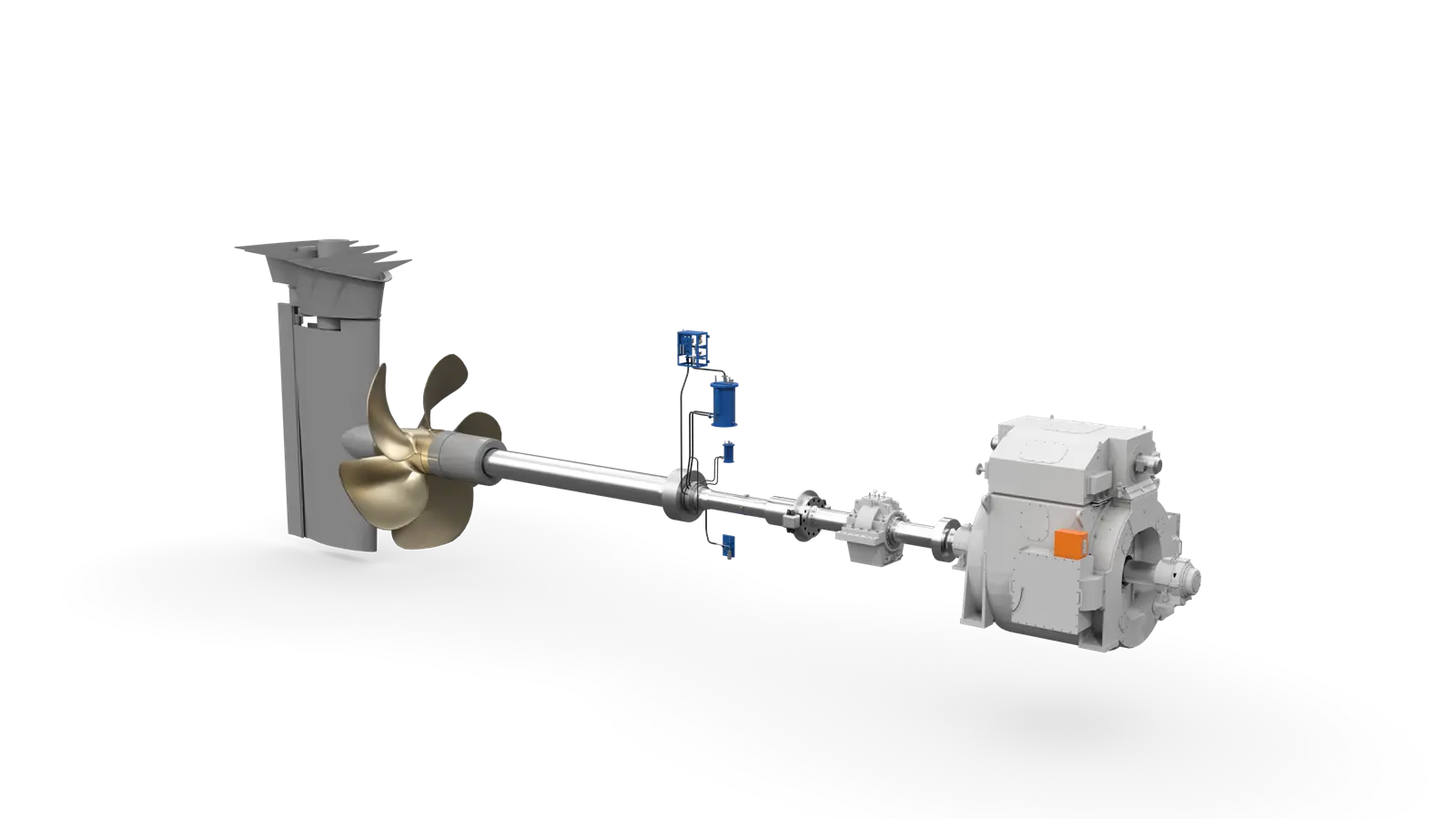
A typical direct-drive two-stroke arrangement rotates at around 70-80 rpm nominal speed, influenced by the selected engine type and rotational speed. The hybrid electric concept makes use of electric motors of the permanent-magnet (PM) type, allowing increased torque to facilitate lower speeds. Larger propellers become possible, resulting in an increase to the propeller efficiency. There is furthermore no need for additional transmission unit (gearbox). A PM motor can provide “low speed and high torque” in a compact arrangement. “So we see an increasingly large interest in this concept, which will become increasingly popular for these relatively high power shaft line applications”, he predicted.
Addressing torque limitations
Traditional mechanical propulsion suffers from torque limitations that are defined by the direct coupling to the engine. This is not the case at the hybrid electric propulsion with electric motors driving the propeller and being designed together. “So you’re able to optimise the propeller for hydrodynamic efficiency through its entire operating window,” he said.
In additional many recent mechanical propulsion concepts incorporate shaft generators, which have the potential to improve the overall system efficiency but alter the characteristics of the shaftline. As the design is a compromise between the two power consumers (propeller and shaft generator), this creates an unfavourable constraint for the propulsive efficiency.
There are also gains for PM installations when compared with typical diesel-electric propulsion arrangements that use asynchronous motors and gearboxes, since (a) there will be no transmission losses, (b) the size of the component is the smallest possible and (c) the overall system CAPEX in certain types of applications can be reduced, Mr Gassner said.
The common design of the propeller with the electric motor does not only cover the thermodynamic characteristics but also extends to the mechanical part. The hollow design of the electric motor with the permanent magnet allows the propeller shaft to go through the motor. Note that each shaftline has its own motor providing about 10MW propulsive power.
As the required power levels increase, there is a trend towards larger PM motor technology for electric propulsion due to smaller size and higher efficiency at low speed. This is valid for both shaftline and certain azimuth thruster applications.
Propeller will impact aft body shape
Final details of the ship’s hydrodynamics – particularly its aft arrangements – are yet to be finalised. “We are optimising the vessel aft body together with the propeller”, said Dr Elias Boletis, Director of Propulsion R&D at Wärtsilä.
“You need to [ensure] that you are directing the flow to the propeller correctly, taking into account the propeller characteristics”, he said. He described the process called ‘Opti-design’, through which “we are designing the vessel aft body together with the propeller”.
This uses a CFD algorithm that Wärtsilä has been developing for nearly 20 years so “we have full confidence that the CFD can provide the correct integration of the hull aft lines with the propeller”, he said. This reduces the design iterations and avoids testing multiple designs at water basins.
Note however that the water basins have still a significant role. The design configurations that emerge from the CFD will be still tested in a water tunnel, he said, predicting that CFD will not eliminate the physical testing. “You will always need to validate the CFD so [testing facilities] will continue to play a significant role in the industry and help understanding the physics.”
Future opportunities
For the LNG carriers, the propeller arrangement today is a ‘traditional’ twin-skeg Fixed Propeller layout integrated within the electric propulsion. “You can really think about outside the box in the future”, Mr Gassner said. Contra-rotating screws, CPPs, combination with innovative rudder designs, and azimuth propulsion are all possible with electric propulsion, opening up the potential for future propulsion innovations.
It is a particularly suitable option for LNG carriers, he believes. In the past, many LNG ships were diesel electric and the industry’s journey towards decarbonisation combined with latest development of 4-stroke engines and hybrid electrical propulsion systems is once again making electrification attractive, not least because average vessel speeds have fallen in recent years to around 13-16kts, which is about 15% slower than a decade or more ago.
This requires less engine power than in the past so if a typical mechanical propulsion layout (two stroke engines is installed, it might typically be operating at less than 50% power load, which leads to lower engine efficiency and higher emissions. When the vessel speed is further reduced, and more energy-saving devices are fitted in the future to comply with decarbonization requirements, it will further reduce the engine load factors making the mechanical propulsion even more challenging.
Hybrid electric propulsion offers the flexibility to operate with high efficiency across a wide vessel speed and power range and offer complete flexibility to easily integrate new energy sources in the future such as fuel cells and to efficiently accommodate new energy saving devices such as wind assisted propulsion.
These factors make hybrid electric propulsion increasingly attractive for “any type of operating profile that has variability in speed and power, frequent low speed operation relative to the vessels design speed and a lot of electrical consumption relative to propulsion power”, he said.
Furthermore, electric propulsion becomes increasingly recognized as the most flexible and future proof typology of propulsion for integration of new energy sources such as fuel cells and for future intentions to implement large scale energy saving devices such as wind assisted propulsion.
Mechanical vs Electric Propulsion Propeller Optimisation
Optimising a propulsion system for electric propulsion eliminates the traditional boundary condition of engine torque limits that impact the propeller design criteria. From a hydrodynamic point of view, the propeller is not fully optimised when using mechanical propulsion”, Dr. Boletis added.
Most of the current design procedures are based on the extensive field experience with the diesel mechanical concept. The required sea margins added to cover operations at rough seas need to be revisited together with the class and flag authorities.
Even the application of energy-saving technologies is easier and results in higher savings at the hybrid electric concept. It does not work the same on the diesel mechanic layouts, explained Dr Elias Boletis, Director of Propulsion R&D. For a ship fitted with wind assist units, for example, a propeller which is directly driven from the main engine will operate at non-optimal conditions. “If you have excessive wind, you further lose efficiency at the propeller”, he said.
This can be a significant amount as industry studies have indicated. “The advantage [of wind power] can be offset by having a shaftline concept which is not well matched”, he said. “The best way to fully exploit the wind-assist propulsion benefits is by having hybrid electric propulsion, because the generating sets can be switched on and off, always delivering optimal power levels at the highest efficiency.”
Other energy-saving devices, such as air lubrication systems – which the LNG carriers at the heart of this project are likely to have – or fuel cells, can have similar effect on two stroke performance, he added, so for ships that combine various such technologies, “hybrid electrical propulsion is the most optimal option”.
Related Articles
 LNG
LNG
 LNG
LNG
 SHAFTS AND PROPELLERS