



Wärtsilä to add methanol engine to portfolio by 2024
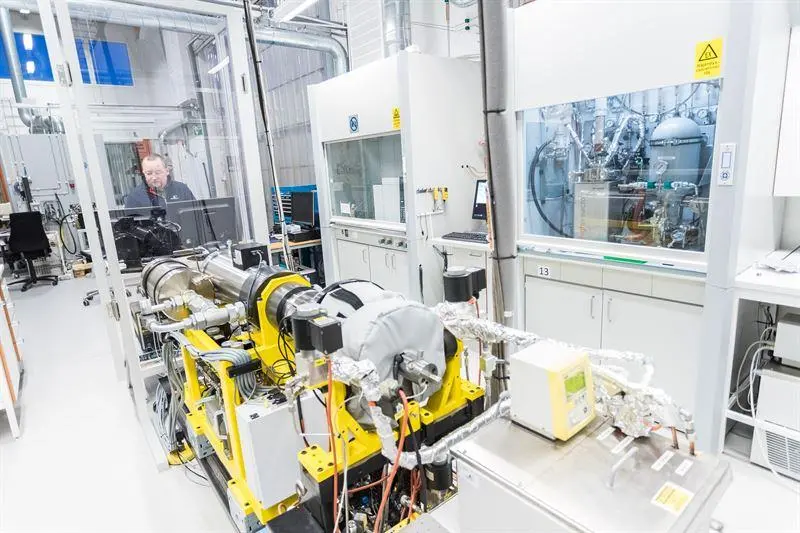
Kaj Portin, General Manager, Fuel & Operational Flexibility, Wärtsilä Marine, confirmed that Wärtsilä Marine was planning to begin running tests of ammonia on a Wärtsilä 32 test engine in Vaasa in the last week of June 2021.
Tests had been scheduled to begin at the beginning of the year, but the need to establish safety rules and to train the team had taken time during set up of the engine test cell, Portin noted.
The test process will be shared between a test engine in Vaasa, and a test engine in Norway. “The test engine for Norway is currently being packed up for dispatch, and we expect that endurance tests will begin there by the end of 2021,” Portin noted.
Portin noted that Wärtsilä’s targets are to validate some of the concepts it had developed for the use of ammonia on dual-fuel engines. At present, Wärtsilä is focusing on testing ammonia in blends with either diesel or natural gas at concentrations of up to 50% or beyond.
The engine will be able to operate with different ratios of ammonia at different loads. “At very low loads, the poor combustibility means that you need to increase the concentration of the other fuel, while at high loads, the fuel injection system comes under pressure because the lower energy value of ammonia requires higher fuel volumes.”
Portin previously noted that ammonia slows down the combustion process at higher concentrations, which will also require ignition concepts to be validated.
“We would be willing to look at higher concentrations of ammonia, or even 100% ammonia combustion, in the future as availability improves.” Portin noted that the company is also investigating a number of issues, including the development of abatement solutions for ammonia engines, as well as the development of lubrication solutions for four-stroke dual-fuel engines operating on ammonia.
“We will be looking at these issues during our endurance tests, but one solution will of course be to change the lube oils more frequently. Wärtsilä is also discussing potential additives to help lube oils neutralise ammonia-blend fuels.”
Portin noted that Wärtsilä had put a lot of effort into lowering the potential GHG emissions produced by the combustion solution. These are the result of incomplete combustion resulting in the production of nitrous oxide (N2O). Unburnt NH3 emissions (ammonia slip) will also be handled.
Methanol producer demand pushes engine development
Wärtsilä has a long-standing interest in methanol, and Stena Line has operated a vessel on methanol, Stena Germanica, since 2015. Unlike some of the other fuels into which Wärtsilä has conducted research, the performance of the fuel is well understood, and solutions have been developed for some of the fuel’s specific characteristics, such as lower lubricity and the technical requirements of the Low Flashpoint.
After 2015, client enquiries into methanol-fuelled solutions were not sufficiently high to justify the beginning of a product development programme, Portin noted. This has changed recently amid rising interest in green methanol as a potential fuel that could help the industry meet 2030 decarbonisation objectives. This interest has also come from a potential green methanol fuel supplier, alongside shipowner interest, Portin noted. Importantly, it was clear that demand for methanol-fuelled propulsion solutions was not concentrated geographically, “unlike the Stena Germanica experience where the west coast of Sweden played an important role.”
As a result, Wärtsilä Marine has begun the process of adapting its methanol-fuelled engine design to develop a commercial solution. The company announced plans to introduce a methanol-fuelled engine into its engine portfolio at a recent press event. The company’s medium-sized 320mm bore engine was the main focus of engine development at present, reflecting the interest in such engines from smaller vessels, as well as for auxiliary engines aboard larger vessels. Research was also progressing into developing a 460mm-bore engine. (The Motorship notes that Wärtsilä Marine recently obtained an Approval in Principle from RINA for a dual-fuel tanker concept based on a 46DF installation).
Portin noted that final stages of engine development were often protracted, and that there may be a delay of up to 2-3 years before engine concepts under development complete the process of obtaining approvals and enter the portfolio.
Evolution of hydrogen
Moving from ammonia to hydrogen, Portin noted that Wärtsilä had made significant progress in developing hydrogen engines that could operate on higher blends of hydrogen.
“We are happy to be fuel agnostic,” Portin said, adding that “we are happy to be able to respond to customer requests for different solutions.”
The previous 25% threshold was a response to regulatory requirements for hydrogen. “Above 25% of volume, EN67009 no longer applies, and our natural gas engine becomes a hydrogen engine,” Portin explained, with onerous consequences for the qualification of materials and safety systems.
While Wärtsilä had already developed potential solutions for the combustion of hydrogen at concentrations of above 25%, Portin noted that the decision reflected an increasing interest in pure hydrogen, particularly from customers in stationary energy markets.
The main change since 2020 has been the sharp increase in commercial interest in pure hydrogen engines, Portin noted.
This partly reflected the influence of hydrogen-based national energy strategies in a few major economies, Portin noted, but also the faster-than-expected emergence of interest in transporting hydrogen via gas pipelines at concentrations of above 25%.
Interest was also developing in the use of hydrogen combustion as a potential solution to the problems of grid balancing in the stationary energy market, because of the challenges posed by intermittency issues in renewable energy generation. Energy produced by small-scale nuclear plants could be used to generate green hydrogen via electrolysers during periods of low demand.
“So, we are now really looking into what systems are needed in a power plant or in a vessel for our engines to be able to safely operate on pure hydrogen,” Portin added.
From a marine perspective, commercial interest in hydrogen as a potential fuel for combustion engines remained largely restricted to the shortsea sector in a few tightly defined markets.
“The energy density and the volumetric issues for containment become a factor when you start to look at long distance deep-sea uses, but you could see demand from the short-sea sector in markets like Norway, where they have a lot of coastal transportation.”
Portin added that Wärtsilä Marine is continuing to participate in research projects looking into potential maritime applications of large engines operating on hydrogen, such as the CHEK project, which kicked off in June 2021. One of the workstreams within the project is focused on the development of an engine capable of operating on pure hydrogen for operation aboard a cruise vessel, The Motorship notes.
The project is also understood to be looking at the development of an injection system capable of handling pure hydrogen.
Retrofit solutions
Portin concluded by discussing the engine designer’s concept for developing solutions for existing customers.
The underlying concept is to develop solutions for customers, starting from the existing portfolio of engines. These solutions range in size, complexity and cost from small, to larger modifications and finally to the introduction of completely new designs.
“It is our intention to develop retrofit solutions for all of our engines in the market,” Portin said, “as part of our plan to offer solutions to help our customers meet environmental standards.” The development of a range of upgrade solutions aligns neatly with Wärtsilä’s new strategic offering for shipowners, as recently reported by The Motorship.
“In the end, we are not promoting one particular fuel or another. We are fuel agnostic,” Portin stressed.
However, he concluded by comparing the relative advantages of operating on fuels that require relatively little modification work, with other fuels that might require significant investments in fuel tanks, bunkering systems, and fuel gas supply systems. “Having discussed the advantages of hydrogen, methanol and ammonia, it is worth noting that it might require significantly less investment to convert vessels to operate on bio-diesel and LBG.”
Related Articles
 2-STROKE & 4-STROKE
 2-STROKE & 4-STROKE
 2-STROKE & 4-STROKE