



WIND-ASSIST FOR DIESEL-ELECTRIC COASTER
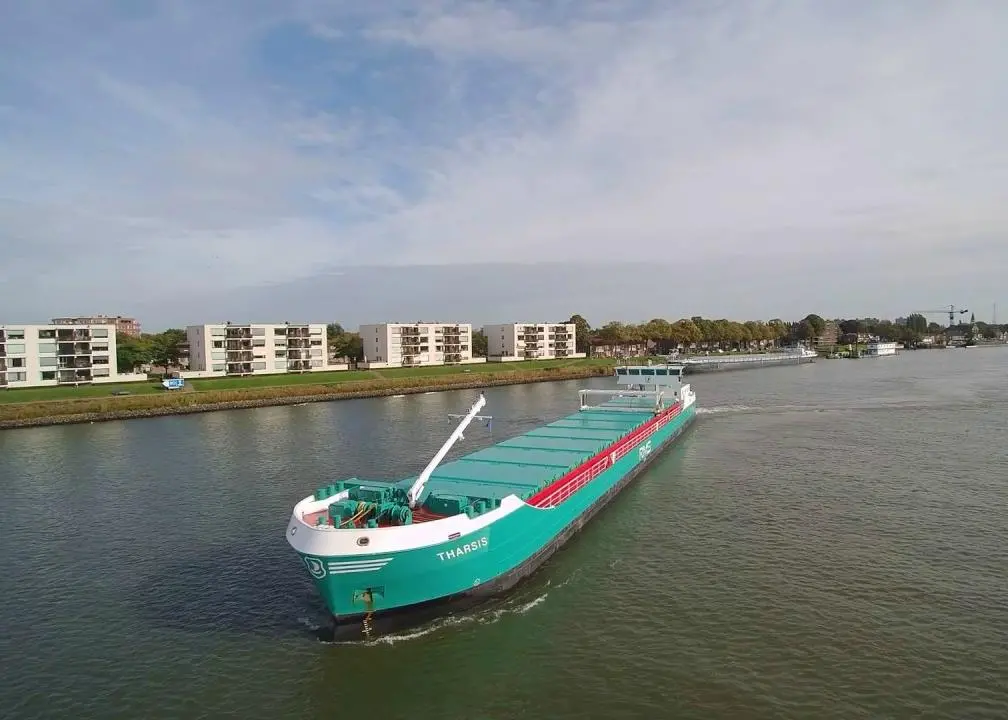
The 2,364dwt Tharsis will be equipped with two nine-metre TwinFoil units under a contract awarded last week to designer eConowind, the joint undertaking of Groningen-based Conoship International and HCP of Amerongen. The TwinFoil is a development on eConowind’s innovative VentiFoil system, specified in early 2020 for a 3,600dwt Dutch short-sea cargo vessel.
The 88-metre Tharsis was constructed in 2012 by Scheepswerf De Kaap in accordance with the latter’s exceptionally fuel-efficient Kaapcoaster concept.
The vessel is unique in blending diesel-electric propulsion with the capability to access inland ports and berths, due to a ballast air-draught of six metres and a minimal sailing draught of just 1.65 metres. ‘Flattening-down’ for navigation under bridges and other crossings is achieved by lowering the hydraulic pillar-mounted wheelhouse and dropping the folding masts. The new sail system can also be lowered.
“We always try to use as little fuel as possible on our weekly voyage from Duisburg (on the River Rhine) to the east coast of the UK, using currents and tides and optimising our schedule. Adding wind-assisted propulsion will further reduce our fuel consumption. Especially interesting is to see how much the tipping point of starting a second generator will shift,” stated Jan Albert Bosma, co-owner of Tharsis Sea-River Shipping.
The eConowind units are integrated in a specially designed aluminium flatrack from which the folding TwinFoils can be deployed. The TwinFoil is a wing-shaped element incorporating the flap principle similar to that used by aircraft during take-off and landing. Setting the wings optimally and quickly relative to the wind will be effected by means of a small, third steering wing.
“We are delighted to add Tharsis to our customer base, and with both river and North Sea routing with varying winds we expect a lot from the TwinFoil,” commented eConowind’s CEO Frank Nieuwenhuis. “Of particular interest is the combination of this self-adjusting technology with a modern diesel-electric drive,” he added.
System fabrication and installation has been assigned to Next Generation (NG) Shipyards, located at Lauwersoog, north of Groningen, which has particular expertise in lightweight aluminium construction and vessels with ‘sustainable’ propulsion.
The performance of the wings will be evaluated as part of the Wind Assisted Ship Propulsion (WASP) research project, funded under the EU’s Interreg North Sea programme. The Tharsis retrofit is scheduled for February 2021 and will be the last of five installations encompassed by the WASP collaborative endeavour.
Related Articles
 PROPULSION
 GENERAL NEWS
 HYDROGEN