



Wind-assisted Coaster Orders For Gelibolu, Holland Shipyards Group
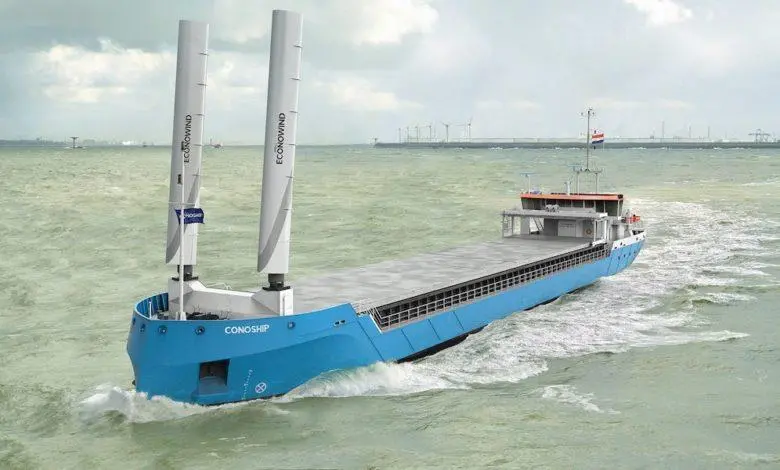
Construction of the first of the series of next generation short sea shipping vessels started at Gelibolu Shipyard in Turkey in late November. The 3,600dwt cargo vessel is expected to be delivered in 2023.
Two further 88m singledecker class newbuildings will be built by Holland Shipyards Group in the Netherlands in 2024, along with three enlarged, tween deck fitted, 3,800dwt vessels for another undisclosed owner.
Both the 3,600dwt and 3,800dwt designs feature diesel-electric propulsion, an auxiliary sail-assist system, and provision for alternative fuels, and have been conceived to allow direct trade to and from berths on inland European waterways. In order to optimise efficiency, the design features a large-diameter propeller, in combination with the proven aftship form known as the ConoDuctTail, and optimised hull lines. The designs will also feature two Econowind VentiFoils, promising fuel and CO2 savings up to 10%, depending on voyage route. A larger 5,800dwt design concept is understood to be under development.
The power plant will be based on three diesel-generator aggregates of 990ekW apiece, feeding a pair of 375kW electric propulsion motors and a 250kW bow thruster, plus other shipboard consumers. The arrangements provide for a speed of 10 knots.
The EEDI of the vessel type as calculated on the basis of diesel-based power is already below the phase 3 requirements. Additional elements of the design arrangement facilitate a switch to future fuels. “For example take off the generators and replace them with a methanol power generator set and then put in methanol tanks as well, or take them off completely and put on liquid hydrogen tanks and fuel cells,” explains Jan Jaap Nieuwenhuis, Managing Director at Conoship International. “All these redesign possibilities were taken into account from the beginning of the conceptual design process.”
Related Articles
 ENERGY SAVING DEVICES
 ENERGY SAVING DEVICES
 AMMONIA