



Wind-Assisted Ro-Ros For Airbus Trade
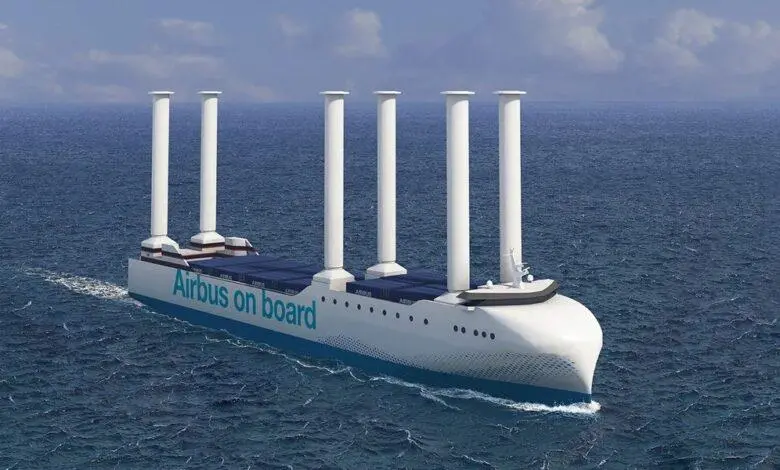
The aerospace group has commissioned LDA to implement the construction, and to own and operate three low-emission vessels incorporating dual-fuel main machinery and wind-assisted propulsion. The planned tonnage will replace the entire, existing flotilla of ro-ros chartered by Airbus to transport aircraft sub-assemblies between production plants in Europe and the USA.
The projected newbuilds are scheduled to be introduced from 2026 onwards, although a shipbuilding contract has yet to be announced.
The investment is expected to realise a reduction in average annual transatlantic CO2 emissions incurred by the Airbus traffic from a current level of 68,000t to 33,000t by 2030. The scheme will contribute to the Airbus strategy of cutting its overall industrial emissions by up to 63%, relative to 2015 as baseline year, come the end of the decade. This is in line with the 1.5-degree pathway (to limit global warming) laid out through the Paris Agreement.
The new ships will each be powered by a combination of six Flettner rotors and two dual-fuel engines running on marine diesel oil(MDO) and e-methanol. The rotors will be mounted in pairs along the hull. Flettner units are large, rotating cylinders that generate lift through the force of the wind, propelling the ship forward.
Furthermore, the vessels will be equipped with route planning software, optimising sailing performance and minimising drag caused by adverse conditions.
The regular operating schedule links the French Atlantic port of Saint-Nazaire with Mobile, Alabama, where the shipped elements feed the Airbus assembly line for single-aisle airliners.
The commitment to fleet renewal involving larger vessels also supports Airbus’ plans to increase the production rate for A320-series aircraft to 75 per month within the next few years. Each newbuild will be designed with capacity for about 70 40ft containers and six single-aisle aircraft sub-assembly sets, comprising wings, fuselage, engine pylons, horizontal and vertical tail planes. This denotes a substantial advance relative to the three or four sets that can be carried by the ro-ros deployed now.
In the meantime, one of LDA’s current Airbus-chartered vessels is being retrofitted with a suction sail system. Developed by the Spanish-headquartered firm bound4blue, an eSAIL installation comprising three 22m-high units will be fitted to the 154m ro-ro Ville de Bordeaux by early 2024. The project is co-funded by the EU.
Performance with the wind-assisted propulsion system will be monitored over a six-month period during the course of the ship’s regular voyages carrying A320 sub-assemblies to Mobile.
The eSAIL solution comprises a sail-like vertical surface and an electrically-powered air suction system that helps the air flow to re-adhere to the sail, generating additional lift and thereby reducing the load on the main engine. In fact, bound4blue claims that its design creates six to seven more times lift than a rigid sail.
LDA and Airbus have tested various sail and kite technologies, using the Ville de Bordeaux as the evaluation platform. The 2004-built vessel was previously fitted with an Airseas kite prototype.
Related Articles
 ENERGY SAVING DEVICES
 ENERGY SAVING DEVICES
 AMMONIA