



Wind propulsion and the key role of automation in making it a reality
While the industry has focused on the near-term challenges of the COVID-19 pandemic, the approaching deadline for 2030 decarbonisation targets and other regulatory developments is intensifying pressure for the industry to lower emissions.
While there are a range of engineering and design possibilities to be investigated that could represent a true breakthrough for the industry, there are particular opportunities for innovation in the sail assist systems space. There are several different sail assist systems that are gaining increasing popularity and being developed, tested, and marketed at the moment – each with their own individual characteristics.
One thing is common to all forms of wind propulsion for the 21st century. If it is to genuinely succeed as a mainstream decarbonisation solution, it must be accompanied by automation expertise. Far from being a return to the Age of Sail, modern wind propulsion systems will require advanced management systems. As a result, shipping, which has often been happy to accept a relatively basic standard of automation, and patchwork integration between systems, will be forced to raise its expectations and standards of automation.
Wind propulsion, applied – The Vindskip design
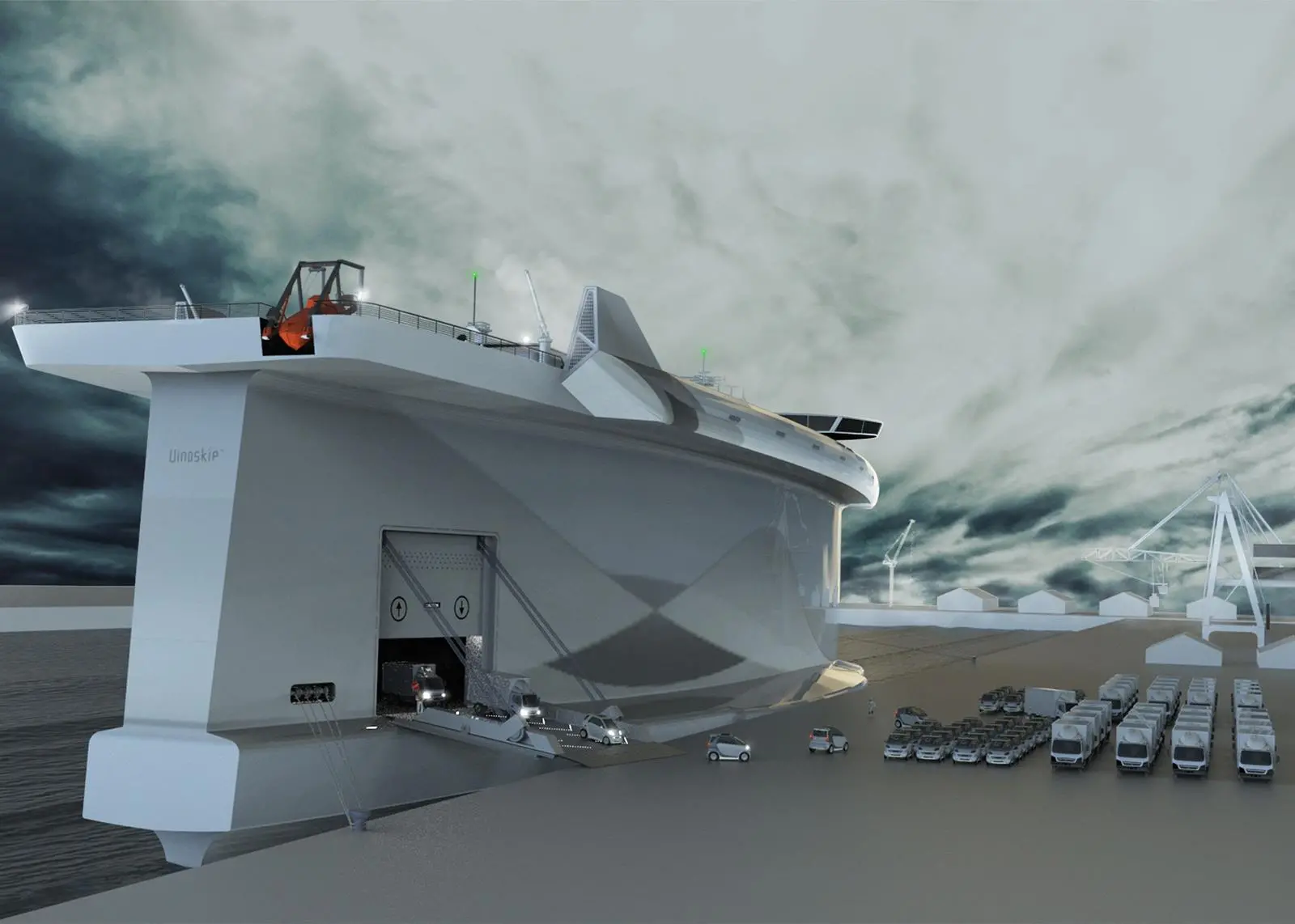
In 2020, looking to make wind propulsion a reality, Høglund/Vindskip AS designed the Vindskip, a unique wind assisted PCTC concept which combines wind and hybrid propulsion. The main feature of the concept is the aerofoil shape adopted for the ship’s superstructure, transforming it into a built-in sail area. The stability required for safe sailing is created through a trimaran configuration consisting of the main hull and one float on either side of the vessel. The exceptional design of the hull – which also serves as a sail – combines advanced lightweight construction with outstanding aerodynamics and water displacement. This results in an extremely futuristic ship with impressive functionality credentials.
The Vindskip concept consists of three parts working together in a dynamic unit: the wind power system, an LNG propulsion system (or “cruise control”) and the weather routing system. The wind power system provides the design with the ability to generate a pull in the speed direction as a function of the apparent wind – or angle of attack – which gives the design its ability to generate a pull in the speed direction due to its aerofoil shape. The system was optimised using extensive computer modelling to ensure increased pull at the widest range of angles to the wind, and reducing drag. The ship’s hybrid electric-LNG propulsion system is designed to respond to any variations of the wind over time to maintain a constant speed, drawing on project partner Høglund’s expertise. It does this by retaining a high level of efficiency over a wide range of power outputs. Finally, a weather routing module was developed which uses the aerodynamic lift generated by the apparent wind as a propulsive force.
Wind propulsion – an ally for shipping’s decarbonisation journey
In order to assess to which extent the Vindskip design is fit for decarbonisation purposes, Vindskip AS completed a research project in July 2020 to document the fuel consumption of the Vindskip design over time, based on historical weather data.
The first stage of the research project aimed to establish and measure the strength of a midship section in order to be able to calculate and to quality assure the light weight of the ship. Additionally, the research aimed to calculate the design’s resistance through the sea under given conditions – such as speed – and draft by means of computational fluid dynamics (CFD).
The third stage of the project looked at calculating the fuel consumption over time through two integrated approaches: performance prediction and weather routing. The performance prediction approach uses a constraint optimisation routine to balance aerodynamic and hydrodynamic forces to determine total resistance while satisfying the equilibrium conditions for pitch, yaw and roll. Meanwhile, the weather routing approach uses the implementation of an algorithm on a dynamic grid, avoiding land masses and harsh weather conditions in line with IMO guidelines.
The results of the research project exceeded all expectations and concluded that with either wind, liquefied natural gas or biogas as fuel, Vindskip would be the world’s greenest overseas car carrier.
The challenges of wind propulsion – striking the right balance between speed and fuel consumption
One common aspect that all the different sail assist systems share is the integration of weather routing, which is crucial to realising each system’s full emission reduction potential.
In its simplest form, weather routing includes considerations of favourable wind angles in the route planning. However, the key role of weather routing becomes apparent when we understand that neglecting the hydrodynamic response to the aerodynamic forces can cause significant errors in the prediction of the propulsion power demand and the corresponding fuel consumption.
Particularly with wind propulsion, striking the right balance between the speed of the vessel and fuel consumption – and savings – is, perhaps, the biggest challenge facing the engineering and design teams working on sail assist systems. Other sail assisted vessel designs have previously studied this balance. We saw the Knud E Hansen-design conclude that the fuel saving at 11 knots was 16.5%, while at 13 knots was only 9% (the vessel needed to then use engine power to get enough propulsion). If we continue to analyse this ratio, we will realise that on some routes with ‘bad’ winds – a route from Korea or China to Europe, for example – the savings will be negative. That is why wind propulsion systems rely so heavily on optimal integration with the engine and other elements of the vessel. Therefore, wind propulsion needs solid automation expertise to work.
Systems integration and automation – key enabler of wind propulsion
The main task of the system supplier of the propulsion system is to optimise the hybrid propulsion system to ensure optimum efficiency and energy consumption from the prime movers, while also considering the wind energy that affects the ship’s sailing. By delivering an intelligent control system, the optimum propulsion efficiency depends on having the ‘right gear shift’ relative to the propeller’s rpm. The propeller’s pitch and rpm work in the same way, and the wind energy contribution will affect the ship in the same way. It is therefore absolutely crucial to have a controller that, automatically and under any conditions, can tune the pitch and rpm to get the most efficient ‘grip’ in water relative to the ship’s speed, wind energy contribution and draft, in order to achieve minimum fuel consumption. The project makes use of project partner Stadt AS’s Lean Propulsion technology expertise.
The kind of cargo transported also plays a key role in the viability of wind propulsion systems onboard. While on a route from Brazil to China with iron ore, for example, where speed plays a small role, a design like this would work well. On shipping services where higher speed is essential (minimum 14 knots), however, sail-assisted ships might not be an efficient option, which is the case with maritime transportation of vehicles across the Atlantic.
In this predicament, one of Vindskip’s biggest achievements was that it was developed and designed to deliver impressive documented regularity and punctuality, with a maximum deviation of three hours from one transatlantic round trip to another round trip.
Not only will this require strong weather routing capabilities, but it will also require sophisticated automation and system integration expertise to fully realise. Wind propelled ships can also represent an operational challenge for crews used to conventionally powered ships, and automation can also help to mitigate this challenge.
On the Vindskip, there are only two moving parts – which are the propeller and the rudder – exactly like on an ordinary ship. The ship’s weather routing module helps it weather-optimise the route from origin to destination to meet the estimated time of arrival with the lowest possible fuel consumption. The route is imported into the ship’s navigation system and a passage plan is generated to confirm and ‘officialise’ the route. When the ship starts sailing in a restricted area, it will be manually operated by the crew aboard as an ordinary ship, while outside restricted areas it will follow the route autonomously. As such, the ship can make decisions about route and weather itself.
The role of wind propulsion in future-proofing the industry
With decarbonisation set to remain one of the top priorities for the maritime community in the coming years, finding solutions that can contribute to securing a sustainable future for shipping has become an urgent necessity for the sector. Wind propulsion offers a greener way to reduce vessels’ carbon emissions, but can only become widely adopted and an option worth considering commercially if fuel consumption – and the resulting emissions – can be significantly reduced without compromising factors such as speed and punctuality – which ultimately enable commercial viability.
In order to ensure this, optimal integration of wind propulsion systems with the other elements of the vessel is absolutely crucial, and the industry must see robust automation work as a key part of the wind propulsion puzzle.
Related Articles
 ENERGY SAVING DEVICES
 ENERGY SAVING DEVICES
 AMMONIA