



Wind propulsion gains large ship momentum
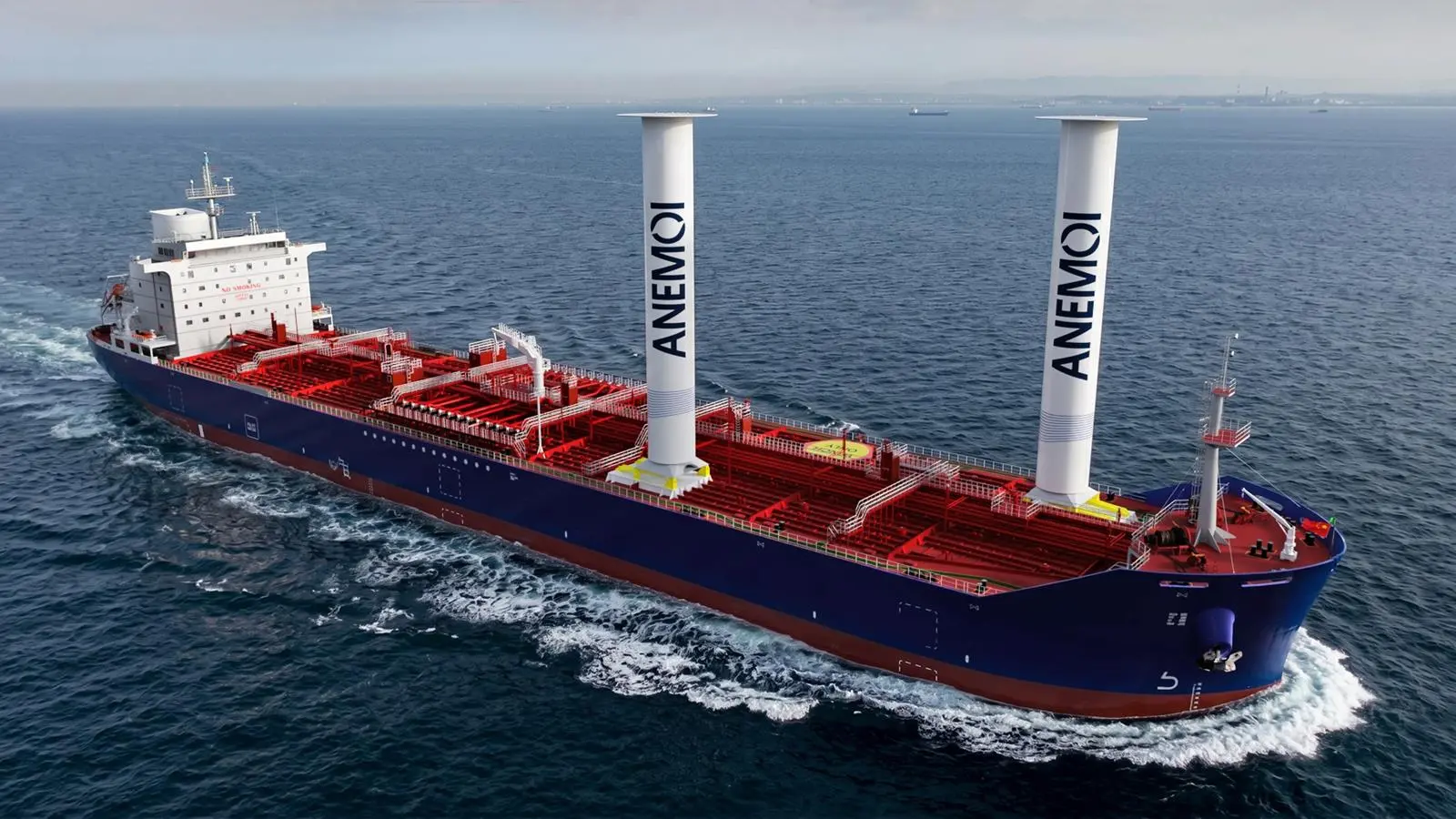
In the latest milestone, Anemoi Marine Technologies and a consortium of partners have completed a joint development project that integrates Anemoi’s Rotor Sail technology into the design of a medium-range tanker. Developed alongside Guangzhou Shipyard International and ship operator Hafnia, the concept has received approval in principle from classification society DNV.
The project tackled one of the industry’s key challenges: fitting wind propulsion systems on to tankers where deck space, cargo operations and safety requirements are particularly demanding. The design incorporates two folding, explosion-rated Rotor Sails and a lightweight deck foundation that avoids the need for underdeck strengthening.
“Completing this project is a significant step for wind-assisted propulsion in the tanker sector,” said Nick Contopoulos, chief production and partnerships officer at Anemoi.
“Demonstrating that our EX-rated Rotor Sail can be integrated efficiently, safely and with minimal structural impact on MR tankers gives owners a clear, verified pathway to adoption.”
Aakash Dua, regional business development manager at DNV added: “Working together with GSI, Anemoi and Hafnia, this AiP means we have a new technical reference point for WAPS in this important ship segment.”
READ MORE: New MR tanker wind collaboration
Meanwhile, bound4blue has secured Type Approval Design Certification from DNV for its largest suction sail system, the Model 3-24 eSAIL. The approval confirms the design meets stringent standards for safety, structural integrity and performance.
The 24-metre-high sail is the first in a new range aimed specifically at larger vessels seeking greater fuel savings and emissions reductions. Two units were recently installed on the newbuild vessel MV Baltazar and on the Maersk MR tankers, the Tahiti and the Trieste.
“Achieving Type Approval from DNV for our most advanced installed eSAIL is an important step forward, both for us and shipowners looking to harness optimal benefits from wind propulsion,” said José Miguel Bermúdez, chief executive and co-founder of bound4blue.
The developments come as shipowners face mounting pressure to reduce emissions and improve efficiency. Increasingly sophisticated wind-assist technologies, combined with evolving classification standards and regulatory support, are helping transform wind propulsion from a niche innovation into a practical decarbonisation tool for larger commercial vessels.
“We’re now beginning to see the next generation of WAPS units,” said Cristina Saenz de Santa Maria, chief executive of DNV Maritime. “One of the key enablers of these developments is the parallel evolution of technical standards, which have been a vital part of building acceptance in the market.”
Together, the two projects suggest that technical, regulatory and commercial barriers to wind propulsion are steadily being overcome, opening the door to wider deployment across the global fleet.
Related Articles
 ENERGY SAVING DEVICES
 ENERGY SAVING DEVICES
 AMMONIA