



Wind resistance of superstructure reduced by 10%
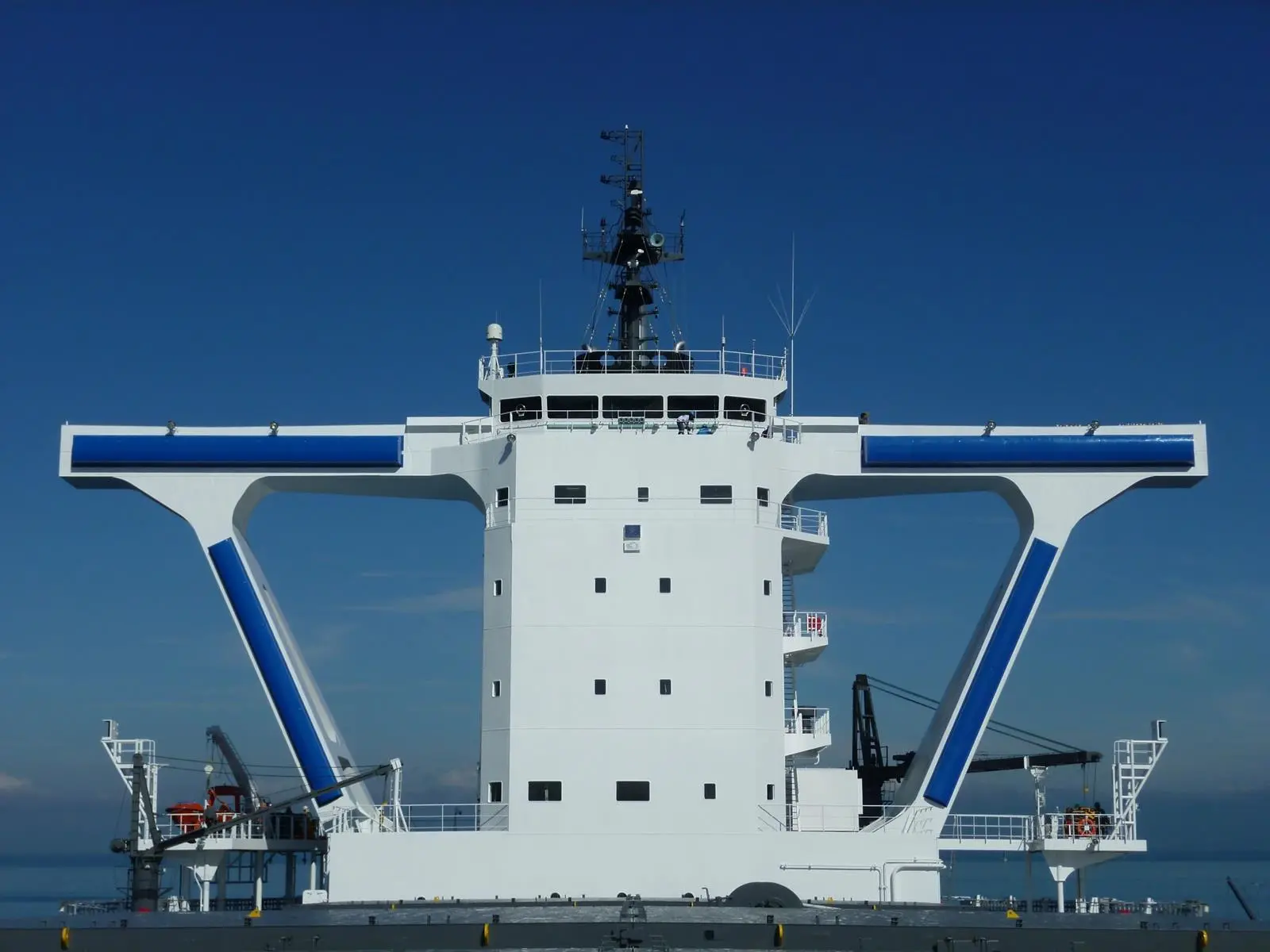
To reduce the wind resistance of the accommodation area superstructure, the two companies have developed various structural forms for the area including a slanted -corner configuration, and applied the structure to an 180,000dwt bulk carrier that has a wider superstructure than other vessels.
Moreover, focusing on the fact that the facades of bridge wings and support pillars account for 30% of the total superstructure, the two companies have pursued research and development into shapes and developed the MT-Cowl technology. This lowers wind resistance by attaching an add-on structure to the facades of the bridge wings and support pillars for the vessel’s superstructure, which creates corners with a slanted shape to reduce the effects of wind resistance.
A wind tunnel test using a model showed that wind resistance was reduced by 10%. For this purpose, it was assumed to receive a wind speed of 17 knots at an ordinary navigation speed of 15 knots and the relative wind velocity was calculated as 32 knots. The companies claim that when applying this percentage to a 180,000dwt bulk carrier, a reduction in CO2 emissions of 520 tonnes a year can be realised as a result of the enhanced fuel efficiency.
A prototype of the MT-Cowl has been installed on the 180,000dwt bulker, Cardinal Victory, and tested during the vessel’s trial voyage. Cardinal Victory was ordered by NYK Line, which took delivery of the vessel on 4 July. With an eye to applying this technology to other newbuildings as well as existing ships, the results acquired during the shipboard tests will be analysed for ongoing R&D activities.
As awareness toward environmental issues is heightened, NYK Line and Tsuneishi Shipbuilding position CO2 reduction as their first priority, and have engaged in joint R&D projects to advance the propulsive capability and environmental performances of vessels.
With the aim of reducing fuel consumption, in February 2008 the two companies developed MT-Fast, an energy-saving hull appendage fitted to a vessel’s hull in front of the propeller to catch the energy from the swirl flow generated by propeller rotation. It was installed on vessels built by Tsuneishi Shipbuilding and a fuel saving of some 4% has been confirmed.
Related Articles
 PROPULSION
 GENERAL NEWS
 HYDROGEN