



WinGD launches VCR solution for X-DF engines
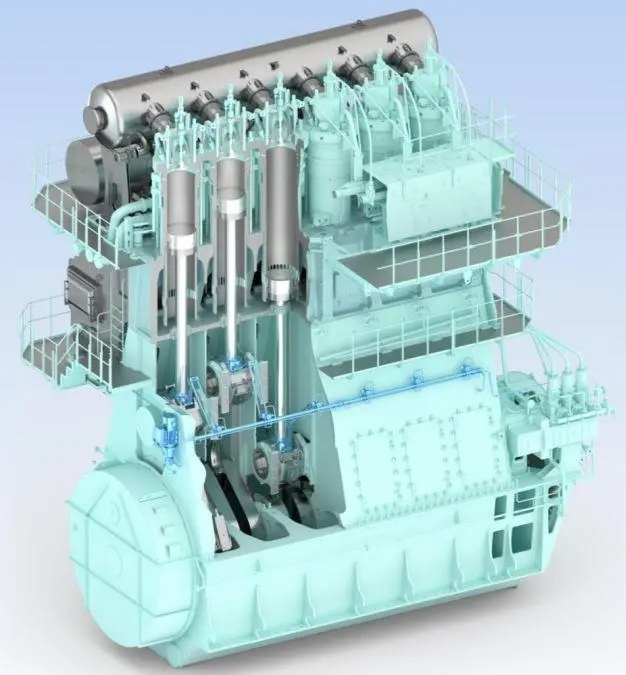
The new VCR solution will be initially offered as an option for 62-bore and 72-bore dual-fuel X-DF engines, although the engine designer anticipates extending the range of the engines covered by the solution, as well as introducing retrofit packages for existing dual-fuel X-DF engines.
The solution was being added as a selectable option for WinGD’s X62DF-2.1 VCR, X62DF-S2.0 VCR, and X72DF-2.1/2.2 VCR engine types.
First orders
The first orders for 62-bore engines equipped with the solution have been placed and a bulk carrier and a pure car and truck carrier (PCTC) will be delivered in 2024, Ott explained to The Motorship.
The first orders for X-DF 72-bore engines, which are typically installed on board LNG carriers, have not yet been finalised, Ott noted, adding that commercial discussions are underway.
Ott added that the decision to add VCR to the portfolio was made following the conclusion of tests on a full-scale installation on a 6X72DF test engine. Ott paid tribute to the development team, which had worked closely with engineers from Japanese engine licensee MES DU.
”This is a significant achievement, and represents the culmination of a decades-long search. For combustion engineers, the search for VCR has been like the search for the Holy Grail.”
While the underlying concept behind the VCR solution has not changed significantly since The Motorship covered the technology in an in-depth feature in 2020, the intervening period has seen significant research into the solution, in collaboration with Japanese engine licensee MES DU.
“The project has seen cooperation in validation tests, and we have worked together to simplify the design of the solution, and to reduce the manufacturing cost,” Ott noted. As a result, the footprint of the engine is unchanged within the dimensions of the previous engine, and the solution does not require any changes to auxiliary systems.
This ensures that the solution is likely to be highly suitable for retrofit installations, Ott noted.
Fuel efficiency savings
The solution can be seen as an elegant solution to some of the trade offs required during the design of an engine for dual-fuel operation. Engine efficiency has been limited by the need to avoid potentially damaging peak pressures.
As dual-fuel engines are optimised for operation in gas mode, the engine efficiency in diesel mode operating on conventional fuels is typically lower. By introducing the ability to dynamically modify compression ratios, VCR will optimise fuel consumption in diesel mode and will also contribute to favourable efficiency in part-load gas operation.
Ott explained that the consumption improvements are significant, with savings seen in gas mode at part and low load operation. By contrast, the improved combustion efficiency in diesel mode means that there will be a reduction in fuel consumption across the load range.
The potential benefits vary according to the operational pattern of the vessel, as well as the proportion of conventional fuel that a dual-fuel engine is using, but WinGD estimated BSGC consumption reductions of 5g/kWh at 50% load and 6g/kWh at 25% load.
“In diesel mode, you gain between 8-12g/kWh,” Ott said. These fuel savings were likely to be make the solution compelling for ship owners, Ott noted, without even taking into account the likely greenhouse gas emission reduction potential of the solution.
“In gas mode, the savings are only 2.4%, but in diesel mode, you gain between 5% and 7%,” Ott said, adding that the highest savings seen were seen in the bulker and container feeder segments.
Related Articles
 2-STROKE & 4-STROKE
 2-STROKE & 4-STROKE
 2-STROKE & 4-STROKE