



World’s longest green and digital shipping corridor agreed
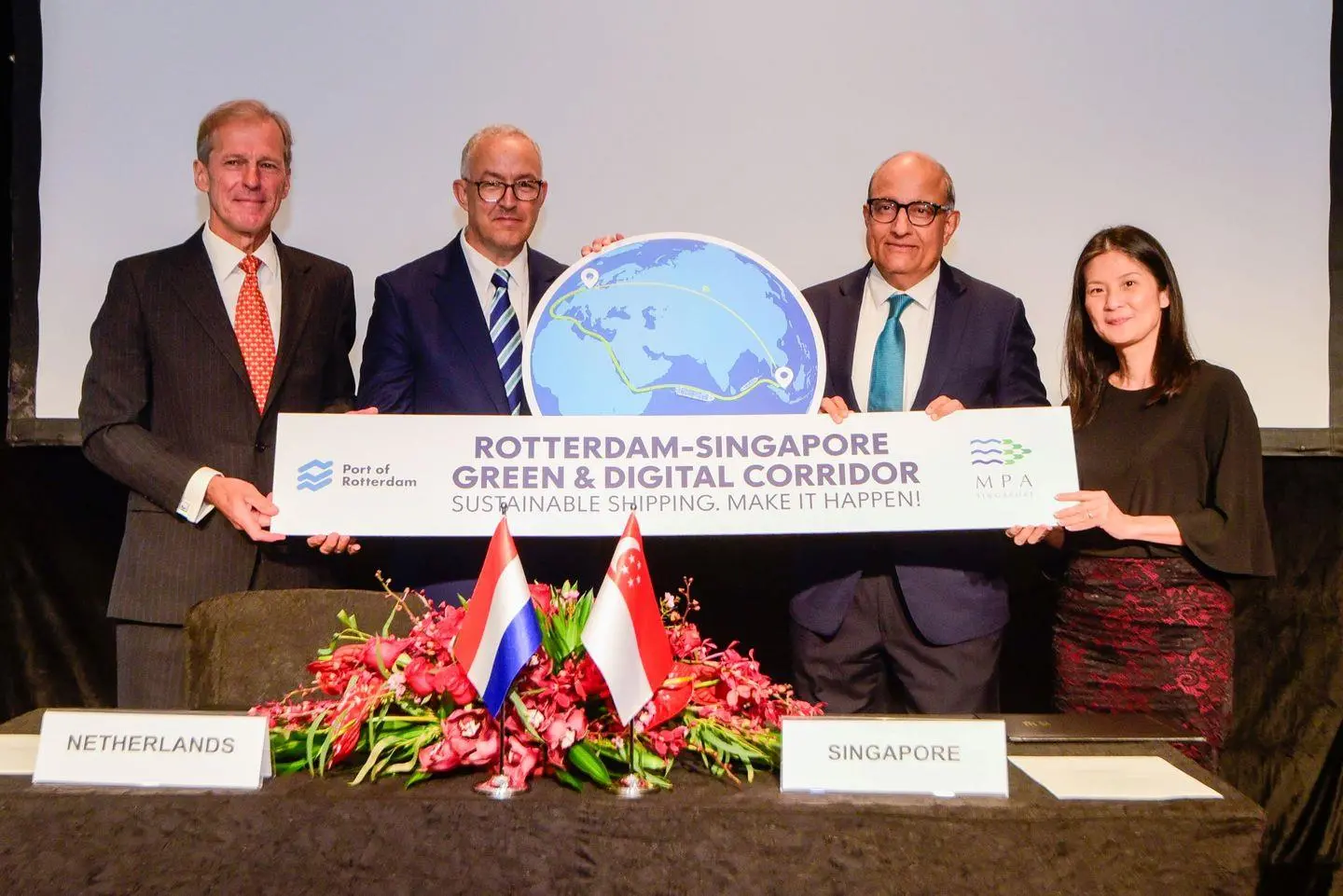
The MoU will bring together stakeholders across the supply chain to realise the first sustainable vessels sailing on the route by 2027.
Each new alternative fuel has its own challenges relating to costs, availability, safety, and restrictions in range due to lower energy density compared to fossil fuels. To tackle these challenges, the two port authorities agreed to bring together a broad coalition of shippers, fuel suppliers and other companies to collectively work on potential solutions.
Beyond alternative fuels, the MoU also aims to optimise maritime efficiency, safety, and the transparent flow of goods by creating a digital trade lane where relevant data, electronic documentation and standards are shared. This will facilitate the seamless movement of vessels and cargo, and optimise just-in-time arrival of vessels from port to port.
The port authorities will work with the Global Centre for Maritime Decarbonisation and the Mærsk Mc-Kinney Møller Center for Zero-Carbon Shipping as action partners, as well as other industry partners across the supply chain, including bp, CMA CGM, Digital Container Shipping Association, Maersk, MSC, Ocean Network Express, PSA International, and Shell.
This will enable the Green and Digital Corridor project to raise investment confidence, attract green financing, and kickstart joint bunkering pilots and trials for digitalisation and the use of low- and zero carbon fuels along the route.
Quah Ley Hoon, Chief Executive of MPA, said: “This MoU further strengthens the strong partnership between Singapore and Rotterdam. It reaffirms Singapore’s commitment towards facilitating a multi-fuel bunkering transition as part of the Maritime Singapore Decarbonisation Blueprint 2050, and accelerates our digitalisation efforts to optimise maritime efficiency and improve supply chain resilience. The pilot will complement efforts undertaken by the shipping industry, including partners such as Google Cloud, and the IMO to support decarbonisation and digitalisation transition for international shipping, as we work towards developing and scaling up green and digital solutions for wider adoption.”
Bo Cerup-Simonsen, CEO of the Mærsk Mc-Kinney Møller Center for Zero-Carbon Shipping, said: “The Singapore-Rotterdam Green Corridor is fully in line with our strategy to accelerate the decarbonisation of the maritime industry by supporting first movers. We need bold projects like this to leverage the learnings and further develop green partnerships across the value chain. Connecting globally leading partners around one of the major trade-lanes will allow us to demonstrate concrete, scalable decarbonisation solutions that can inform and inspire industry as well as policy makers around the world.”
Professor Lynn Loo, Chief Executive Officer of Global Centre for Maritime Decarbonisation (GCMD), said: “International shipping will have to deploy at least 5% zero-emission fuels in its fuel mix by 2030 for the sector to meet a Paris-aligned net-zero target. To this end, green corridors provide a framework to harmonise standards and regulations, increase green fuels availability and strengthen their supply chains, and attract green financing for bunkering infrastructure buildout at ports involved. GCMD is excited to be an action partner in the development of the world’s first green and digital corridor. We will operationalise meaningful route-base, port-to-port pilots along this green corridor to help international shipping navigate and accelerate its transition towards a zero-carbon future.”
Related Articles
 ALTERNATIVE FUELS & LUBRICANTS
 ALTERNATIVE FUELS & LUBRICANTS
 ALTERNATIVE FUELS & LUBRICANTS