



X-Bow proves effective on seismic survey ships
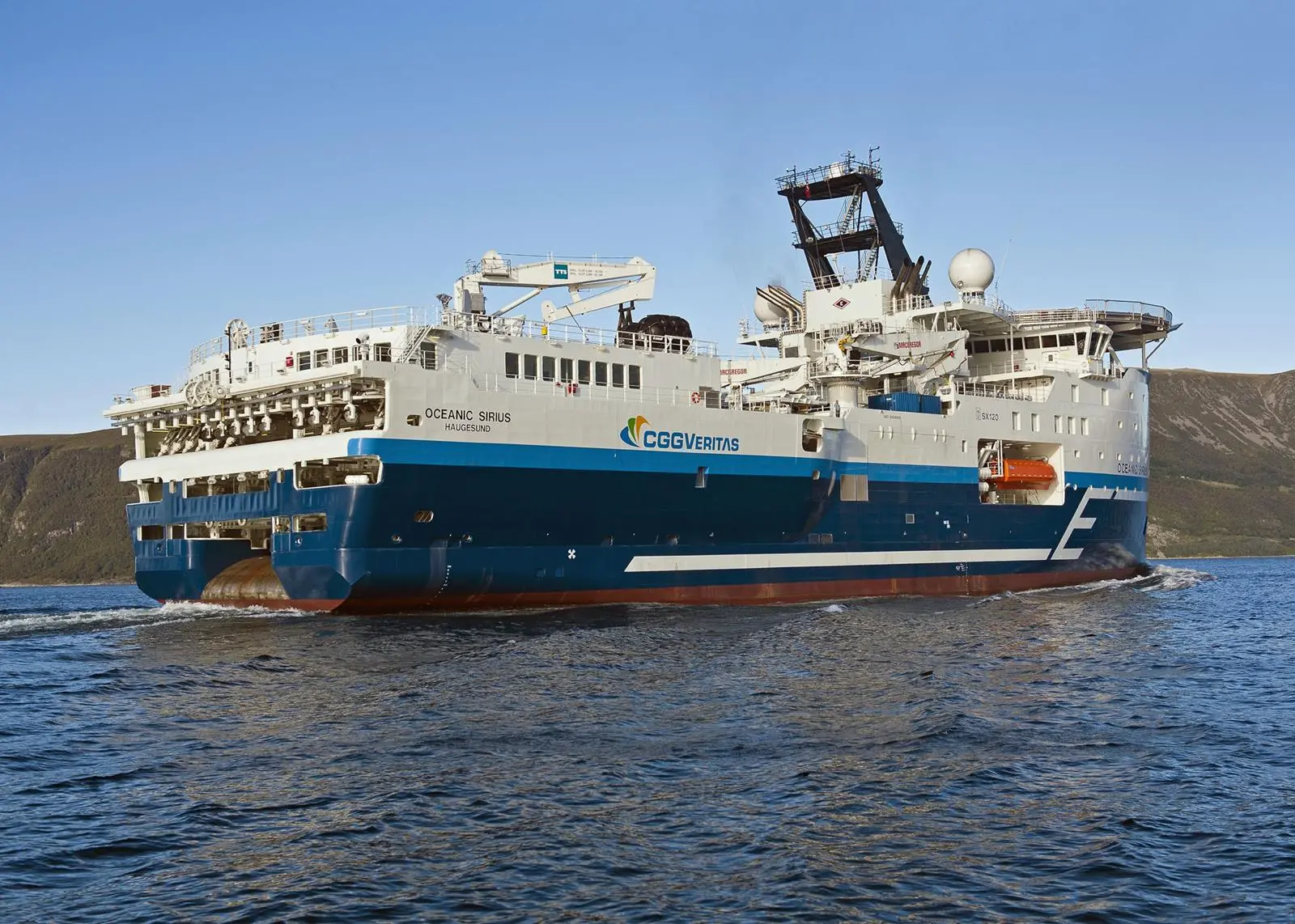
Oceanic Sirius was designed and built by Ulstein Verft in Ulsteinvik for a joint venture between Norwegian shipowner Eidesvik and French company CGGVeritas. She has been built in accordance with strict environmental standards and equipped with the latest technology for advanced seismic research operations. Oceanic Sirius is sister vessel to the Oceanic Vega, delivered by Ulstein in July 2010.
Joint owner CGG Veritas describes the two ships as being among the most powerful seismic vessels afloat. With a static bollard pull of 190 tons, they are suited for large 3D, 4D and high-definition data acquisition projects. With 20 streamer winches, they are two of the largest seismic ships afloat.
The owners consider Ulstein’s X-Bow configuration to be particularly suitable for the demands of the seismic industry, offering reduced surging and turbulence. The bow design is said to result in lower added resistance and smoother bow immergence, leading to reduced operational disturbance and involuntary speed reduction. The hull design allows optimisation for seismic towing operations at 4.5/5.0 knots, leading to reduced noise and fuel consumption and lower CO2 emissions. The propulsion and manoeuvring system is also designed for this type of work, while allowing the ships to travel quickly and economically to an from the survey areas.
Seismic surveys tend to be long jobs, and Oceanic Sirius is designed wit the capability to remain at sea for extended periods, with the capability of being refuelled at sea, reducing the need to return to port. Her sister ship is said to have spend over one year continuously at sea. For such operating patterns, comprehensive storage facilities must be provided onboard. Additionally, high-calibre seismic scientists are in short supply, so provision of a comfortable working environment and off-duty facilities are another important consideration. Our view of the nearly-completed ship suggested a standard of fitting out and provision of equipment that was far closer to a cruise ship than an offshore working vessel.
The ship is classed by DNV, with a Clean Design class notation and certificates for lowest environmental impact. A ‘Green Passport’ has been issued to show that all materials and chemicals used are fully recorded, with a view to end-of-life recycling. Clean Design features include a double hull (no fuel towards outer skin); engines complying with latest Marpol emission limits, and bilge water cleaning and ballast water treatment systems installed. The ship is to DNV Ice Class for year-round operation in challenging environments.
The machinery and bridge layout are designed to NAUT-OSV(A) class, for redundancy, with two independent diesel-electric machinery sets, all running on MDO for low sulphur emissions. Quietness of operation is an important requirement for seismic operations, another point in favour of the diesel-electric solution. Prime movers are four Wärtsilä 12V26 main gensets each rated at 3,900kW at 900rpm and two 6L26 supplementary gensets each rated at 1950kW at 900rpm. The generators and some switchgear were supplied by ABB. The two propellers are 4.2m diameter Wärtsilä Lips CP units mounted in nozzles, each driven by two ABB frequency controlled propulsion motors in tandem. Each motor is rated up to 3,000kWe, 0-720 rpm, thus delivering 6,000kWe total power to each propeller. The propellers turn at 40-135 rpm, through Wärtsilä Lips SV95 reduction gears. This ensures that the constant speed of around 5knots required during seismic survey work can be economically achieved. A 435kWe Scania-powered Stamford alternator provides emergency power.
Steering gear was supplied by Tenfjord, and CP tunnel thrusters (two FU100LTC 2450 of 1,200kW each and one FU63LTC1750 of 800kW) by Brunvoll. Pumps came from Allweiler, separators from Alfa Laval and lock and compressors from Atlas Copco has supplied compressors. The ballast water system is supplied by OptiMarin.
Oceanic Sirius complies with the IMO Code for special purpose ships (SPS code) for up to 70 persons, for whom accommodation is provided in 52 single and nine double cabins. In addition, an internet cafe, gymnasium and sauna are provides as well as the usual facilities. The mess room, galley and the four dayrooms all have large windows facing the sea, and particular attention has been paid to low levels of noise and vibration throughout the accommodation. A heli-deck facilitates crew changeover.
Most of the deck area is taken up by the seismic equipment, with a fully-auomated deployment and recovery system. The ergonomically-designed instrument room is located above the seismic area at the stern with large windows facing aft giving a direct view of the streamer deck. A storage area above the instrument room is served by a knuckle jib crane with a capacity of 10t at 20m outreach. The two offshore cranes placed on C-deck midships have a capacity of 15t at 18m outreach and can be used to lift supplies on board from service vessels.
Ulstein Power & Control delivered much of the equipment for the vessel, including switchboards, the Ulstein Com information and communication system, the Ulstein Nav navigation system and the Ulstein IAS integrated automation system, equipped with integrated modules, including power management system and modules for monitoring the heli-deck and the ballast water system.
Safety equipment comprises two Schat Harding, each of 70-person capacity, DSB life rafts, Aukra Maritime davits and a Mare Safety rescue boat in Vestdavit davits. Two seismic workboats are carried below deck. Cargo handling and access equipment is from Odim (deck machinery), MacGregor Hydramarine (cranes), and TTS (doors), with gangways from Gurskøy. Jotun paint was used throughout. Sanitary systems were supplied by Jets. Furuno provided the majority of the bridge equipment, with SG Brown and Plath compasses and Anschütz autopilot.
“We are proud to deliver a vessel that features among the most advanced seismic research vessels in the world, and we are confident that she will stand the owners in good stead for many years to come,” said managing director of Ulstein Verft, Karsten Sævik.
OCEANIC SIRIUS – PRINCIPAL PARTICULARS
Length oa: 106.5m
Length bp: 99.3m
Breadth moulded: 24.0/28.0m
Depth to main deck: 10.0m
Max draught: 8.0m
Design draught: 7.0m
Deadweight: 6,013dwt
Gross tonnage: 12,550gt
Towing force at 5 knots:140 t
Bollard pull: 190 t
Maximum speed :18.2 knots
Class:
DNV +1A1, E0, NAUT-AW, OPP-F, CLEAN DESIGN, ICE-C, COMF-V(3), COMF-C(3), HELDK-SH, RP
Flag: Norway
Related Articles
 PROPULSION
 GENERAL NEWS
 HYDROGEN