



ZERO-EMISSION CAR CARRIER PROPOSED
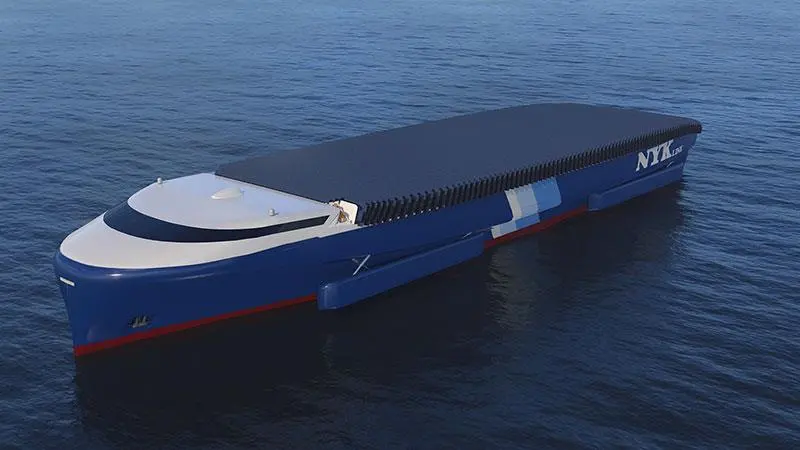
The vessel proposed would provide an 8,000 car equivalent unit (CEU) capacity within the 200m length constraint typically set by Japanese vehicle handling terminals, but would be wider and of lower profile than existing PCTCs of comparable intake.
Instead of fossil fuels, the design envisaged under the so-called NYK Super Eco Ship 2050 initiative may potentially use hydrogen produced from renewable energy sources.
As any new or alternative type of fuel might be expected to impose extra space demands relative to conventional fuel, a key criterion was that the concept ship had to be energy efficient in the extreme. Elomatic claims that energy demand in the proposed design has been cut by two-thirds relative to a heavy fuel oil (HFO)-powered, 2014-built PCTC of 199.9m x 35.6m main dimensions.
The vessel’s topsides would have a 9,000m2 array of solar panels, meeting up to 15% of the vessel’s energy requirements.
Rather than carrying water ballast, a combination of active pontoons and gyro stabilisers on each side of the hull will maintain stability. In normal conditions, the pontoons will be stored above the sea level so as to minimise resistance. When encountering high seas or otherwise difficult or adverse conditions, the pontoons will be lowered to the waterline, to provide extra stability.
An under-hull air lubrication system, a field in which NYK ranks as one of the earliest practitioners, will confer further benefits in countering resistance and improving hydrodynamic efficiency.
Ship weight is markedly reduced through the adoption of durable, lightweight materials for hull construction, and what is described as a “bionic design” of hull that dispenses with traditional beam structures. Consideration is being given to the use of flapping foils in preference to propellers. These devices mimic the movement of dolphins, a solution which is claimed to deliver greater efficiency than conventional propellers.
The Super Eco Ship 2050 also embraces automated mooring and berthing arrangements, and new techniques for cargo handling so as to cut port time. While a crew will be carried, complement size will be less than that of existing vessels, and the future-orientated strategy built into the design will embrace increased automation and a degree of remote control.
COMPARISON of vessel particulars
|
2014-built car carrier |
NYK Super Eco Ship 2050 |
|
|
Length |
199.9m |
199.9m |
|
Breadth |
35.6m |
49.0m |
|
Draught, design |
9.0m |
9.0m |
|
Air draught |
45.6m |
31.0m |
|
Main energy source |
Diesel engine (heavy fuel oil) |
Fuel cells (hydrogen) |
|
Renewable energy |
nil |
Solar power |
Source: NYK Group
Related Articles
 PROPULSION
 GENERAL NEWS
 HYDROGEN