



Zero emission cutter proposed for US Coast Guard
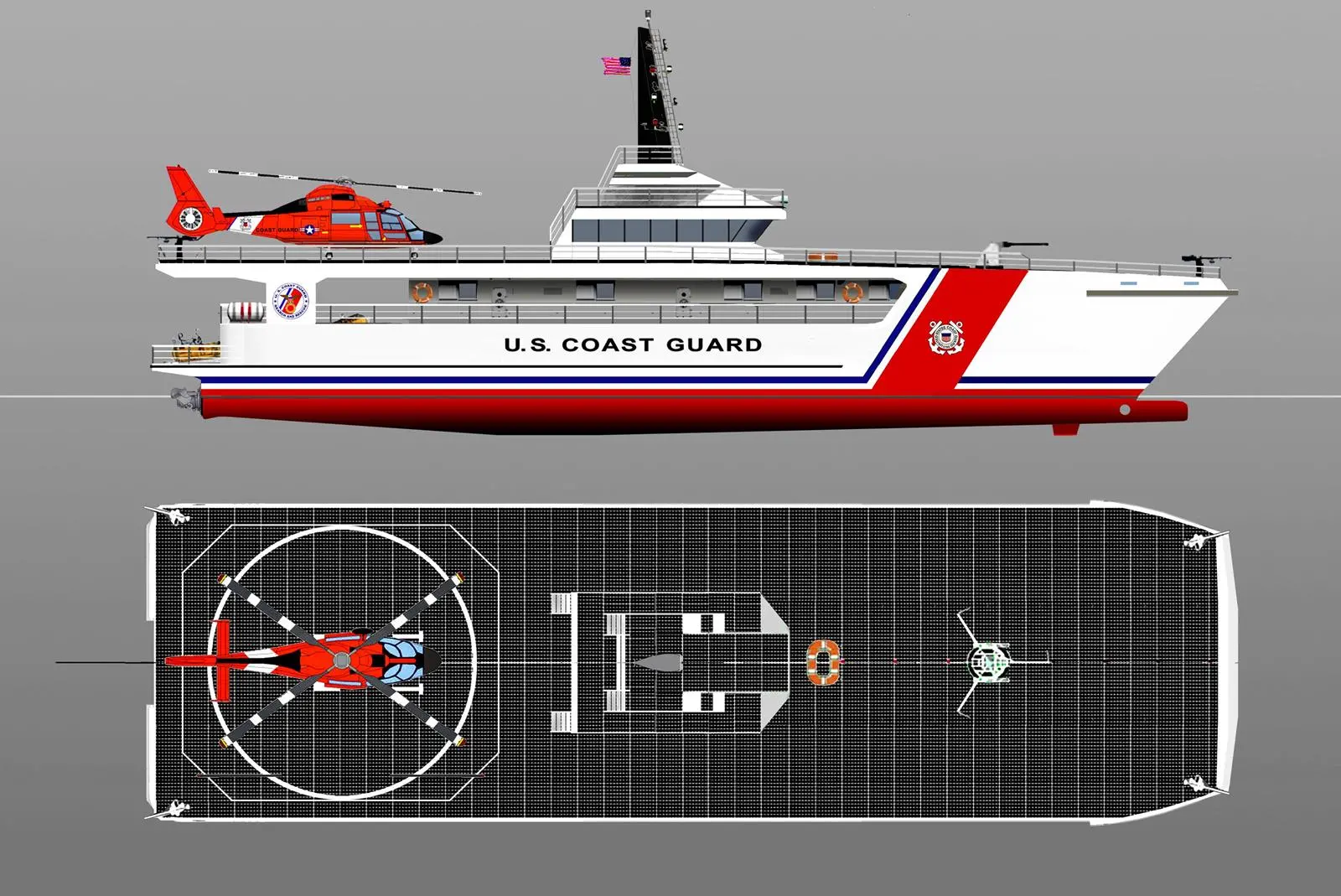
Sauter Carbon Offset Design is a Bali-based naval architecture practice devoted to low-carbon shipping projects. Best known for its superyacht designs, Richard Sauter’s concepts have graced these pages before with the ‘Deliverance’ and ‘Black Magic’ solar hybrid tanker proposals.
The earlier ‘Black Magic’ features low-emission automotive diesel-driven gensets and batteries, backed by wingsails and solar panels, in a pentamaran-type hull, driven by counter-rotating CLT azimuthing propellers. Regeneration and waste heat recovery systems further reduce fuel consumption, resulting in a claimed 75% to 100% reduction in carbon emissions.
This was followed last year by the ‘Deliverance’ concept, a VLCC designed for the enlarged Panama Canal. It obtains half of its energy from a Wärtsilä low loss concept dual-fuel LNG propulsion plant and the other half from solar and wind power. Again, further energy savings are promised through the use of a low-resistance hull form incorporating Mitsubishi bubble technology and twin CRP hybrid propulsion pods. This offers a claimed 75% reduction in fuel consumption and carbon emissions compared with a conventional VLCC.
However, the US Coast Guard proposal has not a sail in sight. SCOD describes the vessel, which it has named the Sea Eagle, as an “ultra green homeland security vessel that’s tough on the bad guys, but kind to the ecology.”
It is designed to provide extensive surveillance below the ocean as well as on and above the waterline. The E Class search and rescue Sea Eagle with helipad and underwater ROV is said to use less than half as much fuel to go 10% faster than the current USCG Sentinel class fast response cutters. The Sea Eagle’s waterjet propulsion, dynamic positioning and small wave making signature are claimed to reduce adverse effects on the marine ecology. US shipyard Kvichak Marine Industries is already geared up to build the all-aluminium vessel.
Instead of the Sentinel’s 11,500bhp from EPA Tier 2 diesel engines, the Sea Eagle uses a total of 5,000bhp from solar hybrid power sources that include MTU tier 4i Diesels. With less than half the fuel consumption of the Sentinel Class FRCs, the Sea Eagle delivers a design maximum speed of 32 knots as opposed to 29 knots, this, says Sauter, is due to the greater overall efficiency of high-speed catamarans versus monohulls.
Energy from the grid, or captured from her 100KW solar array, is stored in a Lloyd’s-approved Corvus 2MW Lithium uninterruptible power supply (UPS). The 16-ton weight of the batteries provides a vital component in the MDR (motion damping regeneration) designed to generate electricity as it dampens the motion of the vessel.
In silent electric mode, being powered solely from the battery pack, the Sea Eagle will navigate in harbours and inland water ways with zero emissions. The solar cells are capable of harnessing and returning over 200MW/year of energy to the grid, which SOCD says offsets 3,000naut miles of cruising at 18 knots, making the vessel carbon neutral. As a certified carbon offset project the vessel can reduce GHG emissions by 12,000 ton/year.
Combining the MDR with self leveling T-foils in each hull improves seakeeping and safety. At the same time it enhances the accuracy of the stabilised remotely operated 25mm chain gun, and the four crew operated .50 calibre machine guns.
The Coast Guard Sea Eagle FRC can accommodate more than 30 crew members and her command, control, communications, intelligence, surveillance and reconnaissance systems will be compatible with the US Government agencies.
“Government agencies like the Department of Defense and the Department of Homeland Security while protecting us can also play a major roll in protecting our way of life for future generations. They have the opportunity, if not a duty, to do this by insuring that only the best examples of fuel efficient eco-conscious vessels are to be found in our Coast Guard and Navy,” says Richard Souter.
The E Class Sea Eagle design is being submitted for review under the US Coast Guard Unsolicited Proposal Program.
Specifications
Length oa: 43m
Beam: 12.4m
Draught: 1.5m
Solar Power: 100kW Solbian photo voltaic top deck
Wave Power: 30kW Wave Motion Regeneration
Battery Power: 2MW Corvus Lithium UPS
Shaft Power: 4 x 1,000kW
Engines: 4 x ZF Hybrid MTU Series 2000 Tier 4i V12, 1 Siemens MTU Tier4i 650kW genset
Propulsion: 4 x Rolls-Royce Kamewa A series waterjets
Cruising Speed: 29 knots
Maximum Speed: 32 knots
Range: 1,200 naut mile minimum
Range: 3,500 naut mile in economy mode
Endurance: 7 days
Crew: 30+
Aircraft: HH- 65A Dauphin US Coast Guard
ROV:ISE with Launch and Recover System (LARS)
Boats: Stern Ramp (1) CG Short Range Prosecutor (SRP)
Related Articles
 PROPULSION
 GENERAL NEWS
 HYDROGEN