



ZERO-EMISSION, MODULAR SHIP DESIGN FOR STENA BULK
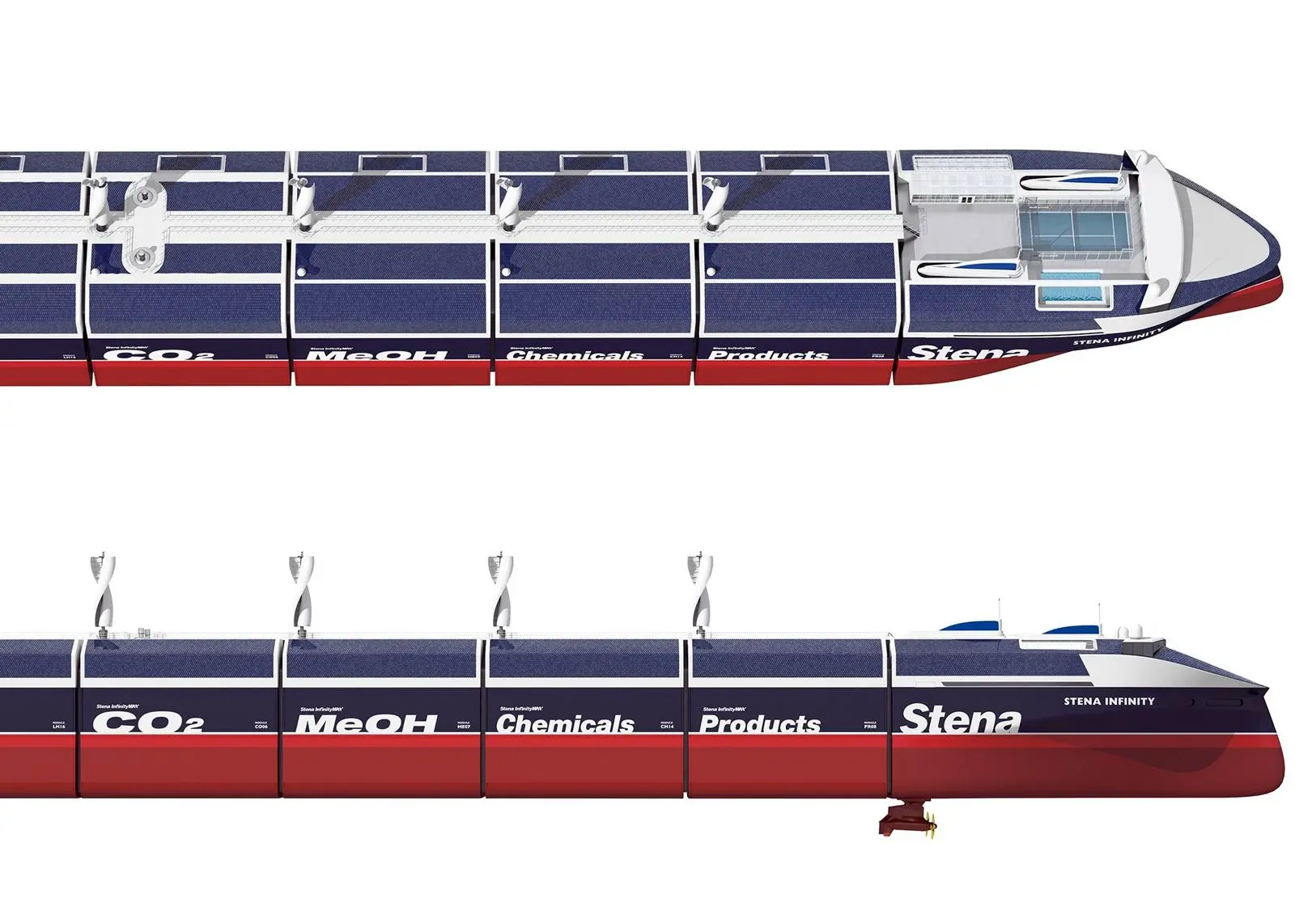
In a proposed advancement comparable in impact to containerisation, the creation of standardised and modular cargo units that can carry dry bulk, liquid bulk or liquified gas products – such as methane, hydrogen or ammonia – is expected to significantly streamline the transport of bulk cargoes and to improve fleet utilisation.
The InfinityMAX concept will be flexible in size and capacity because each cargo unit will be independent and able to be attached or released from the main unit of the ship as desired. This creates the potential for more standardised supply chains and reduces the unnecessary environmental impact of empty tanks being shipped around the world in search of new cargo, says Stena Bulk.
The ship will use liquified hydrogen as fuel for the main fuel cell system and wind turbines to generate further energy. Collapsible wing sails and a shark skin hull have also been incorporated in the concept design to improve efficiency. An azimuth thruster on the main unit will be used for propulsion and manoeuvring. Although the InfinityMAX will be crewed for safety and flexibility reasons, Stena Bulk has designed it to be semi-autonomous.
The cargo units are designed to be self-sufficient in terms of their energy use, with wind turbines and solar panels generating all the electricity needed for internal systems. They will transfer excess power generated to the main unit and thereby contribute to the ship’s propulsion indirectly, although they won’t have propulsion systems themselves.
The units have been designed to be able to be dropped off outside ports and picked up by tugs, avoiding congestion and reducing call times dramatically. Erik Hånell, President & CEO of Stena Bulk, said: “We envision autonomous or semi-autonomous tugs to handle the port logistics in the future, but the cargo units could just as well be transported with traditional tugs. As for port infrastructure, the cargo units will require shore power and equipment for loading, discharging and tank cleaning. Apart from that, existing infrastructure will be sufficient.”
The concept is based on optimized flexibility and efficiency, says Hånell. “We have based the concept on our main segments today: energy and liquid resources, and that’s what the picture is showing. Power-to-X will certainly be a big part of that, but adding dry bulk to the mix enables for more flexibility, broader potential and higher efficiency, and this concept works just as well regardless of type of cargo.”
Although the concept is built mostly on already existing technology, some areas need more development, says Hånell. The technical solutions for module stability and how they will be connected, for example, are part of the detailed design work that is yet to be completed.
“Technically, we believe the ship could be built in 10-15 years’ time. However, we also believe that strong partnerships and collaboration across the industry will be required for new standards and efficiency gains to be achieved.”
Adopting wind and solar power
The new vessel is not Stena Bulk’s first foray into wind and solar assisted power. In June last year, the company presented a prototype design for a product and chemical tanker that incorporated Flettner rotors and solar panels. The IMOFlexMAX is anticipated to be able to reduce greenhouse gas emissions by 25% to 45% compared to modern product tankers.
The vessel, designed by Stena Bulk and sister company Stena Teknik, will be powered by dual-fuel engines that can run on LNG as well as conventional low-sulphur fuels. The IMOFlexMAX vessels are designed so that they can be built with existing and proven technology.
Related Articles
 PROPULSION
 GENERAL NEWS
 HYDROGEN