



Dutch partners develop 3D printer for shipbuilding
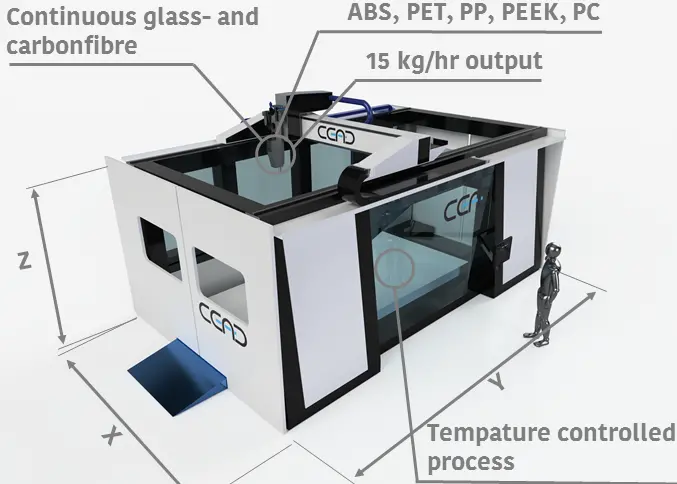
The printer will use continuous fibre additive manufacturing (CFAM) technology to produce objects in a variety of thermoplastics with a build volume of up to 4m x 2m x 1.5m.
The printer was initially developed by CEAD. Royal Roos will contribute to its development by purchasing the prototype, engineering the printer frame and table, and developing 3D printable applications for the maritime industry.
The prototype is expected to be complete by mid-2018 and will, the partners claim, be the first technology capable of fast and accurate printing of large composite parts with sufficient strength for use in shipbuilding and industrial applications.
Royal Roos has created a new company, Royal3D, to accommodate the three ‘pillars’ of its 3D printing activities: researching the 3D printing of parts for marine use with research institutes and class societies; printing reinforced plastics on request for clients; and offering consultancy services to companies wanting to start their own 3D printing operations.
The project is the latest of several initiatives exploring the use of 3D printing in the maritime arena. Most recently a project involving Rotterdam-based RAMLAB, shipyard group Damen and class society Bureau Veritas has printed the first class-approved, 3D-printed ship propeller. A project exploring onboard 3D printing is also underway with shipowners J Lauritzen and Maersk as part of the Green Ship of the Future cooperation.
Related Articles
 ALTERNATIVE FUELS & LUBRICANTS
 GENERAL NEWS
 GENERAL NEWS