



Wallenius Marine tests wind-powered PCTC
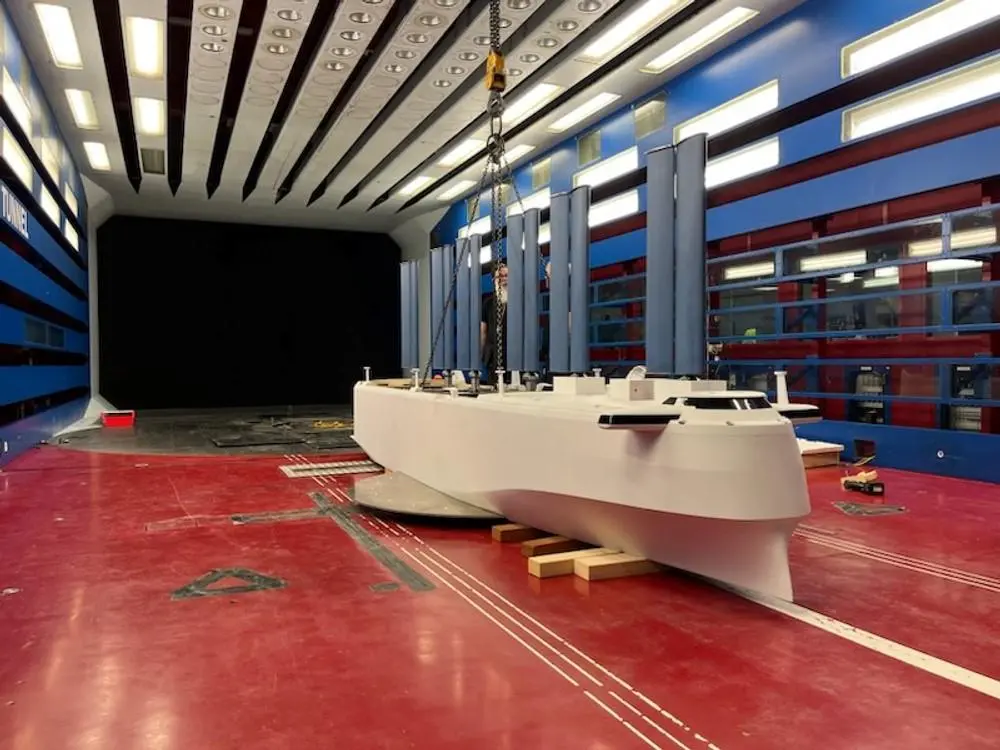
The initiative brings together Wallenius Marine, RISE, KTH, and Oceanbird to validate the latest design for the innovative vessel. This collaboration is not only focused on confirming the vessel’s design but also on contributing to the development of new data simulation models for wind-powered ships, an essential step in advancing sustainable maritime transport.
Key areas being examined include the interaction between the hull and six advanced wing sails, the optimal spacing between the hull and wings for peak performance, and the impact of three different command bridge designs on overall efficiency. Tests also explore operational challenges under “off-design conditions,” such as when a wing sail is misaligned, and provide data for developing advanced wing control systems.
The tests are being led by RISE’s Maritime Department, formerly known as SSPA, which has constructed a detailed 1.2-tonne model using cutting-edge technology. Measuring five by two metres, the model is designed to simulate the complete aerodynamic performance of the ship in the wind tunnel. While previous experiments tested wing sails independently of a hull, this project marks the first time that a combined hull-and-wing design has been tested in a large-scale wind tunnel, making it a unique endeavour.
“We are currently at a crucial stage in the design process, where we need to ensure that our design meets all technical and operational requirements before finalising the tender design,” commented Carl Fagergren, senior project manager at Wallenius Marine.
Representatives from KTH, RISE, and Oceanbird are present at the testing facility, bringing expertise and technical insights to support the project’s development. The results of these tests are expected to play a pivotal role in bringing wind-powered PCTC vessels closer to reality, representing a significant leap forward for sustainable shipping.
Related Articles
 NEWS
NEWS
 ALTERNATIVE FUELS & LUBRICANTS
 ALTERNATIVE FUELS & LUBRICANTS