



Diesel SCR uses heat recovery to boost payback
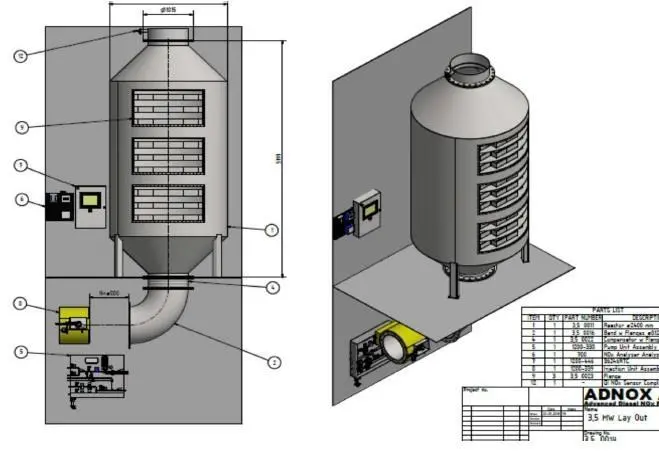
The system, developed by start-up company Adnox (in which Hans Jensen Lubricators recently acquired a majority stake), is claimed to cut NOx emissions by 80%. Using diesel (as opposed to ammonia or urea) leads to cost advantages by eliminating the need for additional reductant and separate storage tanks, which also means lower weight and space requirements.
The oil injected is converted to heat, which the company says results in 50% more heat being available for recovery to produce electricity, for example. The diesel oil is non-corrosive and is not prone to crystallisation, while the evaporation and mixing of the diesel oil with the exhaust only needs a short pipe length upstream of the Adnox reactor. The system is claimed to be IMO Tier III compliant.
The system consumes oil at a rate of around 14l/MWh. The oil injected is cracked on the multi functioning catalyst and produces heat during the NOx reduction process, increasing the exhaust temperature at reactor outlet. An exhaust boiler can be installed after the reactor, generating steam for the production of electricity or water. Electricity corresponding to 7% of the shaft power output can be produced.
The Adnox system weighs approximately 40% less than standard SCR systems. The reactor is installed after the turbocharger turbine on four-stroke engines, while on two-stroke engines it is installed between exhaust receiver and turbocharger turbine inlet. The system has received approval in principle from DNV GL and is said to be suitable for both retrofit and newbuilding applications.
Related Articles
 EMISSIONS REDUCTION TECHNOLOGY
 EMISSIONS REDUCTION TECHNOLOGY
 EMISSIONS REDUCTION TECHNOLOGY