



Underwater wing lifts French OPV fuel efficiency
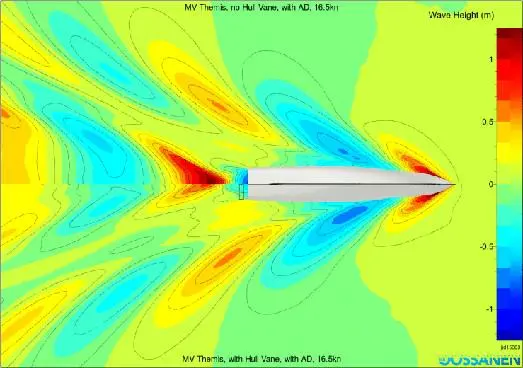
The patented Hull Vane, an underwater wing which reduces the ship’s resistance, was fitted to the French Coastguard’s OPV Thémis at CMN Shipyard in Cherbourg, France, in summer 2018. Sea trials on 13 June 2018 showed a reduction in fuel consumption of 18% at 12 knots, 27% at 15 knots and 22% at 20 knots compared with the OPV’s benchmark sea trials, which were conducted in January in exactly the same conditions. The top speed increased from 19.7 knots to 21 knots.
The device was specifically optimised by Hull Vane BV for the Thémis. Bruno Bouckaert, sales director of Hull Vane BV, said: “The Hull Vane® is basically a patented application of a hydrofoil on ships where you wouldn’t expect one: steel and aluminium vessels which operate in the area between full displacement and planing mode, what we call fast displacement vessels. It works by creating a lift force from the upward flow at the stern. This lift force is angled forward and therefore not only lifts the vessel, but also pushes it forward. The Hull Vane® also reduces the stern wave, which is a form of energy loss, which we try to minimise.”
The Hull Vane for Thémis is the eleventh unit built, but it’s the first one retrofitted on an Offshore Patrol Vessel, a ship type which Hull Vane BV expects to become one of their major markets. About a dozen studies and model tests have indicated similar savings percentages on patrol vessels, ranging from 25 metres to 108 metres. Thémis has a top speed of 21 knots, but most of the time she sails around 12 knots to save fuel. Taking into account the operational profile of the vessel, the annual savings amount to 20% of the fuel consumption, along with similar reductions in emissions of CO2, particulate matter, NOx and SOx.
Related Articles
 EMISSIONS REDUCTION TECHNOLOGY
 EMISSIONS REDUCTION TECHNOLOGY
 EMISSIONS REDUCTION TECHNOLOGY