



Deck kit could soon be getting much smarter
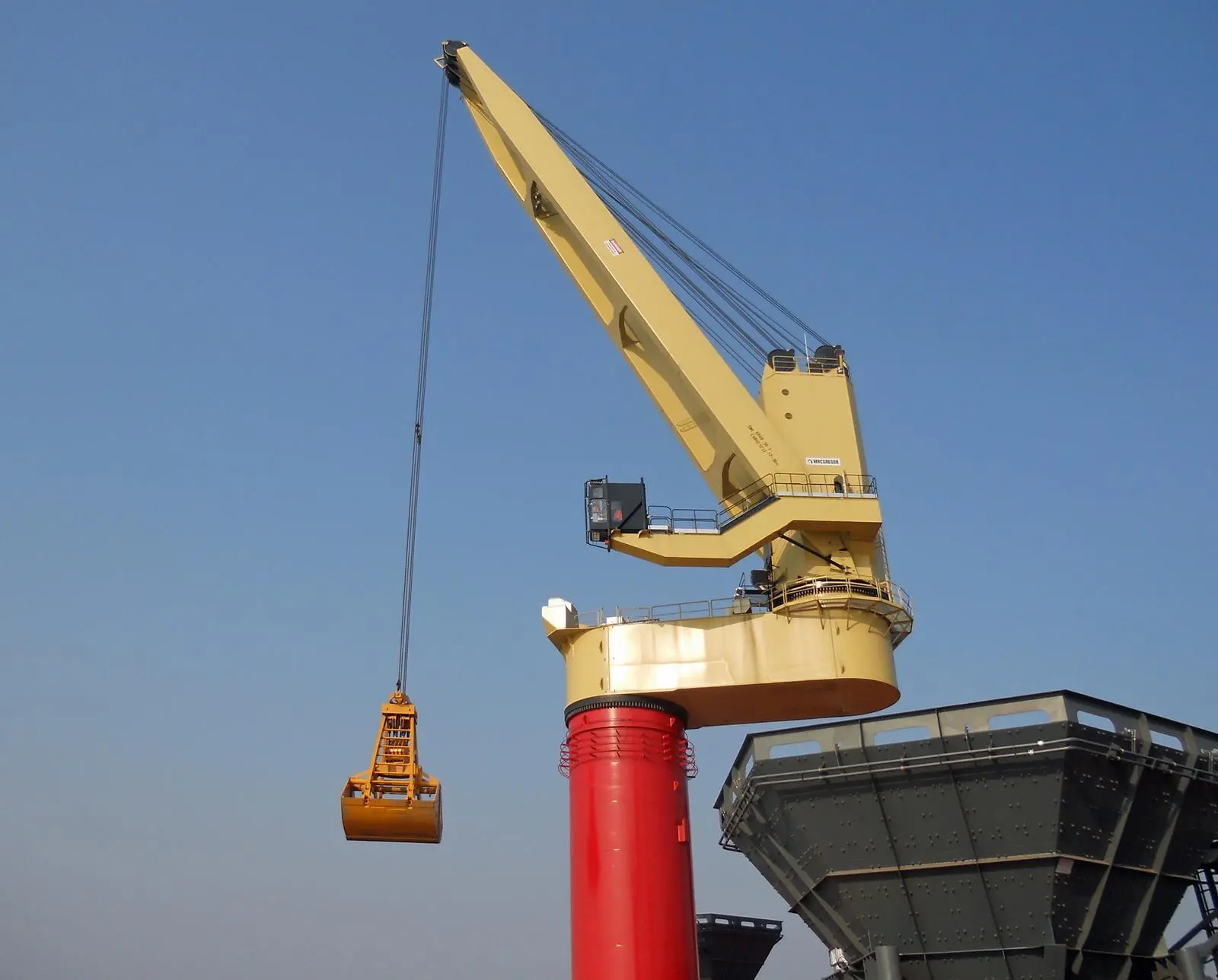
A familiar, well established technology is going to be given the potential for independent, autonomous running onboard ESL’s Haaga and Viikki , a pair of 160m, 25,600dwt bulk carriers. MacGregor’s 30t electro-hydraulic K-series bulk cranes and grabs are being transformed by combining a number of independent control modules, explains R&D director Per Strandberg.
Sensors will map the material distribution in each hold, creating a topographic model that determines both how much is left and the best place to dig in. Alongside this, the Auto-grip software resolves one of bulk’s biggest inefficiencies – an overloaded bite that has to be released and retaken. Instead, machine learning will adjust the grab’s fill to the material, “for example, as the density of the bulk cargo changes as you expose different layers in the hold,” he explains.
Furthermore, each crane pre-calculates the route paths of jib and bucket travel, arriving at the most appropriate hopper or quayside pile via an optimised path. Tabs are kept on the vessel’s list and unloading operations to ensure that stability is maintained but, since there will be some vessel movement, a gyro unit will compensate for the motion, keeping the grab steady.
Speed and movement are monitored to mitigate pendulation, but most importantly, there is built-in prevention of clashes between these 30m outreach cranes. “This is a departure from the normal anti-collision or static object avoidance systems,” explains Strandberg. “Instead, the cranes have to communicate with each other about their intention, so if they’re both going toward the same hopper to drop a load, one will have to wait until the other is clear.”
This is the first time that these intelligent modules have been tied together onboard a cargo ship to allow fully automated crane operation – and it hasn’t exactly been easy.
“The underlying technology itself is probably the smallest of the challenges,” says Strandberg. There are a multitude of elements to consider, including sensor resilience “in the very harsh and dirty environment of a dry bulk terminal” he points out. However, the most important element has concerned safety. MacGregor’s system relies on well-defined, sensor-protected no-go zones, so operations will only start if the area is entirely clear of personnel and cease if someone enters.
But, he points out, this has to apply not just to the vessel’s deck, but also to a variety of dock areas “so although pilot ships are sailing, at the moment these cranes are being manually driven as we are still in the testing phase”.
There are future developments with promise, says Strandberg “We can already operate these cranes from the bridge, so it makes sense to allow them to be controlled from the pier as well,” he explains. Further, he adds: “Since we have the ability to unload directly onto the quay, loading seems to be the next, most obvious step.” However, he remarks this will take development “as recognising a bulk pile on the pier is harder than recognising a hatch”.
But he sees other possibilities on the horizon – given the right economic drivers and a few technology tweaks: “We may see automatic unloading of large containerships to feeder vessels, which would open up smaller, more local harbours. Or it could work the other way round, with loaded barges coming out from a mining area and uploading onto a big capesize ship. That for certain will be a future market.”
Interestingly, many of the different elements that comprise MacGregor’s control systems were initially developed for shore-side applications. So, what’s likely to be pulled onboard next?
There are some clues. iSAM is a process automation provider, and has itself developed autonomous bulk ship unloaders for the ports of Hamburg and Rotterdam.
These sophisticated machines have a number of parameters to calculate: again, they use sensors to map the edges of the hatches and the bulk inside, but there’s an extra layer of difficulty: the grabs need to reach into the furthest reaches of the hold while at the same time, compensating for the differences in motion between quayside and ship movement, explains Bernd Mann of iSAM.
Augmented GPS and a 3D LiDAR unit linked with a PC updates the position ten times a second to give the equipment the necessary real-time response.
So, could it benefit ships with a different type of cargo – one that can’t be dropped?
Potentially, says Mann. The capability could be turned on its head to provide the basis for very flexible onboard unloading systems: “From a technical point of view, it doesn’t matter whether the crane is mounted on the quay or ship, it’s still all about the relative movement.”
While he underlines that at the moment the costs of the LiDAR sensors are prohibitive for general uptake, he predicts the price will eventually come down – and capability will skyrocket.
“The big game changer will be mass-produced solid-state LiDAR. This will give you high resolution imaging with update frequencies above 20Hz. While at the moment we can get that kind of capability for around US$150,000, I think this development will see the sensor price brought down by a factor of ten or more – and maybe we will see unit costs of a few thousand dollars,” says Mann. He adds: “Everyone is trying to get into the lead: I think it’s not an overstatement to say the first to arrive will be heading up a billion dollar corporation.”
This in turn will open other doors.
For example, breakbulk is the stuff of construction projects, but developing locations are often still in the initial stages of building up transport capacity. As ‘last mile’ costs usually dwarf those of other cargo types, it makes sense to charter vessels that can get as close to the site as possible. While out-of-gauge parcels will need specialist handling, this is usually outweighed by more repetitive breakbulk – pipe and wire bobbins, crated steel and a smattering of containers. There are also the renewable energy projects: wind, for example, is engaged in minimising costs by smoothing out the supply chain.
The joy of this type of cargo is that it could present a recognisable outline to onboard lifting systems, enabling parcels to be deposited gently on the quay.
Although Mann doesn’t envisage even very smart onboard cranes being able to deal with ‘one off’ shapes in the foreseeable future, those with a regular set of characteristics could benefit from semi-automated handling “perhaps with one operator in charge of three or four cranes at a time”, he concludes.
So, while not exactly autonomous, these systems could still be pretty intelligent.
All this is within reach, it seems. But how much of it will be realised – and if so, how soon? That’s still not clear, though some point to the strides already made by robotised cranes in the production industries, the shipping market is still dominated by ambition-crushing concerns about its overheads. And these are often heavier than the physical loads on the hook.
Related Articles
 OTHER EQUIPMENT
 LNG
LNG
 GENERAL NEWS