



TANKER SERIES DENOTES BOLD RUSSIAN OUTLOOK
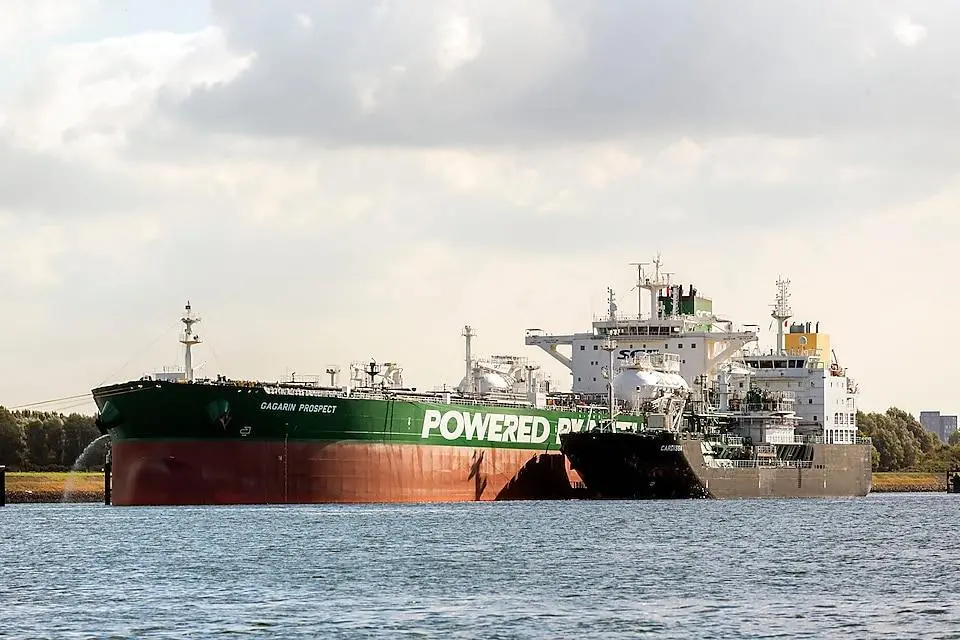
Russian shipowner SCF Sovcomflot put down a new marker for tanker shipping when it specified an LNG dual-fuel solution to power a series of ice-strengthened Aframax crude carriers contracted from Hyundai Heavy Industries(HHI) in South Korea.
The sextet of newbuilds, delivered between July 2018 and April 2019, has strengthened the company’s hand in oil transportation as a whole, given the trading versatility of Aframax-size tonnage, while specifically boosting the capability for all-year liftings of crude oil from Russian Arctic and eastern Baltic outlets.
The new generation of 113,170dwt tankers, constructed by HHI subsidiary Hyundai Samho Heavy Industries at Mokpo, is distinguished by a high environmental standard attributable in no small part to Sovcomflot’s decision to adopt LNG as the primary fuel, a pioneering step in application to large tankers. At the time of ordering, the LNG fuelling infrastructure was still in its infancy. The scope to use cleaner-burning fuel was a vital consideration given the ships’ intended operating profile encompassing Baltic and North Sea Emission Control Areas (ECAs).
Series-opener Gagarin Prospect and sixth-of-class Samuel Prospect have been fixed on long-term charter to Shell, for up to 10 years, affording ‘blue-chip’ international endorsement of the design’s attributes. In fact, the new class had its genesis in the technical design work implemented by Sovcomflot in collaboration with Shell, HHI and DNV GL during 2015. The resources offered by the Russian company’s dedicated engineering school were brought to bear on the project.
Sovcomflot is already set to augment the new Liberian-registered flotilla, dubbed its ‘Green Funnel’ tankers. The next additions will be two further vessels of the type ordered for completion in 2022 by Zvezda Shipbuilding Complex, the new development in the Russian Far East at Bolshoi Kamen.
The environmental credentials of the class can be expected to increasingly favour the Green Funnel fleet as time goes on, given growing tonnage selectivity by shippers and charterers, against the backcloth of the march of emissions legislation and wider societal concerns over the impact of tanker shipping in ice-prone waters.
The dual-fuel two-stroke main engine specified for each ship ensures compliance with IMO’s stringent sulphur controls and Tier III NOx emission limits when running in gas mode, and the adoption of selective catalytic reduction (SCR) plant also achieves Tier III compatibility when burning heavy fuel oil(HFO).
Data accumulated over the first 12 months from the ships in service, using LNG as the primary fuel, showed a 30% reduction in CO2 emissions relative to similar vessels powered by HFO, a finding that exceeded the original design target values. Running on LNG, the machinery produces at least 90% less SOx and some 80% less NOx compared to engines fired on standard marine fuels.
Propulsive power is delivered by a low-speed, dual-fuel engine from the X-DF range of Winterthur Gas & Diesel (WinGD), featuring low-pressure gas admission. The seven-cylinder X62DF engine is rated for 13,800kW at 86rpm, and was manufactured under licence by HHI’s Engine & Machinery Division (EMD) in Ulsan. The 620mm-bore unit confers the flexibility to burn LNG, HFO, distillate or hybrid liquid fuels, with Tier III compatibility attainable across the fuel spectrum, and assures direct drive to a single, four-bladed fixed-pitch propeller.
The low-pressure SCR technology also emanates from WinGD, as does the proprietary Engine Diagnostic System. The latter targets increased availability via monitoring, lower fuel costs via engine performance optimisation, and extended times between overhaul (TBO) for components.
X-DF engines employ a lean air-gas mixture ignited by injection of a small amount of liquid fuel, to achieve the requisite fuel efficiency, stable combustion and inherently low NOx formation in gas mode, securing Tier III compliance in ECAs without extra onboard measures. In contrast to engines with high-pressure gas injection, the gas fuelling system on X-DF two-strokes does not require high-pressure electrically-driven cryogenic pumps, thereby reducing costs.
The auxiliary outfit is based on three gensets driven by eight-cylinder, Wartsila 200mm-bore engines prepared for dual-fuel operation. Oil- or gas-firing is also incorporated in the boiler plant supplied by Kangrim Heavy Industries of South Korea.
The lessened emissions impact from burning LNG, or by applying SCR to the exhaust stream when fuelled by HFO, has the added operational, pecuniary benefit of allowing the tankers to qualify for discounts on port charges in major European harbours. The average discount obtainable is understood to amount to about 9%.
The initial LNG bunkering took place at Rotterdam in October 2018, when Gagarin Prospect was fuelled by Shell’s bunker tanker Cardissa. The operation constituted a procedural and technological milestone, laying the foundation of a system for LNG bunkering of tankers and other large merchant vessels not tied to fixed routes or set timetables.
The hull is divided by eight transverse bulkheads and a centreline bulkhead into 14 cargo tanks, giving 129,400m3 of oil cargo containment. The Ice-1B class notation and Ice-1A certificated hull meet the requisite criteria for seasonal voyaging of Russia’s Arctic seaway, the Northern Sea Route (NSR), and for conveying exports from terminals in the Gulf of Finland and the Russian Far East, as well as for trade in other areas subject to harsh winter conditions.
The ships are equipped with ice radars and spotlights and other features ensuring compliance with the Polar Code. The class showed its mettle early on, when the Lomonosov Prospect completed a full transit of the NSR in October 2018, delivering a cargo of petroleum products from South Korea to northern Europe.
During 2019, another representative of the class made a westbound passage, while the Korolev Prospect crossed the NSR eastbound in September, followed in October by eastbound voyages of the Mendeleev Prospect and Lomonosov Prospect. Both the latter vessels carried cargoes of crude from the Russian Baltic port of Primorsk to China. With favourable ice conditions and precise route planning, the ships travelled the entire NSR seaway without icebreaker escort and using LNG fuel.
Sovcomflot’s Green Funnel initiative, to introduce LNG as the main fuel for large oil tankers, led to a succession of international environmental and design concept awards through 2018 and 2019.
While commercial management is undertaken by Sovcomflot’s UK arm in London, technical husbandry of the series is conducted from the Dubai headquarters of SCF Management Services, which has branch offices in Limassol, Novorossiysk, St Petersburg, and Yuzhno-Sakhalinsk.
Rather than source its further Aframax tonnage requirements overseas, Sovcomflot has looked to the Russian shipbuilding industry for more vessels of similar design to the Gagarin Prospect type. Two 114,000dwt dual-fuel newbuilds scheduled to join the fleet by the end of 2022 have been entrusted to Zvezda Shipbuilding Complex, a major development project taking shape under the auspices of the Far Eastern Shipbuilding & Ship Repair Centre (FESRC) of Vladivostock.
Zvezda started production in 2016 and the shipyard is due to be fully completed in 2024. Established by an all-Russian consortium comprised of Rosneft Oil Company, Rosneftegaz, and Gazprombank, its initial tranche of work has emanated from Rosnefteflot. The 10 Aframax crude carriers of 114,000dwt ordered to Rosnefteflot’s account, plus two such vessels for Sovcomflot, mean that Zvezda can look to a long serial production run of deepsea vessels unequalled in recent times in Russia. The Sovcomflot pair is being built with financing from Vneshekonombank (VEB) and against the security of 20-year timecharters to Rosneft.
Hyundai Heavy Industries is providing Zvezda with design input and technical assistance for the Aframax programme. Sovcomflot’s involvement also encompasses newbuild supervision and subsequent technical shipmanagement services for three of the Rosnefteflot vessels.
PRINCIPAL PARTICULARS – Gagarin Prospect class
|
Length overall |
249.99m |
|
Length bp |
241.10m |
|
Breadth |
44.00m |
|
Depth |
21.10m |
|
Draught |
15.02m |
|
Cargo tanks |
14 |
|
Cargo capacity |
129,405m3 |
|
Deadweight |
113,170t |
|
Gross tonnage |
64,909t |
|
Displacement |
136,724t |
|
Propulsion system |
Dual-fuel 2-stroke direct-drive |
|
Main engine power |
13,800kW |
|
Genset engines |
3 x 1,340kW |
|
Speed |
14.6kts |
|
Class |
DNV GL/RS |
|
Class notations |
+1A1 Tanker for Oil, BIS, BMON, BWM(T), CCO, Clean(Design, Tier III), COAT-PSPC(B, C), COMF(C-2), CSR, E0, ECA(SOx-A), ESP, Gas-fuelled, Ice(1B), LCS, NAUT(AW), Recyclable, SPM, TMON(oil lubricated), VCS(2) |
|
RS Class notations |
KM(*), 1B, 1A(hull), AUT1-ICS, OMBO, L1, VCS, CCO, ECO-S, BWM(T), SPM, GFS, TMS, IWS, DE-Tier III, Oil tanker(ESP), CSR |
|
Flag |
Liberia |
SOVCOMFLOT AFRAMAX series
|
Name |
Delivery |
|
Gagarin Prospect |
Jul 2018 |
|
Lomonosov Prospect |
Oct 2018 |
|
Mendeleev Prospect |
Nov 2018 |
|
Korolev Prospect |
Feb 2019 |
|
Vernadsky Prospect |
Mar 2019 |
|
Samuel Prospect |
Apr 2019 |
|
Zvezda Yard No.131110 |
Jun 2022 |
|
Zvezda Yard No.131120 |
Sep 2022 |
Related Articles
 METHANOL
 GENERAL NEWS
 HYDROGEN