



EMSA study highlights fuel cell technology
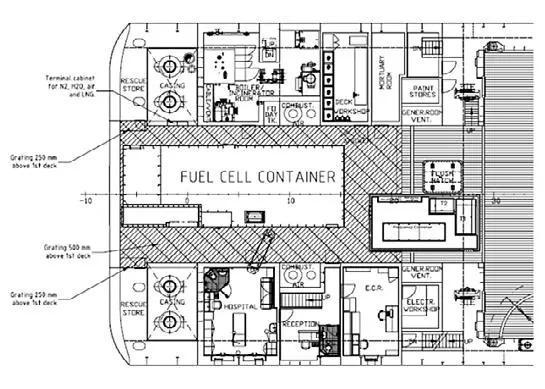
The report, prepared by DNV GL, reviews maritime fuel cell projects – 23 in total over the past 16 years (see table) – to identify the three technologies with the greatest potential for use on ships. Gaps in the regulatory framework for fuel cells were also identified, and a theoretical safety assessment of the three leading fuel cell technologies has been conducted for ro-pax and LNG carriers.
The technology with the most potential for marine applications is the proton exchange membrane (PEM) fuel cell, which requires pure hydrogen to generate electricity and has a low-operating temperature. High-temperature PEM is less advanced, but greater tolerance to impurities enables the use of other fuels while water handling is simplified. Solid oxide fuel cells offer similar fuel flexibility and operate at even higher temperatures, meaning that in combination with waste heat recovery even greater efficiency can be achieved.
The report notes: “Smaller and medium applications may favour low and medium temperature technology, such as PEM and high temperature PEM. Larger applications which can more easily accommodate waste heat solutions, such as industrial and large maritime, are better for the high temperature solutions such as molten carbonate or solid oxide fuel cells.”
There are big regulatory gaps that need to be filled before fuel cells can take a wider role in shipping, the study notes. The IMO’s IGF Code does not yet cover fuel cells or many fuels (including hydrogen) that could be used to fuel them. A new part E of the code will include fuel cell requirements and is under development as part of the second phase of the IGF Code. Meanwhile fuel cell applications must follow the alternative design stipulations in SOLAS II-1/55, requiring demonstration of an ‘equivalent level of safety’. The IGF Code does not cover the shore-side aspect of bunkering, and the study noted that standards would need to be developed for the relevant fuels in this area too.
The safety assessment concluded that tolerable risk levels could be reached regarding operational and human safety if further mitigation actions (recommended for 100 out of 148 failure scenarios) were taken. The most critical events identified include a strong exothermic reaction in the reformer material, the leakage of hydrogen rich gasses and a collision penetrating the fuel cell. Further study was recommended in two areas: the influence of fuel behaviour on the definition of hazardous zones and safety distances; and the storage of hydrogen with respect to collision and potential storage under accommodation blocks.
The full report can be downloaded here.
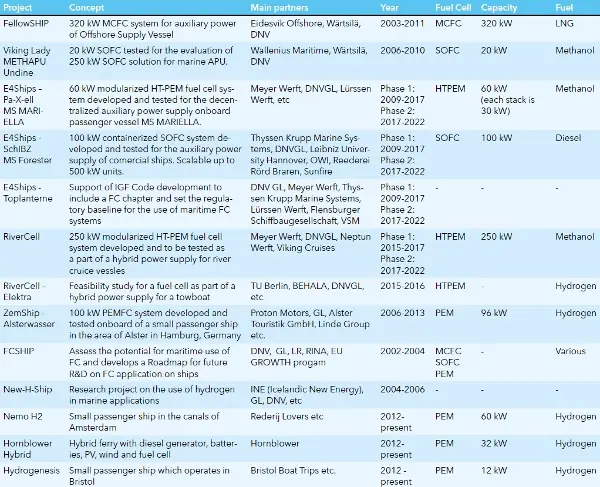
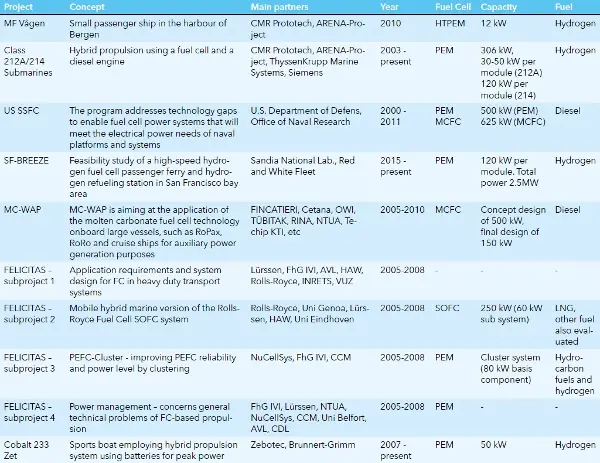
Marine fuel cell projects (source: EMSA, DNV GL)
Book your place at the 2017 Gas Fuelled Ships Conference to learn the latest technologies for alternative fuels.
For further information, please call the Events team on +44 1329 825335 or email gasfuelledships@motorship.com
Follow the event on twitter @GFShip.
Related Articles
 ALTERNATIVE FUELS & LUBRICANTS
 GENERAL NEWS
 GENERAL NEWS