



Motorship PFF Live panel reiterates need for unified approach to decarbonisation
Industry heavyweights
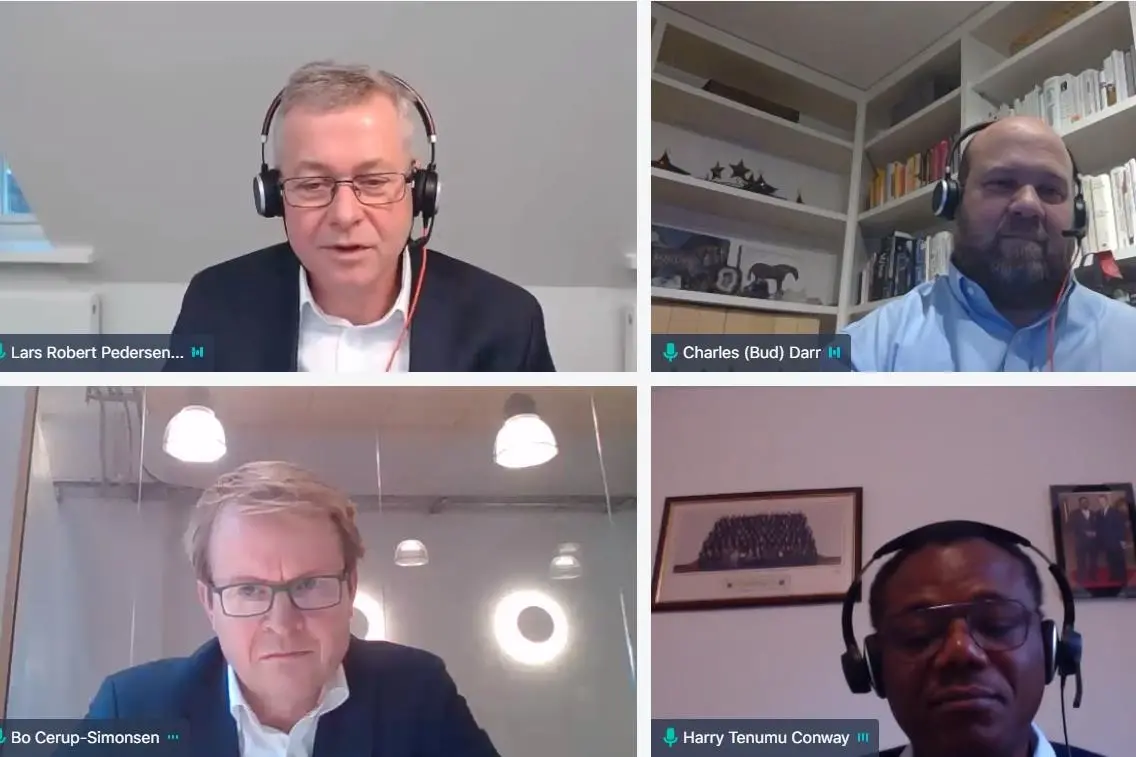
The high-level panel, which was chaired by Lars Robert Pedersen, deputy secretary-general of BIMCO, brought together senior industry representatives, including Bud Darr, executive vice president, Maritime Policy and Government Affairs, MSC Group; Bo Cerup-Simonsen, ceo, Mærsk Mc-Kinney Møller Center for Zero Carbon Shipping; and Harry Tenumu Conway, vice chair of the Marine Environment Protection Committee (MEPC), IMO.
Complementary approaches
The panel, which was originally convened to discuss the implications of the EU’s proposed extension of the Emissions Trading System (ETS) to cover shipping, was ideally placed to consider the role of the IMO, coming shortly after the conclusion of the 75th session of the IMO MEPC (MEPC 75) on 20 November 2020.
Mr. Conway was forthright about the risks that the unilateral imposition of market-based measures might have on other IMO members, and noted that the MARPOL Annex VI changes agreed at MEPC 75, including short-term operational and technical measures, represented a step in the right direction.
Mr. Cerup-Simonsen agreed, emphasising that while regulation at both a regional and national level had an important role to play in driving the transition, “we will need global regulation to drive this transition.” Creating greater clarity about the regulatory environment would also help to reduce ‘de-risk’ political uncertainties for shipowners, he added. The upcoming discussion of mid to long term measures at the IMO in 2021 represented an opportunity to build confidence in the IMO system.
Mr. Darr added that attention on the issue within and outside the industry had intensified greatly in the past 12-18 months.
EU proposals
While the final scope of the EU’s ETS proposals for maritime emissions remained unclear, some of the panel raised technical concerns. Bud Darr identified a number of potential ‘hot button’ issues with the proposal approved by the European Parliament, including the potential use of data reported via the MRV mechanism for the ETS, as well as the absence of clarity about the final destination of funds raised via the scheme.
Mr Darr noted that regional approaches, such the potential application of the ETS to extra-EU voyages as well as intra-EU voyages, was likely to create political frictions with trade partners such as China and Brazil, among others.
The EU Parliament scheme also proposed extending responsibility for emissions under the MRV scheme to time charterers, Mr. Darr noted, which will add a different level of complexity if applied to the ETS scheme as well.
Technical issues
Mr. Cerup-Simonsen and Mr. Darr noted that there were broader technological issues to consider as part of any discussion about decarbonisation.
Mr. Darr offered a frank perspective on different technological solutions, emphasising the different technological requirements of MSC’s diversified range of vessels.
Mr. Darr stressed flexibility was a key consideration for retrofit and newbuilding projects, because “ships built purely with business as usual in mind are unlikely to, at a minimum, have the same economic projections at the end of its lifespan as they do today”. The operational lifespan of vessels might also be affected, he suggested.
He expanded in the point discussing the medium-term outlook for MSC’s multi-billion dollar LNG-fuelled fleet of cruise vessels. The vessels’ 15% net reduction in GHG emissions was very welcome but would not be sufficient to meet longer-term targets, such as the 50% absolute reduction in GHG emissions required by 2050. However, Mr. Darr noted that dropping in LBG or synthetic LNG to LNG supplies could reduce emissions significantly. “We don’t have all the technical solutions available yet,” he said.
However, he cautioned against selecting any one future fuel as the chosen path, noting that any alternative to LNG would be unlikely to reach commercial scale before the 2030s, drawing on the 40-year lead time required by LNG.
Beyond fuels, Mr. Darr noted that MSC was looking at technological solutions to reduce emissions from its fleet, include large scale battery technology. “Large scale battery technology is one of the areas we are exploring,” he said, noting that shipowners were not technology developers.
Bo Cerup-Simonsen noted that the Mærsk Mc-Kinney Møller Center for Zero Carbon Shipping was looking at a range of issues surrounding the decarbonisation of shipping ranging from the financial to infrastructure constraints, as well as technology development. The increasing need to certify emissions from new fuel types, such as e-fuels or biofuels, would create new supply chain risks for shipping that would need to be mitigated in future. “We’re not used in shipping to having to look at the entire supply chain on the energy supply,” Mr. Cerup-Simonsen concluded.
Related Articles
 ALTERNATIVE FUELS & LUBRICANTS
 GENERAL NEWS
 GENERAL NEWS