



Floating turbines are essential for windpower targets
He made his remark in an article on the class society’s website about a UK target of 40GW of offshore wind by 2030, which he described as “not realistic” under current UK policies and argued that it could only be met if it was supported by floating wind turbines, enabling development of deeper waters to the west of the country. The title of his article underlines his point: it is called ‘Floating offshore wind – a national prize or a lost opportunity?’
Another class society, DNV GL, recently made a similar point about the global situation. During a webinar in early December, DNV GL’s floating wind advisor Magnus Ebbesen presented a slide stating that “floating wind works as a boost for offshore wind” and predicted that, by 2050, floating offshore wind projects will account for 255GW of installed capacity worldwide, “more than 20% of the offshore wind market.”
Just a week later, the global nature of floating wind projects was reinforced by an announcement by Korea Hydro & Nuclear Power (KHNP) that it had agreed a memorandum of understanding that it said will lead to the world’s largest floating offshore wind power generation complex.
The MoU was signed on 15 December with OW Offshore of Spain and Kumyang, a Korean renewable energy company, for a scheme involving three 500MW wind farms located 72km off south east South Korea.
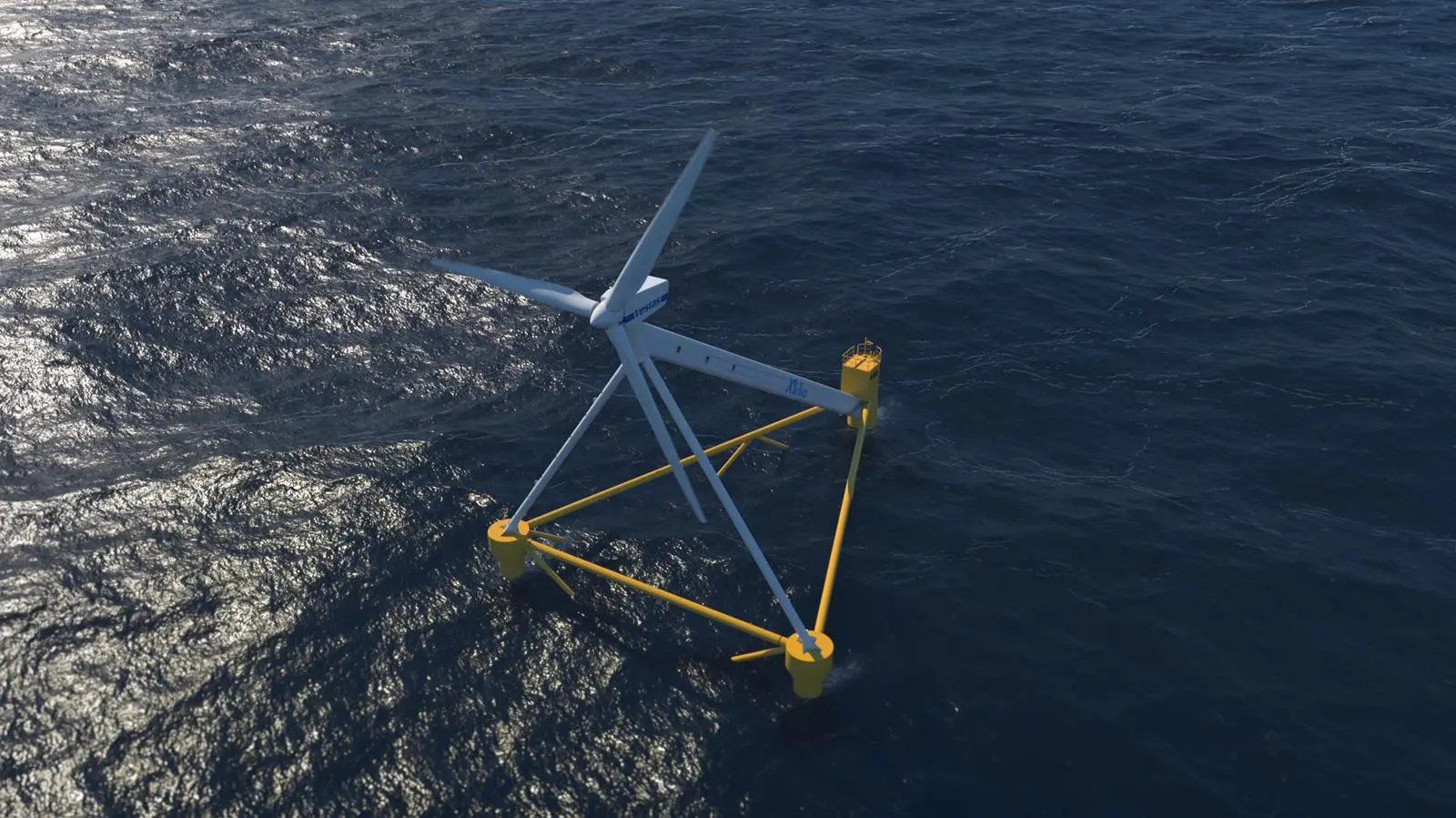
Mr Spring drew The Motorship’s attention to another floating wind energy project, X1 Wind, which is being developed in Spain. A scale model is under construction for testing off Gran Canaria using a Vestas V29 225kW turbine that has been modified so that it operates facing away from the direction of the wind.
Although this unusual arrangement is generally avoided because of the ‘tower shadow effect’ on the wind flow, it is being trialled as a solution to the challenge faced by large turbines that their long blades risk hitting the tower as the bend in the wind. Strategies to avoid this lead to inefficiencies, the X1 Wind project’s website notes.
Testing will also validate the projects’ PivotBuoy single-point mooring system, which is expected to provide “cost-effective and reliable floating wind mooring, connection, installation and operation” for the turbine.
Another important objective for the project is that construction and commissioning will be possible without needing a heavy-lift crane barge, with all subsequent maintenance carried out at sea level.
Related Articles
 ALTERNATIVE FUELS & LUBRICANTS
 GENERAL NEWS
 GENERAL NEWS