



GE SIMPLIFIES KEY COMPONENTS TO BOOST POD EFFICIENCY AND AVAILABILITY
In the SeaJet system, the electric motor is housed in the hull mounted pod and directly connected to the propellor, freeing up cargo and operational space in the ship. Manoeuvrability and efficiency are greatly improved, says GE, and total fuel consumption and exhaust emissions are reduced.
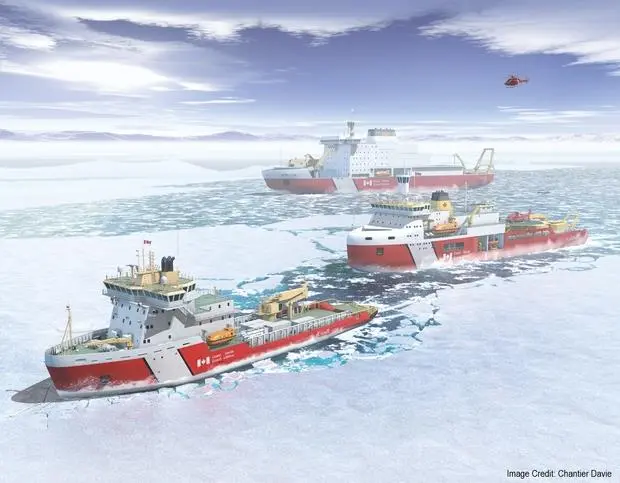
The pods have already demonstrated their robustness across a wide range of naval, merchant and offshore applications, and the newly updated technology is gaining traction with owners building Arctic tonnage. In February 2021, GE was added as a Strategic Partner to Chantier Davie’s Polar Icebreaker program. Chantier Davie, GE, Vard and Serco formed a centre of excellence for polar technologies and Arctic expertise in Quebec’s maritime cluster where they will focus on the replacement of Canada’s ageing icebreaker fleet. GE has already delivered its Integrated Full Electrical Power and Propulsion System for a series of the Royal Canadian Navy’s Arctic and Offshore Patrol Ships, with the last two ships in the eight-ship series scheduled for delivery to the Canadian Coast Guard. The Canadian Coast Guard are considering pods for their future polar class icebreakers.
The pods have already been chosen for a series of LNG carriers being built for Rosneft’s Arctic LNG program. Sapphire Pod Manufacturing Plant, a joint venture between GE and Rosneft Oil Company, will supply the electric power and propulsion systems for five new ice class LNG carriers. Each will be equipped with GE’s power and propulsion system including three 15MW Arc 7 SeaJet ice class podded propulsion systems, generators, HV switchboards (main and cargo), propulsion transformers and six MV7 propulsion convertors. The technology package provides the ice-breaking and ice-manoeuvring capabilities needed to traverse the increasingly active Northern Sea Route between Europe and Asia, which is bound by ice for most of the year.
SeaJet has also been chosen for a series of 100-metre ice breaker supply vessels under construction in Russia for Rosneft.
Expanding market
The ice-class range of the SeaJet system is a joint technology development with AETC Sapphire. Systems are available for ice going vessels up to icebreaker 7 ice notation with a power range from 7.5MW to 15MW. They have been designed using a pyramidal strength philosophy to withstand extreme loads on the propeller blades, steering system and propulsion module.
The pods are designed to meet International Electrotechnical Commission standards, and with newly-introduced technological improvements, they bring a strong competitive edge to the shipping market, says Jean-Philippe Chaignot, Executive Business Leader, Marine Business at GE Power Conversion. They are particularly well suited for the growing investment that is being made in new tonnage designed for polar exploration and the Arctic shipping route and will play a major role in this growing industry, he says. GE has also identified opportunities to extend the technology to other applications, such as passenger vessels.
Modular design
GE’s MV7000 medium voltage drives are used to drive the pods. The pods themselves are designed to be modular and include an inboard and auxiliary equipment module, a steering module and a propulsion module. This modular approach provides for standardisation of inboard components across the GE product range and improved ability to adapt the pods to the specific hull of each individual project, says Chaignot.
The pod is installed under the hull, and the number of internal webs and stringers has been reduced so that it can be accessed from inside the ship to allow for inspection and all regular maintenance without the need to schedule dry dock availability. The safe handling of braking, locking and turning can be achieved without the need for manual access into the pod. Additionally, a pressurised air system prevents any air-contamination or condensation in the pod.
An anti-pollution seal system ensures environmentally safe operation and long service life. It uses advanced bearing technology with self-contained lubrication and direct thermal exchange with sea water. “The advantage of the advanced bearing system is its capability to operate reliably without continuous operation of an external lubrication circuit,” affirms Chaignot.
The pod’s electrical steering system provides high thrust and steering dynamics at 360° which results in high manoeuvrability and station keeping performance for both dynamically positioned (DP) and non-DP vessels. The special design of the steering module has simplified the pod hull’s interface with the ship.
Induction motor simplification
The auxiliaries are compact to facilitate integration in the pod room, using a smaller induction motor with a pressurised bilateral cooling system which provides homogenous cooling of the active parts to limit any differential thermal effects.
The SeaJet pod induction motors are designed with significantly larger air gaps than those used in other marine synchronous motors. This together with a very stiff solid forged shaft and reduced distance between bearings which GE says cuts rotor deflection in half compared to equivalent synchronous motors. Halving the rotor deflection eliminates any possible collision of the rotor with the stator even under the worst shock conditions that can be encountered, such as on an ice class vessel. The larger air gap also contributes to the ability of the motors to achieve very low structure borne noise levels through the reduction of slot harmonics.
The ability of the MV7000 PWM drive to operate at very low frequency allows the motor pole number to be optimized so a low resistance squirrel cage design can be used for the induction motor. The induction motor is a simple cylindrical squirrel cage with no active insulated parts such as windings, exciter, rotating diodes or permanent magnets. The design reduces unsymmetrical magnetic attraction and reduces shaft deflection making air gap integrity safer than synchronous technology. The simplicity of the system increases the reliability and the availability of the motor and also increases efficiency and power usage.
“SeaJet pods equipped with GE’s advanced induction motors draw on proven propulsion technologies and empower shipowners to improve the performance of their vessels and to also reduce emissions to enable more sustainable operations,” said Chaignot.
“Noise and vibration are reduced by the optimization of the rotor and stator core, the number of slots and the slots interaction between stator and rotor,” he continues. “The structure borne noise of a propulsion motor will be directly influenced by the stator voltage which will generate radial forces in the air gap being an excitation source of stator resonant modes. The noise and vibration behaviour of our induction propulsion motors is excellent and has been proven on many naval and scientific vessels.”
Drive technology
MV7000 systems are available for a power range of 2.5MW to 22MW. The Pulse Width Modulated (PWM) drive technology delivers efficient and flexible control of electric power across all speed ranges, and the active front end enables regeneration of the energy to the network. The overall system provides a power efficiency of up to 99% and a power density of up to 1.1 MVA/m3.
With press-pack IEGT technology, fuseless protection and low component count, the MV7000 series offers longer life expectancy even under load cycling, says GE. Built-in redundancy is achieved through secured continuous conduction of the point-to-point interface (PPI) in failure mode. The drives are case rupture free and arc ignition free due to the pressed contacts and no wire bonding.
“The main benefit of using MV7000 converters is the low level of current harmonics, resulting in the following advantages: reduced motor losses, a filter-less solution (for harmonics) and a network power factor optimization over the whole speed range,” says Chaignot. “There is no excitation system required, which will save on installation footprint and power consumption. This improves global system efficiency.”
SeaJet pods are also compatible with transformerless solutions, hybrid variable AC networks and energy storage DC/DC converters. For multiple drive applications, a common DC link fed by a single active front end can reduce overall equipment cost and footprint.
Benefits for owners and yards
Robust product testing is the foundation that ensures high quality and reliable equipment, says Chaignot. GE’s test bench and test system allow for real-time technology validation. The pods can be tested under simulated load, torque and dynamic response conditions. “Our testing capabilities push equipment boundaries to help achieve the highest standards of reliability.”
He says the benefits of SeaJet for owners and operators include increased propulsion system efficiency, reduced total installed power generation, reduced total fuel consumption and exhaust emissions, reduced noise and vibration levels and improved manoeuvrability. For shipyards, the benefits include flexibility in the machinery arrangement, a simplified machinery installation with fewer components, a simplified hull form and reduced installation time and cost.
Related Articles
 ELECTRIFICATION AND BATTERY HYBRIDS
 BATTERIES, SUPERCAPACITORS, FUEL CELLS AND OTHER ENERGY STORAGE TECHNOLOGY
 ELECTRIFICATION AND BATTERY HYBRIDS