



OPTIONS FOR SHORE POWER CONNECTION GROW AS PORTS SET AMBITIOUS GHG TARGETS
Denmark’s Port Esbjerg runs its shore power on renewable electricity from offshore wind turbines, and the port has most recently set up a mobile system to increase the flexibility of its offerings. The port aims to reduce its carbon emissions by 70% by 2030 and is using Honeywell’s Enacto Carbon and Energy Management system to help achieve its goals. The cloud-based system enables the port to monitor the emissions and resource consumption of every one of its 1,200 power socket and every visiting vessel. The engine size, type of generator and power consumption are recorded for each ship, and energy consumption and carbon emissions determined.
There are existing standards to ensure compatibility between port infrastructure and shipboard solutions for accessing power during port stays. First introduced in 2012, the IEC/ISO/IEEE 80005 shoreside connection standard is designed to ensure that vessels from all over the world can be supplied at berth regardless of equipment manufacturer.
To date, 1,000 ships have been registered in Esbjerg’s monitoring system, and the port says calculations show that in an increasing number of cases, shore-to-ship power can be competitively priced compared to the costs of using the ship’s own generators.
The critical moments
Esbjerg is one of a growing number of ports with major shore power infrastructure in place. Siemens is currently building a large shore power system at the Port of Kiel in Germany. With a power of 16 megavolt amperes (MVA), the Siharbor solution will, for the first time, supply two ships simultaneously with certified eco-power.
The Siemens solution handles the large amounts of electricity involved in a single compressed system rather than using multiple parallel switching of smaller devices. It consists of four cast resin transformers, four air-insulated medium-voltage switchgear units and one 16 MVA MMC frequency converter.
According to Siemens, the most critical moment is when the ship’s system switches over to shore power. To avoid having to power the onboard network back up in stages after an initial blackout, the shoreside connection and onboard generator have to supply the ship’s electrical system in parallel for a certain period of time, and the control parameters of both power sources must be coordinated with a high degree of accuracy.
Another critical factor is correctly dimensioning the power of the frequency converter to prevent a blackout due to overload. Typically, frequency converters are only able to withstand overload for a few seconds. The dimensioning of the frequency converter has to take brief load peaks into account, such as when compressors start up or non-premagnetized onboard transformers switch on.
In the stationary state, however, the load is many times smaller than the dynamic peak load. Often, the frequency converter needs to deliver less than 50 percent of its rated power and is operating at partial load for most of the time. To keep losses and operating costs down, a converter’s efficiency at partial loads is as important as it is at rated power. Because of its special converter topology, Siemens says its solution supports especially high partial load efficiency, keeping losses at a minimum.
The solution supplies the highest possible voltage on the converter side, resulting in lower current levels and thus minimizing losses. The output voltage level of the frequency converter also affects the selective fault-finding on board. For transformers compliant with IEC/ISO/IEEE 80005-1, the higher the converter connection voltage, the more current can be provided to the ship for selective fault tripping on board. Without selective fault-finding, the entire ship could experience a blackout.
Business model exported
The Port of Bergen, together with Plug Bergen, a 50/50 partnership with Plug Holding, a company owned by regional energy provider BKK, has recently completed five high voltage shore power connections: two at the Skolten pier, one at the Bontelabo pier and two at the Jekteviken pier, with a total capacity of 48 MVA.
The first low voltage connection point for offshore supply ships was installed in 2015, and there are now 16 in operation at Bergen. The port’s success with the technology has enabled Plug Holding to take its business model to other ports in Norway. The company is now building shore power for cruise ships in Alesund (three connection points) and Nordfjordeid (one connection point). Maria Bos, CEO of Plug Holdings, says: “Our ambition is to expand this further. We are very interested in also exporting this business model to ports abroad, for example to other European ports.”
She says that for every project the company needs to look at the location, the overall power need, the grid constraints, the available space and how the quay is built. “There will always be constraints, whether in the grid or in the converter capacity we invest in, and together with the ports we try to optimize which investments are needed from the start and what we should do if or when we need to expand the facility. I would say that the most important factors in a successful shore power project are early dialogue with the utility, thorough mapping of the potential customer need in cooperation with the port, and controlling cost through good processes with the solution providers.”
Bos says that technological development continues to provide better solutions or lower costs. “We are looking forward to seeing better and cheaper cable management systems for vessels ranging from small cargo and container ships to the larger cruise ships. Among the most demanding tasks are floating, movable shore power connections for cruise ships that are not berthed quayside.”
If shore power is to make a real contribution to a better port environment, she says, the goal has to be an attractive offer for the shipowners. “That is not easy. Diesel is cheap. But we see more and more ports and shipowners who are really taking up the challenge and are willing to work together. The key is volume and making the smart, cost effective choices on the way.” She notes the importance of clusters such as the Maritime CleanTech’s Shore Power Expert Group. This brings together technology suppliers, ports, shipowners and shore power providers like Plug.
Business hotting up for system integrators
A few years ago, Yara Marine Technologies found the shore power market was too slow. Now, however, with new regulations and grants supporting shipowners’ shore power investments, the company is back in the business, and together with NG3, it is ready to take on new orders, says Aleksander Askeland, Yara’s Chief Sales Officer.
Yara Marine Technologies is mainly focused on the retrofit market, and its scope of supply includes complete turnkey retrofit installations with design and delivery of cable interface, high voltage switchboard, step down transformer and transfer breaker for the ships’ main switchboard.
According to the Fourth IMO GHG Study Final report, chemical tankers and oil tankers have on average more than 20% of their total emissions associated with operations at or near the port or terminal, says Askeland. “In areas where electric shore power is tax free, or heavily reduced and coming from a renewable energy source, shore power has proven to be efficient, both environmentally and financially.”
Options for zero emissions
Mia Elg, R&D Manager at Deltamarin, says that the company’s power analysis enables a holistic approach to designing onboard electrification. For vessels considering battery power, there may be a requirement for the battery to be charged in port as well as the need for shore power to the vessel. Fuel choices could also impact the power requirements of the berthed vessel, as new fuels may not require heating like heavy fuel oil does.
Another consideration is the provision onboard heat which could involve emissions in port even after shore power is connected if the onboard boiler is not electric. Depending on the vessel’s power needs and the number of ports it visits that have shore power, an electric boiler may be desirable. Elg notes too that a heat pump could be considered in some cases. Despite the higher initial investment, it could be financially viable when zero emissions are desired in multiple port visits.
Containerised solutions
Around 600 container vessels globally are equipped with Cavotec’s ShorePower technology, and the company says its containerized solution, PowerFit, is ideal for retrofitting. The solution is fully compliant with IEC/ISO/IEEE 80005-1 and compatible with all electrical (class certified) main switchboard brands. It includes the company’s cable management system, PowerReel and can be fixed or movable from port to starboard side. It can also be kept in port and placed on the ship when the ship is moored.
Cavotec works with shipowners to define the best solution for each vessel and sets up a retrofit calendar that does not interrupt the vessels’ regular operations. The company’s current projects include the retrofitting of 10 bulk carriers in Asia. Additionally, Cavotec is supporting a major container carrier by equipping five new container ships which are being launched in 2021 with shore power solutions.
Wärtsilä provides the containerised system, SAMCon, based on the modification of standard containers. The vast majority are 40ft high cube containers, but 20ft containers are also an option. Wärtsilä’s team creates openings for the cables, insulates the container and fits the components, including a medium-voltage cable reel, a cable reel control box and a medium-voltage switchboard.
Usually, the containers are placed on a standard container slot above the winch deck. They are always on the outer edge of the vessel, sometimes in front or just behind the accommodation area. Many customers choose to have the cable connections between container and vessel connection point screwed into place. Another option is the plugged solution which requires Wärtsilä to fit a second cable reel next to the shore connection reel. The extra cables with plugs connect the container to the vessel’s connection point with installed sockets and allow customers to take the container off the vessels at short notice – in 15 minutes.
Containerised systems can sometimes be the most desirable solution for other vessel types, but a more bespoke approach is generally taken for vessels such as tankers, depending on available space. So far, there have been no showstoppers for retrofits, says Jürgen Zabel, Senior Manager, Power Conversion, although for smaller vessels it can sometimes be challenging to find the necessary space and to align it with port infrastructure.
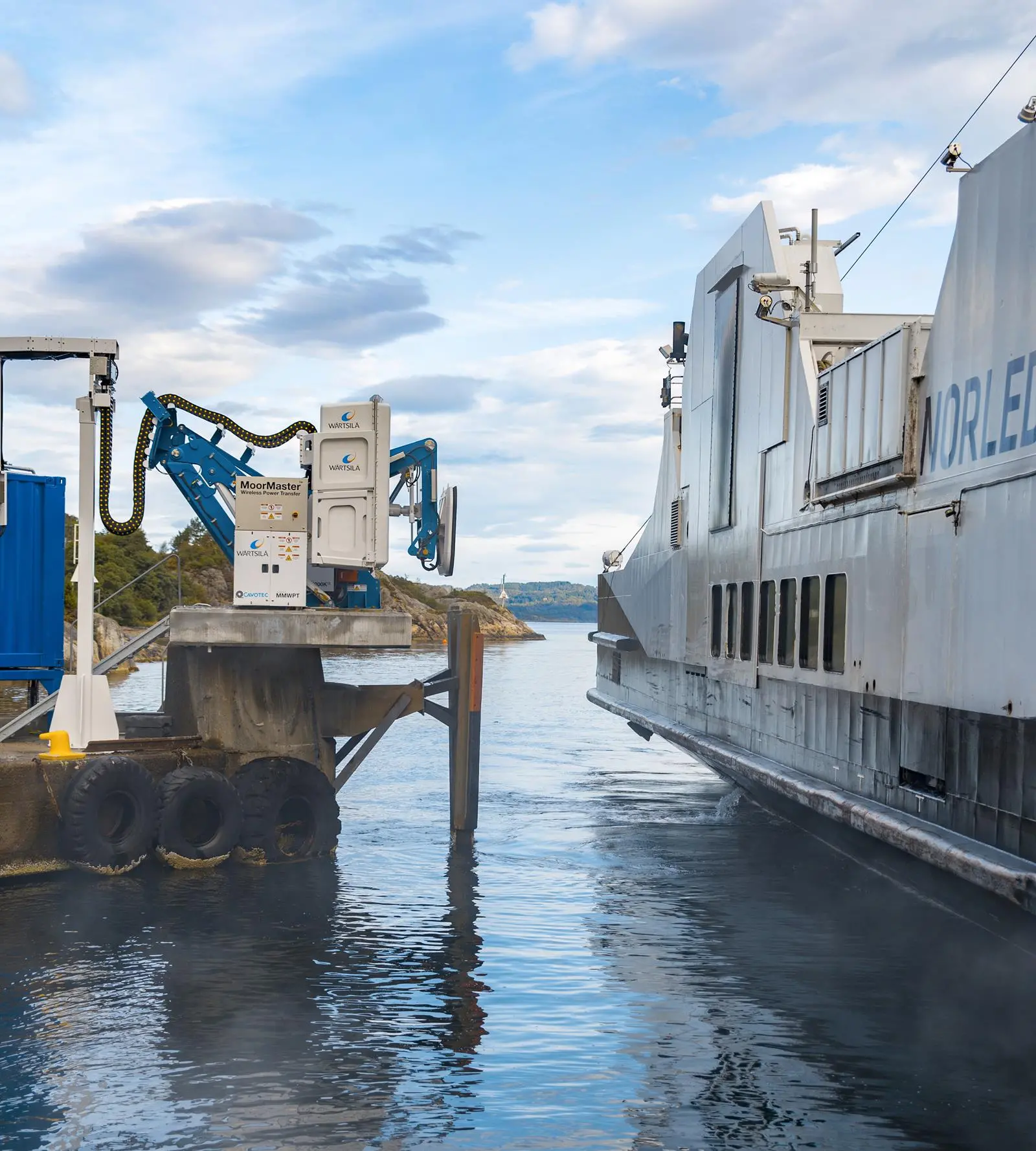
For fully electric vessels that require shore-side battery charging for zero emission operation, Wärtsilä has developed a wireless charging system with a sending coil arrangement onshore mounted on a hydraulic arm with y and z axis movement. The sending coil has a grid connection or alternatively shore based energy storage can be connected. The vessel has a similar coil arrangement connected to a rectifier for DC conversion.
There is a very high degree of safety in the system, as there is no physical connection to break even if the vessel drifts away, says Ingve Sorfonn, Technology Manager at Wärtsilä Marine Power. If the distance becomes too great, the system automatically shuts down. Additionally, effects of the physical environment, such as rain and cold, have no influence on the inductive charging.
While the solution is suitable for a wide range of vessels, it may not be optimal in every case, he says, partly due to the higher initial cost of the system. It depends on the operating profile of the vessel. For example, the rapid connection and charging potential of the technology is not a key consideration for a large cruise ship staying in port for several days.
More standardisation required for charging systems
While the IEC/ISO/IEEE 80005 is working well for ensuring power at berth, many integration specialists highlight that there is no similar standard in place for charging stations for electric vessels. More work is required to standardise the shore connection equipment in particular, says Peter Rampen, Principal Research Engineer at Damen Shipyards, to encourage more shipowners to consider electrification.
Damen offers a fully integrated service, covering both ship and shore, leading to the delivery of either hybrid or full electric ships for low or zero emission sailing. Having a scope that covers both ship and shore is necessary, says Rampen, because there are not that many charging stations in operation, and the design of an electric ship needs to be integrated with the availability of power on the shore for every location it visits.
Damen has a growing number of references for its electric vessels including the Port of Auckland’s recently launched fully electric tug. For Damen, with increasing levels of ecological awareness and ever more stringent regulations coming into force, electric powered ships represent a future-proof solution for shipowners.
Related Articles
 ALTERNATIVE FUELS & LUBRICANTS
 GENERAL NEWS
 GENERAL NEWS