



Environmental compliance drives innovation in scrubber technology
Almost as long as scrubber technology has been commercially available for shipping, questions have been raised about the potential longevity of the technology. The potential for extending the scope of scrubber technology beyond reducing SOx emissions from high sulphur fuel oil was not a commercially viable research area for a mono-fuel world. However, scrubber manufacturers are now starting to look at how the technology can evolve over time as demands for a wider range of emissions reductions technologies builds.
Manufacturers of scrubbers do not anticipate that demand for these systems will ebb, but expect that that these systems will also play a part in cutting emissions in the future as well. This confidence is supported by a current orderbook, with manufacturers reporting that shipyards are continuing to build vessels with scrubber technology onboard.
Wärtsilä sees a pipeline of such orders continuing into the future. “We have seen continued heathy interest in orders for scrubbers, especially on the newbuild side. Newbuildings have been the mainstay of our exhaust gas abatement technology orderbook, with owners opting for a mixture of open loop and hybrid types,” Sigurd Jenssen, Director, Wärtsilä highlights.
Jenssen also notes that a lot of the commercial sector of shipping such as containerships, tankers and bulker owners are now opting for scrubbers when ordering newbuildings. From this, Jenssen expects to see growth for scrubbers for this year and beyond in both the newbuilding and retrofit market.
This was supported by BIMCO’s Chief Shipping Analyst, Peter Sand, who reported that installations of scrubber systems had reached 228 ships in the first quarter of 2021. Sand also noted that the proportion of newbuilds compared with retrofits had risen since 2020, with newbuilds accounting for around two-thirds of installations in Q1 2021.
Jenssen noted that Wärtsilä had its best ever year in 2020 for scrubber deliveries, despite the COVID-19 pandemic. She highlighted that shipowners continued to express an interest in exhaust gas abatement systems as long-term solutions for the global fleet. The Motorship notes that some shipyards are also keeping faith with scrubber-equipped designs, as they modernise series designs to meet EEDI Phase 3 standards.
Jenssen notes that a significant order was booked in November 2020 with a Japanese shipyard, Japan Marine United (JMU), to install a 25MW scrubber on a new Japanese-owned Very Large Crude Carrier (VLCC) set to be delivered in 2022.
The system for the newbuild VLCC will run in an open loop configuration with the vessel. The company noted that it shows that scrubbers are a full lifecycle asset going forward. Wärtsilä’s scrubbers take a modular approach and can be upgraded over time, with the potential to incorporate technology to mitigate Nitrogen oxide (NOx) and Particulate Matter (PM) emissions.
Alfa Laval is still carrying out further developments with its PureSox system for the market with some recent developments such as its Energy Reduction Mode, which optimises energy and water consumption based on the compliance values. The company is also working developing its water cleaning system to optimise efficiency.
Wärtsilä also notes that it is working on other development for its technology to trap particulate matter as a modular add-on for its scrubbers, and are also exploring how it can enable NOx emission reductions. “The capacity to reduce PM and NOx further provides ship owners and operators with assurances that they are future-proofed against any future more stringent emission reduction targets,” Jenssen adds.
Future fuels are also playing their part in the market as the use of LNG along with a scrubber is being touted as method that shipowners can use to cut their vessels’ emissions. While common sense would seem to indicate that the development of clean fuels may render scrubber technology redundant, broadening emissions reductions targets and a growing understanding of the emissions challenges posed by new fuels suggests that the technology may have a long term future.
Jenssen struck a bullish note, adding that: “The question of future fuels is so far into the medium and long-term – and not to mention the huge development in infrastructure and vessel equipment needed to handle those fuels – that we see little impact at the moment.”
Alfa Laval also notes that currently it sees that the market is at a “balance” between the adoption of new fuels and scrubbers. The company notes that there are many fuels now coming into focus, some of which are still in development but it believe that there will be a market for scrubbers in the future.
From a product perspective, Alfa Laval noted that this being reflecting in increased demand for hybrid systems. It has also received several orders for its systems over the last few months mainly in the containership segment, with some also in the tanker and bulker segments too.
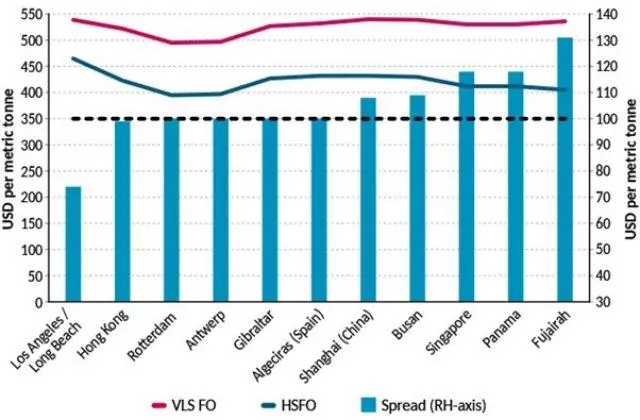
Jenssen also noted that price differentials in the fuel market were also supportive for the scrubber market, adding: “The economics of exhaust gas abatement technology becomes increasingly favourable as the fuel price spread between HSFO and LSFO widens, so the scrubber case becomes a good investment.”
Further developments have seen Subsea Industries also get involved in the market through its Ecospeed coatings. Usually the Ecospeed brand is best known for hull coatings, but the company has recently applied it to scrubber pipes, outlets and diffusers of several oil tankers and bulker.
The company notes that because of the tight regulations on emissions in the shipping industry, the installation of the exhaust scrubber system has become increasingly widespread. This unfortunately has also led to an increase of corrosion damage on scrubber pipes and outlets which results in water ingress in the engine room, ballast tanks and cargo holds.
Although this is not the company’s first application of the coating it notes that scrubber systems do need this chemical resistant coating to be able to withstand the process of filtering out the hazardous pollutants of the exhaust gas.
The Belgium-based Hydrex has also been active with scrubbers recently where its diver/technicians carried out scrubber overboard pipe repairs in ports in France, the Netherlands and Spain. On a 400m containership six pipes were replaced, while one pipe was replaced on another container vessel and a tanker.
In each case the pipes needed to be replaced completely with new pipes constructed at the Hydrex warehouse in Antwerp. In the case of the tanker, a team travelled to its location in Le Harve where they carried out an initial inspection of the damaged areas. Hydrex diver/welders then sealed off the outlet to the overboard pipe and removed the stub piece of the scrubber pipe and replaced it with a new one.
The 400m containership’s operation was slightly more complex due the fact that six pipes needed to be replaced in this instance.
Future proofing scrubbers
Although the future of scrubbers is still not clear, manufacturers are taking steps to make sure that this technology still has a place in the industry in the coming years.
Sigurd Jenssen, Director, Wartsila explains about how the company sees the developments for this technology for the future. “It is increasingly understood that exhaust gas treatment systems, beyond just backing sulphur, can provide the shipping industry with an innovation springboard to tackle pollutants into the future, including NOx, PM and Greenhouse Gases.”
It will be about moving these technologies beyond just servicing the sulphur challenge which will require investment and research, but the long term goal would be to tailor the technology to meet with other specific challenges that are coming in the future. “We believe that this forward-looking innovation is a key route for shipping to meet its sustainability challenges,” he added.
Alfa Laval are also looking to the long-term for its systems through helping customers move away from fossil fuels. “We have taken an active role to drive developments in this area, for example through our strategic Corporate Partnership with the Maersk Mc-Kinney Møller Centre for Zero Carbon Shipping,” explains a spokesperson for Alfa Laval, “However, this change will not happen overnight. When it comes to emission abatement, as said, scrubbers will continue to have a role to play.”
Jenssen also adds that: “If we can create an ecosystem of modular technologies around the stack to tackle pollutants, we will be playing out part. A mix of carbon capture and storage, clean and environmental technologies, and new low carbon fuels will be needed to tackle the challenges of the future.”
Related Articles
 EMISSIONS REDUCTION TECHNOLOGY
 EMISSIONS REDUCTION TECHNOLOGY
 EMISSIONS REDUCTION TECHNOLOGY