



PBST IS READYING TWO NEW SERIES OF MODULAR RADIAL TURBOCHARGER
Both turbocharger families are based on newly-developed technologies, leading to a significant step in product capabilities, says project manager Daniel Albrecht. They use significantly smaller rotors and thereby allow for a fast dynamic response of the engine.
Albrecht says the main innovation behind both series is the advanced numerical simulation used for their design, something that wasn’t possible several years ago. Improved numerical methods and steadily rising processor capabilities allow complex simulations to improve flow parts for higher performance.
As part of the development work, both aerodynamic and structural mechanics behaviour was simulated, and a key design consideration was to ensure the highest possible component lifetimes given the higher pressures and temperatures they are exposed to. The designs developed based on the numerical research were then tested on the company’s test rig confirming the positive results.
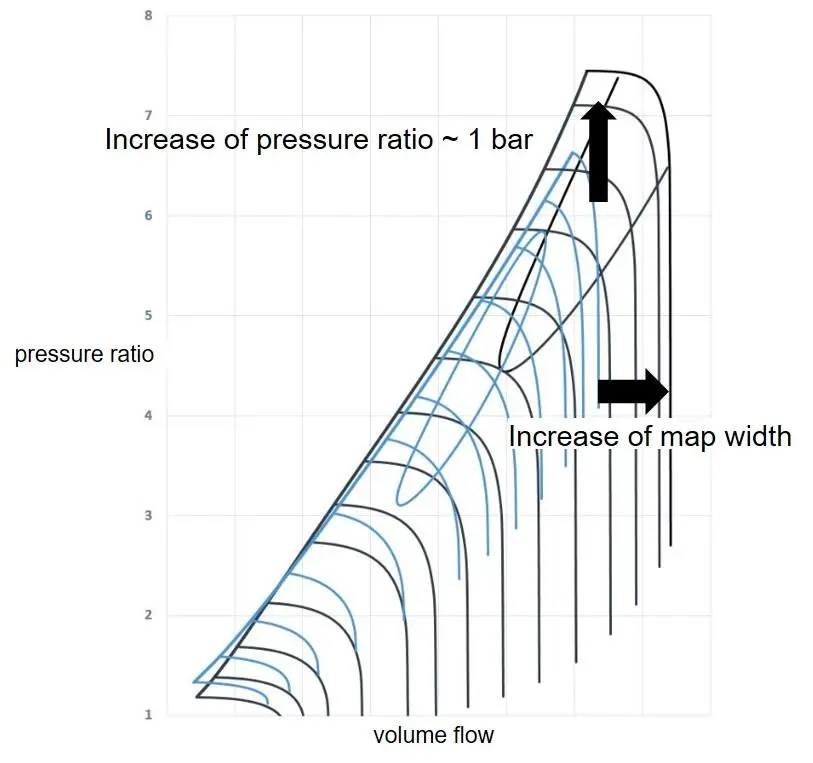
Current 1-stage turbocharger systems achieve pressure ratios of 5 to 6, but the new TCP range is significantly increasing this pressure ratio to well above 6, and pressure ratios beyond 7 are feasible, says Albrecht. “We’ve developed completely new aerodynamic stages for both the compressor side and the turbine side to reach this industry benchmark.”
The new turbochargers use the same connection dimensions as similar turbochargers with lower output and can be exchanged without major adaptions. The increased pressure will allow customers to significantly increase engine power output, and a first application of the technology has achieved power increases of around 20% with only slight engine modifications. This means more power with similar costs or smaller engines or less cylinders for the same output. “In parallel, we managed to significantly increase the efficiency of the turbochargers to reduce fuel consumption and emissions from our customer engines,” says Albrecht.
The second turbocharger range, TCF, offers significantly increased volume flow. The new range is an expansion and upgrade of the existing TCT range but with newly optimised flow performance. The technology has been designed to achieve the highest efficiencies at pressure ratios below 5 and is especially well suited to optimising engines for part load. Significant improvements in fuel consumptions, especially for gensets, have been demonstrated in studies with first customers.
Due to the turbochargers achieving their highest efficiencies gains in part load, and easy exchangeability, they are especially well suited to help shipowners to better comply with future Energy Efficiency Existing Ship Index (EEXI) requirements and reduce emissions of engines already in the field, Albrecht says. In one study case, fuel consumption in the relevant operation range was reduced by 4.5% with a TCF retrofit and engine optimization package. The series is also suited to work as a low-pressure stage turbocharger in two-stage applications.
Modular design
Both new turbocharger series have been designed to be modular in construction, using as many parts in common as possible, although some rotating components and casings will differ between the two families. In this, PBST has leveraged the Volkswagen Group’s expertise in developing modular systems for the car industry.
The new turbochargers are designed for gensets or main propulsion engines and will include models for high, medium and low speed engines, including TCF models for 2-stroke engines. “To enable for full decarbonization of our customers portfolio, the turbochargers are being designed for operation for a wide range of future fuels including hydrogen and ammonia,” says Christian Reith, head of technical sales at PBST, although he notes that the company’s existing ranges are also suitable for use with new fuels on test engines without any show stopper already today. “Now it’s time to implement a new turbocharger series to cope with the upcoming CO2 targets we see being set all over the world leading up to 2050. We expect, of course, the need for higher efficiencies and the need for higher pressures to get increased power density out of existing engines as well as equal power density out of the new engines being developed for burning future fuels, and this is what we are prepared for.”
PBST is conducting on-going tests of new-series TCP and TCF turbochargers, and component tests are also well under way. Engine manufacturers are engaged in several projects, and first series hardware will be available for engine tests starting from 2022. Seven frame sizes are currently planned for each series to cover a wide application range of high, medium and low speed engines for marine as well as other mobile applications including rail and mining and also stationary power generation applications. The range will be rolled out over time in response to customer demand.
Related Articles
 PROPULSION
 GENERAL NEWS
 GENERAL NEWS