



NEW PRECIPITATES TECHNIQUE BOOST STRENGTH, DUCTILITY OF STRUCTURAL ALLOYS
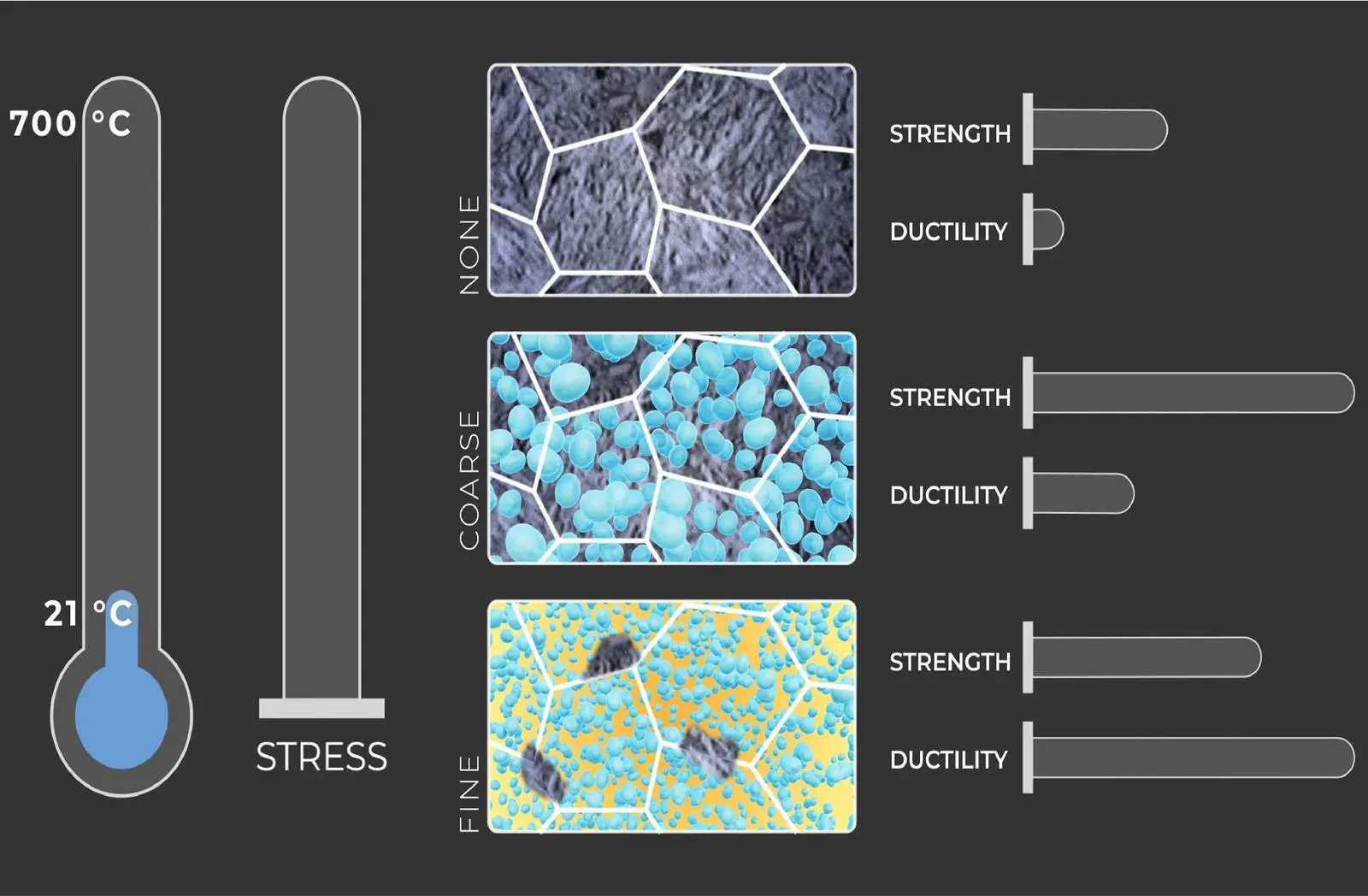
The method introduces nano precipitates, solids that separate from the metal mixture as the alloy cools, into the alloy matrix and tunes their size and spacing.
Easo George, principal investigator and Governor’s Chair for Advanced Alloy Theory and Development at ORNL and the University of Tennessee, and co-principal investigator Ying Yang of ORNL, used computational thermodynamic simulations to support the development of custom-made alloys that contain four major elements — iron, nickel, aluminium and titanium — that form the matrix and precipitates, and three minor elements — carbon, zirconium and boron — that limit the size of the individual metallic crystals.
The strength of a material usually depends on how close the precipitates are to each other. The more closely spaced they are, the stronger the material gets. However, traditionally this also makes the alloys very brittle. The team’s alloy avoids this brittleness, because the precipitates perform a second useful function: by spatially constraining the matrix, they prevent it from transforming during thermal quenching (a quick immersion in water that cools the alloy to room temperature). This means ductility is maintained when the alloy is then stretched. Together, the complementary mechanisms of conventional precipitation strengthening and deformation-induced transformation increased strength by 20-90% and elongation by 300%.
“Adding precipitates to block dislocations and make materials ultra-strong is well known,” George said. “What is new here is that adjusting the spacing of these precipitates also affects phase transformation propensity, which allows multiple deformation mechanisms to be activated as needed to enhance ductility.”
The researchers also found a reversal of the normal strengthening effect of nanoprecipitates: an alloy with coarse, widely spaced precipitates is stronger than the same alloy with fine, closely spaced precipitates. This reversal happens when the nanoprecipitates become so tiny and tightly packed that the phase transformation is essentially shut down during straining of the material, not unlike the transformation suppressed during the thermal quench.
The research introduces a new family of structural alloys, Yang said. “Precipitate characteristics and alloy chemistry can be precisely tailored to activate deformation mechanisms exactly when needed to thwart the strength-ductility trade-off.”
Next the team will investigate additional factors and deformation mechanisms to identify combinations that could further improve mechanical properties. “Today’s structural materials realize but a small fraction, perhaps only 10 percent, of their theoretically capable strengths,” says George. “Imagine the weight savings that would be possible in a car or an airplane, and the consequent energy savings, if this strength could be doubled or tripled while maintaining adequate ductility.”
The Motorship notes that a number of maritime-focused research projects are attempting to achieve similar weight reductions in structural steel requirements. The development might also have potential applications in the field of high speed tool materials.
George says it’s too early to tell whether the alloys will be useful for shipbuilding, as the team hasn’t done the necessary follow-on work to determine, among other things, weldability, heat treatability and cryogenic properties, but these are important practical considerations for future work. Another important property that needs to be controlled is the phase (martensite) transformation temperature of the alloy. Currently, it can undergo deformation-induced transformation at room temperature, which is what leads to the combination of high strength and ductility. “For operation at temperatures below room temperature (for example, in very cold/icy waters), the martensitic transformation temperature should be below the ambient temperature. One of the questions we are interested in is precisely this, namely, how to dial in alloy characteristics (chemical composition and precipitate features) to tailor the transformation temperature at will.”
The researchers haven’t yet studied the effects if any of trace impurities (such as copper residues) on the properties of the alloy. “Our suspicion, although it is merely a hunch at this stage, is that it will be tolerant of impurities introduced through scrap and electric arc furnace melting.”
Corrosion properties are also yet to be been investigated. “Resistance to marine corrosion may require the addition of other alloying elements to this ‘base’ alloy to improve it. Because the alloy has high strength, it is likely to have decent wear resistance as a result of local, near-surface transformation of soft austenite to harder martensite during wear loading, but this needs to be confirmed by testing.”
The development has not yet gained commercial interest, but George and Yang believe its application will be comparable to other alloys containing similar elements, as the processing of the current alloy does not require innovative processing, instead relying on similar steps to those used in conventional alloys production (melting, casting, heat treatment, rolling, etc.).
Related Articles
 ALTERNATIVE FUELS & LUBRICANTS
 GENERAL NEWS
 GENERAL NEWS