



VOC MEASURES HAMPERED WITHOUT TERMINAL INVESTMENT
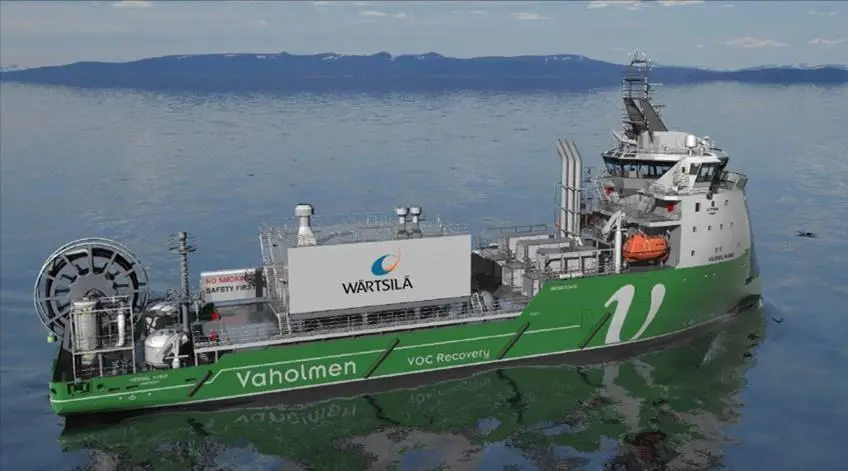
Canada and Norway submitted a paper to the Intersessional meeting of the Working Group on Reduction of GHG Emissions from Ships in August (ISWG-GHG9) calling for changes to regulation 15 of MARPOL Annex VI for oil and chemical tankers that carry volatile cargo. As well as having GHG potential, these emissions can be harmful to human health and contribute to the formation of tropospheric ozone, a component of smog.
The submission is based on a report by DNV that found that approximately 70% of VOC emissions are generated during cargo loading. Around 20-30% are generated during laden voyages.
Currently Marpol Annex VI Regulation 15 regulates the control of specific VOC emissions for oil tankers and at ports and terminals. (Methane is excluded from the definition of VOC.) Where required, both the shipboard and shore arrangements are to be in accordance with MSC/Circ.585 “Standards for vapour emission control systems”. A second aspect of the regulation, regulation 15.6, requires that all tankers carrying crude oil have an approved and effectively implemented ship specific VOC Management Plan.

The proposal
Norway and Canada, based on an analysis by DNV, propose amendments to MARPOL that they consider to be feasible, practical and economically viable:
1. installation of pressure control systems in way of the mast riser for the purpose of automatic maintenance of tank pressure on voyage and during loading.
2. increased settings of pressure/vacuum (P/V) valves from current standard at 0.14 bar to 0.2 bar.
3. requirements to P/V valve type in terms of blow-down.
DNV notes that the ability to load cargo against a controlled back-pressure has been shown to reduce the quantity of VOCs in the ullage space with a VOC emission reduction potential of approximately 10%. Additionally, an investigation of shuttle tankers in the North Sea indicates that maintaining the cargo tank pressure could reduce the emissions by 30-40% depending on tank design pressure.
The submission notes that a vapour return system used during terminal loading would send all cargo vapours to shore for processing with no VOC emissions to air. However, currently only few terminals are requiring loading with vapour emission control systems.
Industry responds
Dragos Rauta, Technical Director at INTERTANKO, says the involvement of the shore terminals is the key element to success. “The proposed amendments in the DNV Study, forwarded to ISWG-GHG9 by Canada and Norway do suggest tankers contain onboard VOCs but there is no indication what tankers can do with these VOCs. Therefore, one cannot see a net environmental benefit without assistance from shore facilities.”

Christian Bækmark Schiolborg, BIMCO Manager, Marine Environment, notes: “This proposal – by Canada and Norway – is the first step on the path to reduce emissions of VOCs which by itself is a welcomed and positive step towards decarbonisation. The fundamental problem related to VOCs, however, is that the majority of tankers have had costly vapour emission collection systems installed since the MARPOL regulations came into force in 2010, but many port and terminals still don’t have vapour emission collection systems installed and are therefore not capable of receiving VOCs from tankers. The problem will not be solved by continuing to regulate oil tankers if the ports and terminals are not mandated or incentivised to catch up with the oil tankers.”
Jahn Viggo Rønningen, Director – Head of Ship Safety for the Norwegian Shipowners’ Association, says members can agree to the proposed control measures, but says: “By far the largest effect during loading at the terminal would be to fully utilize the VECS (vapor return line) onboard. To which degree the received crude oil is stabilised (from shore side) during loading dictates the amount of VOC emissions from the ship throughout the journey.” He notes that very few oil terminals have a vapor return facility, unlike the ship side. “There’s not much point in regulating the maritime sector further if the shore side is lagging.”
Rajiv Malhotra, Thome Group’s Head of Technical Support, also points to the need for terminal facilities. “Another measure that needs to be considered is the mandatory quantification of the VOC emissions using suitable means, to set future targets and assess the effectiveness of the enforced measures. This will help to reasonably understand what future industrywide investments would be justified for further VOC emissions control.”
He says: “There is room to improve the control of these emissions without extensive financial implications, and I believe substantial reductions can be achieved without compromising on operational safety. The proposed amendments to MARPOL annex VI regulation 15 appear to be addressing reductions in a practical way through minimal intervention with the design and construction requirements while implementing significant strengthening of operational controls.
“The increase in the PV valve settings to safe levels without changing the tank designs should be possible without incurring major costs while significantly reducing emissions. Similarly, automatic pressure control systems can be installed at reasonable costs, if not existing already.”
Captain Cristin Nutu, Cargo Manager at Ardmore Shipping, says the proposals are all good ideas that can easily be put into practice if they aren’t already. Class could check that the proposed pressure increases would not jeopardise the structure of the ship. He also notes the lack of terminal facilities. “Vapour emission control systems are used in north-western Europe and Australia, and it’s working perfectly.” However, he notes that in other places, including ports in the Far East, this is not the case. “And I’m not just referring to VOC. When the vessels trade chemicals, sometimes it is carcinogenic products such as benzene being released to the atmosphere.”
He believes that the cheapest, safest and fastest way to achieve the goal of reducing GHG emissions would be if VOC systems were operational in all terminals worldwide. However, Nutu also notes that training can help minimise VOC releases operationally and that improved cargo sampling systems could reduce the release of VOC during routine port operations.
Advanced recovery systems
DNV didn’t propose the use of advanced recovery systems, with Canada and Norway therefore noting in their submission: “Due to the high investment cost of the installation (approximately USD25-40 million or close to 30% of the new build cost for a very large crude carrier) and also operational cost in combination with complexity of operation, it is difficult to see how advanced VOC recovery plants for mitigating VOC emissions will work as an effective measure on a global scale.”
Wärtsilä and Norwegian company Vaholmen VOC Recovery have formally responded, saying: “In our view, the report’s conclusion is based on limited knowledge of products available on the market.”

The companies offer a VOC recovery system to be installed on a dynamically positioned platform supply vessel (PSV). The PSV would be stationed alongside and in safe distance to tankers being loaded at sea islands or offshore single point moorings. The VOC would to a certain extent be combusted in the PSV’s three gas turbines and most of it liquified and then discharged to shore where it would be reinjected in the crude storage tank or exported for further refining. The companies say that the system enables the owner of the captured VOC to capitalise on its value. “You can imagine that a single PSV vessel serving 200+ VLCC loadings per year could generate tremendous total savings,” says Hans Jakob Buvarp General Manager, Sales at Wärtsilä Gas Solutions.
He says the system has worked in the North Sea and would work well in countries such as Saudi Arabia and Brazil. He had hoped that the proposal by Norway and Canada would be more ambitious and calls on the IMO to look further into imposing restrictions on crude oil tankers’ liberty to discharge VOC to the atmosphere during loading or discharging. Such restrictions would be in line with the obligation of gas tankers not to emit gas during loading or discharging (IGC Code chapter 17.18.13).
If restrictions were imposed, say the companies, it would significantly reduce VOC emissions. Their analysis indicates that the VOC recovered (including methane – the gas element with the highest CO2 equivalent index) could be as high as 200 tons per one million barrels of crude oil loaded. The companies also note that active process equipment removing emissions during laden voyage is available at a fraction of the cost mentioned in the DNV report.
In response to the letter, DNV notes that its report was delivered in March 2021 and included concepts that were in the public domain before that point. A spokesperson says: “We have identified vapour emission control systems as the most efficient way of reducing emissions from loading. We have also identified that there are a lack of terminals providing reception facilities for vapour return. The Vaholmen/Wärtsila concept seems to be intended as an alternative to terminal facilities for such vapour return. We note that they present it as an alternative to installing VOC recovery plants on individual tankers.
“With respect to the mention of active process equipment during laden voyage, we have only referred to active measures to handle VOC emissions during loading, as this represents 70-80% of the total VOC emissions and have proposed procedural and low cost technical measures to limit emissions during voyage for international shipping.”
The proposal from Canada and Norway will be discussed at MEPC 77 with a recommendation from the ISWG-GHG9 session to possibly send it for technical discussions to the IMO’s PPR Sub-Committee.
Related Articles
 CONVENTIONAL FUELS & OILS
 ALTERNATIVE FUELS & LUBRICANTS
 AMMONIA