



INVENTOR SEES ‘NO SIZE LIMIT’ FOR GATE RUDDER ESD
“Despite the impact of the Covid-19 pandemic, the past 12 months have seen significant developments for the gate rudder, including the results of a joint sea trial and the launch of the EU-funded Gaters project,” Dr Noriyuki Sasaki said.
Noriyuki noted that commercial developments for the solution have also been rapid. Wärtsilä entered into a partnership relationship with the device’s Japanese patent holders in 2020, granting the Finnish technology company an exclusive license to the technology outside Japan. Inside Japan, commercial interest is growing and the first newbuilding designed for operation with the gate rudder will be delivered in 2022.
Japanese gate rudder orders
In Japan, President Takayuki Imoto of Imoto Lines Ltd. has specified that a next generation coastal container vessel, Nagara, should be equipped with the gate rudder. The second generation 670TEU container newbuilding has been ordered at Kyokuyo Shipyard and will be delivered in the beginning of 2022.
Mr. Imoto decided to proceed after analysing the efficiency savings achieved by Shigenobu, the first gate rudder ship.
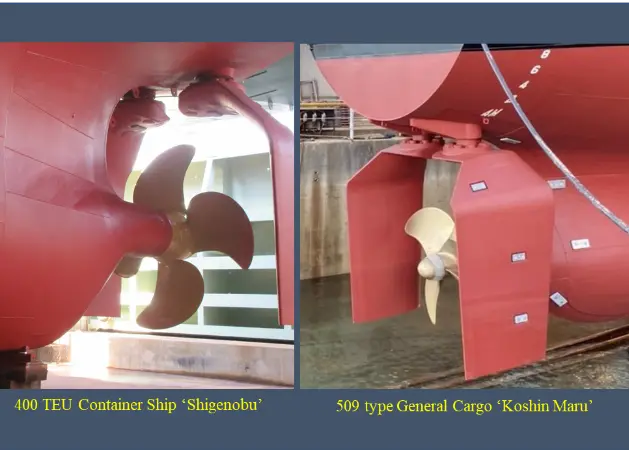
The conversion of the Nagara will increase the number of vessels equipped with the gate rudder to 4 in Japan. Apart from Shigenobu, which was the subject of 2019 Motorship article, two gate rudder ships have been delivered since 2020. A cargo ship Koshin maru, which entered service in June 2020, was designed with the propeller situated further aft from the original position. By contrast, the stern of the third vessel Shinmon maru was unaltered except for propulsion device itself. It is expected that this vessel will provide valuable information about the potential retrofit advantages for vessels, with a specific focus on potential EEXI and CII applications.
In addition to the four vessels mentioned above, the gate rudder which will be installed on a cargo ship Erge in the middle of 2022. The retrofit forms part of an EU-funded project, Gaters, as part of which the University of Strathclyde received a US$7.2 million grant to retrofit the rudder system to a commercial ship.
Potential wind propulsion benefits
Dr. Sasaki noted that the research had identified additional benefits for the gate rudder solution. One particular benefit of the solution is that it can offset the heeling forces on the vessel.
While wind assisted propulsion is among the solutions being considered by European ship owners as a response to the IMO’s ever-stricter environmental requirements, wind forces can generate large drifting and heeling forces on the ship. Consequently, we need a large keel to keep the ship course avoiding so-called leeway.
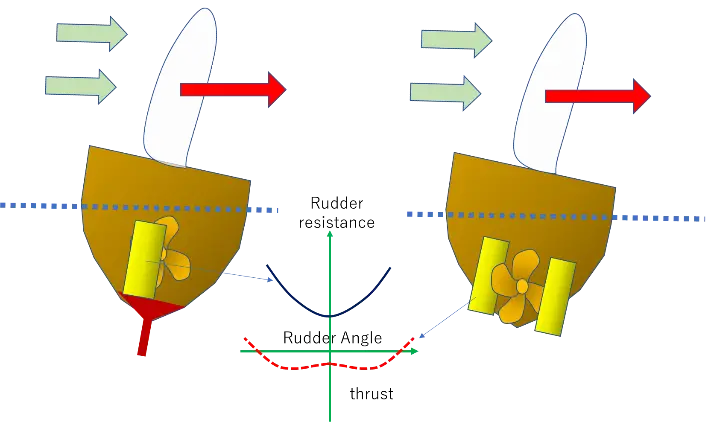
While conventional rudders only generate resistance, and the total hull resistance will be much amplified by ship motions such as yawing, rolling and heeling, the gate rudder can generate thrust. “It works like ‘Under Water Sails’,” Sasaki said.
The resistance produced by a conventional rudder is huge. It easily goes up 30% of ship resistance by only 15 degree steering, more than offsetting the valuable thrust obtained from the sail on the deck. Sometimes the wind assisted ship need to be equipped with a large bottom keel to resist this large drifting force and heeling force. “It means that the potential energy efficiencies generated by wind-assisted propulsion should take this handicap into account,” Sasaki added.
The gate rudder can compensate for this drifting force and heeling force as the gate rudder produces a lifting force itself. This is based on a similar mechanism as the thrust produced by a sail on deck. The difference is only fluid density, i.e. water is 800 times larger than air, which, Dr. Sasaki insists, guarantees very effective under water sails.
Safely Turning
Turning ability is important to avoid the accident such as a collision. IMO regulates two performances as standards which are advance and tactical diameter. On the other hand, a vessel’s turning ability has a strong relationship with her course keeping ability and her rudder type. It is well known fact that the excellent turning ability can be obtained by the vessel with poor course keeping ability. The excellent tactical diameter can be obtained by the vessel with high lift type rudders such as a flap rudder because of higher rudder resistance.
A recent study of sea keeping ability in severe following-quartering seas revealed that the turning characteristics, such as the maximum turning rate, has a dominant effect on a ship’s safety.
The ship speed at the steady turning condition is also important. The excessive ship heeling angle, the excessive rudder resistance are the main source of sudden speed loss of the vessel at the turning motion. The sudden speed loss or remarkable speed loss will introduce the large turning rate and change of ship attitude which is not preferable from the safety view point, especially in fast ships such as Ro-Ros and passenger ferries equipped with fin stabilisers.
Sasaki noted that the gate rudder gives us remarkable safety turning ability without excessive speed loss. The speed of a gate rudder ship at the same turning rate (the same tactical diameter) is between 20-30% higher than a vessel equipped with a conventional rudder.
Manoeuvring capability at port
Crabbing mode and pivot turn can increase operational efficiency in the port. The joint sea trial proved this clearly. Under the same weather conditions, Shigenobu performed very strongly. By the combination of two rudder angles, 55deg and 110 deg, Shigenobu succeeded in showing the best berthing using a pivot turn and crabbing at the extremely narrow port. On the contrary, Sakura decided to use her anchor and head in mode which will require another turning operation at her departure from the quay.
It is well known fact that efficient port operations for coastal vessels are critical from a fuel efficiency perspective. If we take a typical coastal ferry running 25kts with 30 minutes duration time as an example, the vessel can save up to 50% fuel by minimising the port operation time from 18 minutes to 13 minutes by gate rudder. The same saving can be obtained by the use of a stern thruster, but the gate rudder will be more cost-effective.
Safety Navigation
A recent study about the cargo loss and damage to a RoRo vessel in a severe following quartering wave reveals two remarkable features. The first trend is sudden speed loss due to increased hull resistance. Second, large turning rate due to the excessive turning motion. The gate rudder can protect these trends during the turning motion. In other words, the gate rudder can offer not only fuel saving but also improve the safety operation, Sasaki added.
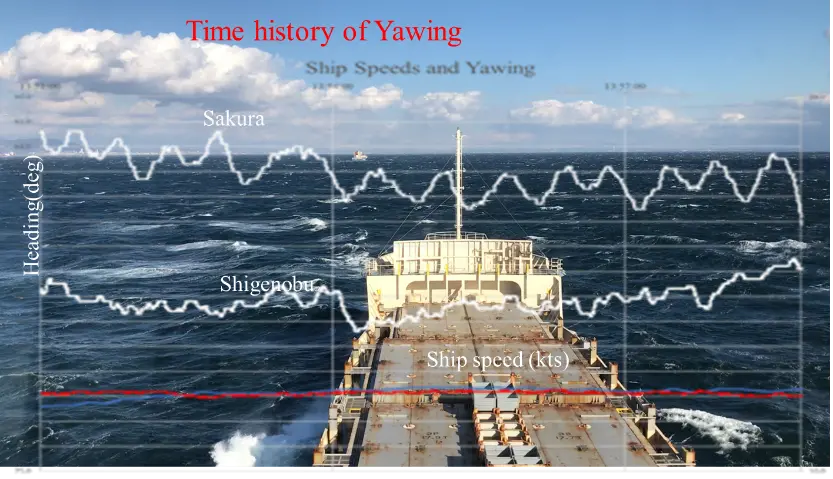
“We obtained clear evidence from the joint sea trial of Sakura and Shigenobu where the wave and wind were coming from following quartering direction. The gate rudder showed a remarkable damping effect on the ship motions during their running period on the same track. The ship conditions of two vessels can be assumed to be exactly the same because of the short distance between the two vessels (about 300m). The yawing and rolling amplitude of Shigenobu was less than half of that of Sakura.”
Sea Margin
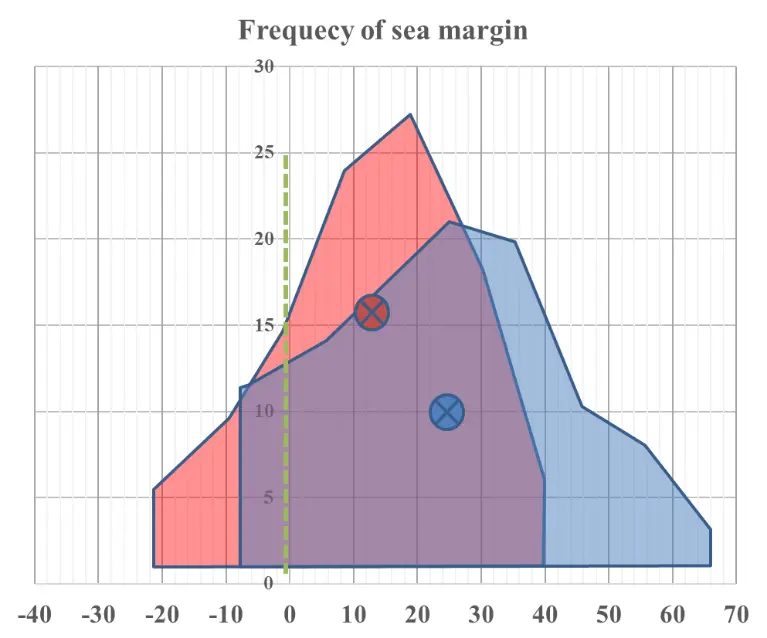
Sea margin (power margin) is not identical for all ships and it depends on customer experiences from previous operations at specific conditions and routes. However, the ship operator will accept the same sea margin for sister ships if they are operated on the same route, as is the case with Sakura and Shigenobu. As previously reported, the two vessels share the same hull form and engine and the same route along the Japanese coast. By comparing 30 months of voyage data from Shigenobu with those of Sakura, it revealed data from the aspect of frequency of sea margin. The result clearly shows an 11% difference between the two vessels’ sea margin (Sakura 24%, Shigenobu 13%).
The zero sea margin conditions of both ships are different because Shigenobu showed 14% less power at her speed trial condition. This accurate power save of gate rudder can be calculated by summing up the difference between the sea margin and sea trial results
Actual fuel saving = Fuel saving ( calm sea ) + Fuel saving (difference of sea margin)
For example, 14% + 11% = 25% in the case of Shigenobu
Safe structural design
The inspections of rudder itself, rudder shaft, rudder trunk and steering gears have been conducted frequently and continuously. The inspection data has been positive. In addition to this, the vessels themselves are very quiet during operation, with reduced vibrations and noise. The three captains with operational experience have commented on the remarkable damping effect that the gate rudder has on the ship’s motion, and on rolling in particular.
Sasaki explained, “Our rudder design is very safe because we have a lot of margin by applying conventional rudder strength calculations. The most critical aspect for the conventional rudder is fatigue failure due to a propeller periodic force including propeller cavitation attack. The exciting force occurring on the gate rudder is extremely low compared with conventional rudders thank to the positions. We believe the structural design rule for the gate rudder can be much relaxed in the future. We have no limitation for the size of gate rudder. The larger the size, the higher the cost-effectiveness that can be expected.”
Commercial activity
Elias Boletis, Director of Wärtsilä Propulsion, said “Wärtsilä has an exclusive license for the application of gate rudder technology outside Japan. Wärtsilä is continuously developing energy efficiency solutions that can help our customers to improve vessel performance, achieve significant fuel savings and reduce emissions. The gate rudder is quite a new idea and we have noticed its difference from other ESDs. We expect the gate rudder can be a game changer in the world of ESDs.”
Kazuki Itazawa, senior executive director of Kamome propeller said “Kamome Propeller Ltd. is one of patent holders of the gate rudder technology. We have delivered three gate rudder systems to different ship owners. The performance data we obtained from these vessels has surpassed our expectations. We believe that the gate rudder is a very promising technology, with potential applications as a solution to IMO EEXI requirements.”
Itazawa added, “We have received a number of enquiries from our customers after delivering three gate rudder systems, and some of our customers are scheduling model tests soon. This is good news for us because the research and development phase is over, and our customers are thinking about applications for newbuilding vessels.”
Academic activity
The GATERS project led by the University of Strathclyde under the Horizon 2020 Fund (EUR6 million), will see the ‘gate rudder’ – a novel propulsion and steering system – retro-fitted to a commercial vessel as part of a trial.
Professor Mehmet Atlar, who is the project coordinator from Department of Naval Architecture and Marine Engineering (NAOME) at Strathclyde, said: “GATERS demonstrates significantly reduced emissions from ships particularly within coastal and port areas, challenging and even exceeding the current and future legislative requirements of the International Marine Organization and local regulations for emissions.
“As a propulsor-based solution, the gate rudder offers a significant amount of power-saving that cannot be achieved by any other single energy-saving device which is currently available in the market.
“An important advantage of the gate rudder system is highly-effective manoeuvrability within coastal and port areas as well as navigating more efficient in waves during oceangoing operations. In addition, the gate rudder system is simple, generic and flexible that can be installed on new-built ships or retrofitted to existing ships, as well as integrated easily with other fuel-saving and emission reduction technologies. Based on these features, the gate rudder design presents a great prospect of replacing conventional design.”
Related Articles
 PROPULSION
 GENERAL NEWS
 GENERAL NEWS