



Fire caused by fuel hitting uninsulated exhaust header
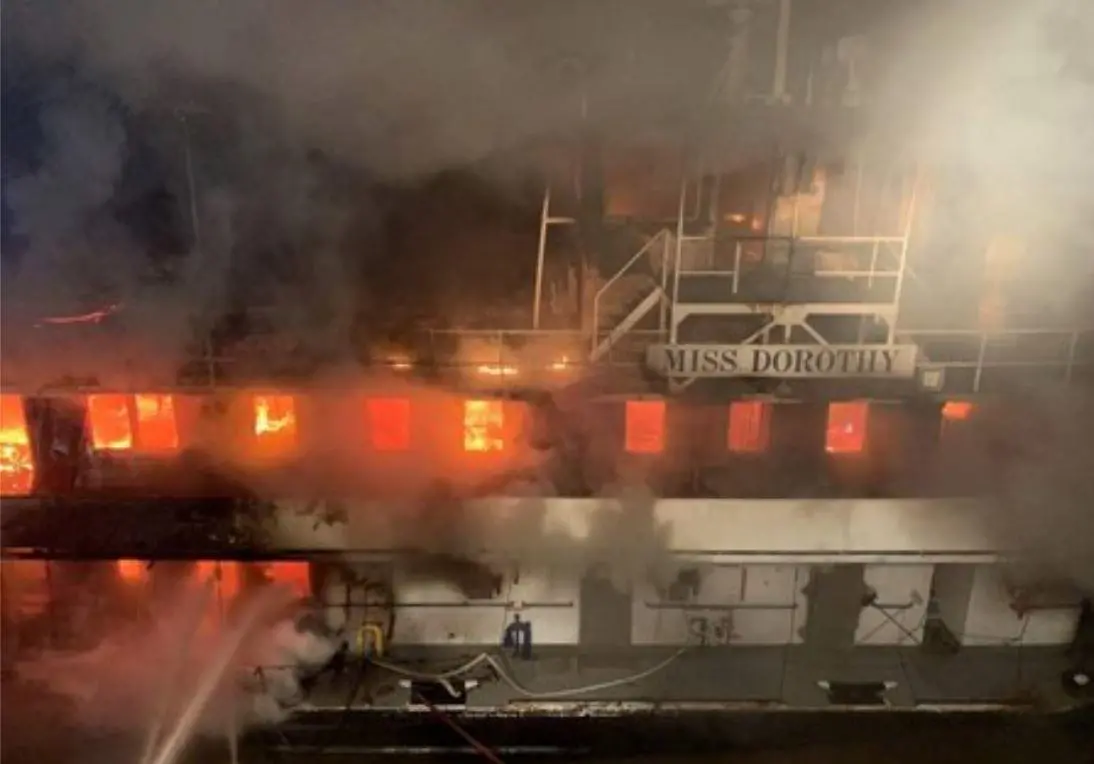
On March 17, 2021, the towing vessel Miss Dorothy was pushing 14 barges upbound on the Lower Mississippi River, north of Baton Rouge, Louisiana, when a fire broke out in the engine room. The eight crewmembers aboard briefly attempted to fight the fire but were unsuccessful and evacuated to the barges. No pollution or injuries were reported. The vessel was declared a total loss at US$2.4 million.
Shortly after midnight, fire alarms began to sound in the pilothouse and throughout the vessel. The pilot saw smoke that “grew in intensity very quickly” and flames coming from the starboard main engine in the engine room. The crew attempted to use fire hoses and handheld extinguishers to fight the fire.
Shortly after, the chief engineer activated the ventilation shutdown and pulled the emergency fuel oil shutoff for the fuel tank that supplied the starboard main engine. However, air continued to be drawn in through open engine room doors and open or broken windows, and the shutoff valve remained open because the shutoff did not function as intended.
The fire continued to grow despite the crew’s efforts. The captain ordered the crew to abandon ship, and the crew was rescued by towing vessel, Christopher Wilson, which then secured the tow against the bank. The fire was extinguished several hours later by first responders and crew aboard the towing vessel.
Regulations for towing vessels state that “piping and machinery components that exceed 220°C (428°F), including fittings, flanges, valves, exhaust manifolds, and turbochargers, must be insulated.” Investigators found that the exhaust header leading from the individual cylinder heads to the exhaust manifold in the Miss Dorothy – which were subject to temperatures greater than 428°F (often higher than 600°F) – near the suspected origin of the fire were uninsulated.
The NTSB determined the probable cause of the engine room fire was the ignition of spraying diesel fuel from a main engine’s fuel system onto an uninsulated section of the engine’s exhaust system. Contributing to the severity of the fire and damage to the vessel was the inability to effectively secure ventilation to the space and fuel to the affected engine.
Marine Investigation Report 22/05 is available here.
Related Articles
 ALTERNATIVE FUELS & LUBRICANTS
 GENERAL NEWS
 GENERAL NEWS