



Design changes would reduce enclosed spaces risks
Captain Kuba Szymanski, Secretary General of InterManager, said that, first of all, the shipping industry needs to realise that “Houston we have a problem”. InterManager has been keeping statistics on incidents involving enclosed spaces since 1999, and during this period enclosed spaces have claimed the lives of 104 seafarers and 51 shore workers. Szymanski highlights deaths in May and June 2022 as indicating that the danger continues.

He believes there is under-reporting of incidents by shipping authorities. An analysis of the IMO’s Global Integrated Shipping Information System (GISIS) database showed that only 26% of enclosed space accidents were reported through GISIS.
He believes that accurate reporting is a prerequisite for the introduction of safety improvements – “what is reported is managed” is a management axiom. “By not reporting accidents the shipping industry is not giving people the chance to properly investigate, understand and learn from them. This is potentially putting the lives of more seafarers and port workers in danger.”
Szymanski urges the shipping industry to work harder to address the root causes of enclosed space accidents which InterManager has identified are particularly due to ship design, time pressure on workers, and contradicting and confusing regulations. Dangerous timeframes are imposed for hazardous tasks and safety improvements do not happen because shipping industry investigations encourage a blame culture, he says.
The 2018 survey, Szymanski’s idea, asked a simple question: why do we die in enclosed spaces? Around 5,000 seafarers responded, and the results highlighted that procedures are confusing and do not take account of the resources, equipment and time available aboard the vessel. Commercial pressures are a significant impediment to following procedures, and ship design and equipment added to the problems by creating hazards. As well as being hard to reach, enclosed spaces are frequently impossible to properly ventilate or to measure the atmosphere in, some respondents said.
Seafarers asked for more training, prioritisation of management-led safety cultures, and suggested using the “fear factor” to raise awareness of the dangers of working in enclosed spaces. In fact, respondents recommended changing the phrase to “dangerous space” or even “fatal space” to push the message home.
In response to the findings, the Human Element Industry Group (HEIG) set up a project involving some 50-100 maritime sector individuals, and produced an analysis of the problems and how they can be addressed. HEIG includes participants from The Nautical Institute, IMarEST, InterManager, INTERCARGO, ITF, the International Chamber of Shipping, IFSMA, BIMCO, IMPA, Nautilus and IACS. The group worked closely with the IMO, and the enclosed space project also included other organisations such as MAIIF and the Royal Navy.
Designing for safety
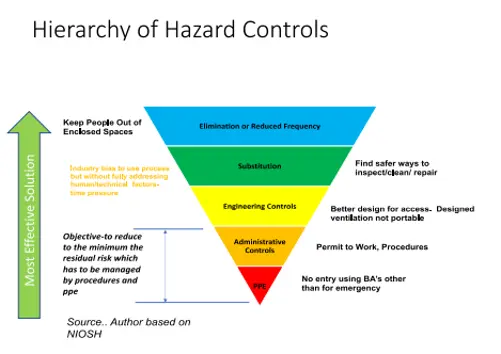
The group looked at the problem using a hierarchy of hazard control based on the premise that eliminating a hazard is better than accepting it and relying on procedural controls to manage it. The resulting report Technical Solutions to Enclosed Space Fatalities identified a number of generic changes to the design of ships and equipment that can be made to improve safety:
One reason to enter an enclosed space is to carry out repairs or maintenance on equipment within that space. Careful design can reduce the need for this by ensuring that equipment is not fitted within an enclosed space unless absolutely necessary. If it is, the equipment should require no or minimal maintenance or have a period between overhauls that allows the work to be carried out in drydock. Another alternative is to keep the maintainable components outside the space or making them withdrawable as with tank washing machines and some deep well pumps.
Access arrangement to enclosed spaces are governed by IACS requirements, but the size of the manhole needs to be suitable for the size of seafarers and the equipment they need to carry. Rescue operations also needs to be considered. Rescuers may be wearing breathing apparatus and will need to manoeuvre the casualty out of the manhole.
While pump and compressor rooms have fixed ventilation, other areas may not. Small areas could be fitted with a fan with an ‘elephant’s trunk’ that could enter via a separate access point to the manhole. Air circulation would be improved, and the air being expelled could easily be monitored.
Tanks that require cleaning could be designed without internal supporting structure to facilitate draining. They could also be designed with sloping bottoms, and sumps to collect sludge. Cleaning could be undertaken without the need for full entry, and top access could facilitate mechanical cleaning.
Greater use could be made of fixed gas monitoring systems so that entry to the space is not required for testing. This could be particularly important for some foc’sle spaces on general cargo ships with doors into holds that may not routinely contain hazardous cargoes.
Connected spaces
Australian ladders pose a significant risk to bulk carrier cargo access, states the report. These ladders were required by AMSA to manage fall risks. They have landings at intervals and are often enclosed. While they pose little risk at the loading port when the holds are empty, clean and ventilated, they will share the atmosphere once a hazardous cargo is loaded, and there will be limited airflow when hatch covers are open, so the space may remain hazardous.
Enclosed ladders could be eliminated from newbuilding designs and replaced with vertical ladders with strong rings to protect from grab damage. Mesh “windows” could be installed on existing enclosed ladders or forced ventilation and a fixed monitoring system could be added to the bottom of the space.
A hazardous cargo can also result in danger to connected working spaces. Even a very small hole can result in an oxygen deficient atmosphere migrating to another space. Connections should be eliminated where possible, or forced ventilation and fixed gas detectors could be installed.
Regulatory clarity
The investigators found that there is a tendency to rely on procedures and to cite failure to follow procedures as the main cause of accidents. However, these procedures are complex and require understanding of the risk and the procedure to be successful. They may require special tools and be labour intensive and time consuming. Additionally, locking and signage arrangements may not follow standards recognised by stevedores.
There is also little standardisation in personal protective equipment for enclosed space operations. Onboard, there is often a mismatch of equipment that does not fit comfortably or work correctly. The report indicates that there should be an integrated review of equipment and applicable ISO standards.
Current regulation is built around IMO 1050(27) “Revised Recommendations for Entering Enclosed Spaces Aboard Ships” which was last updated in 2011. There are some significant issues with this document, and HEIG is preparing a submission to IMO, in conjunction with Flag States, to address some of these concerns. The UK’s Code of Safe Working Practices (COSWP) has recently been revised with the participation of HEIG members, and ISGOTT 6th Edition was revised in 2020, jointly published by OCIMF, ICS and IAPH. It includes guidelines and recommendations for enclosed spaces.
Further changes to industry practices are being considered. The HEIG report proposes a register of enclosed spaces be prepared for each vessel that includes the physical layout of the space, hazards present, ventilation information, along with other information that would help with risk assessments and subsequent entry.
Many sources of regulation and guidance conflict with each other, says Szymanski, and some confuse people instead of helping them. “Good examples are the Code of Safe Working Practices, the ISGOTT Guide, and IMO resolution 1050. There is recent improvement, but still the language used varies, leaving huge space for interpretation. Let me stress: lack of consistency allows people to interpret things differently and unfortunately that kills!
“The use of breathing apparatus (BA) sets is a striking example. Ashore only emergency services personnel can use them – full stop. Onboard, on one hand we say something very similar: “BA sets are to be used in an emergency only, but we also say they can be used when operational issues require. This disparity has killed many, many people.” He notes that some oil majors still require wall wash tests which can only be done safely wearing BA sets.
Leadership
After the survey, Szymanski said: “When I examined the results of the survey, I noticed that the most positive responses came from within companies where senior managers took a leading role on safety matters, where they engaged themselves and led from the front. I would especially like to thank those individuals, because it is them who are creating the company safety culture.”
Today, Szymanski continues to urge the shipping industry to work harder to address the root causes of enclosed space accidents. “Big changes need to come, particularly in the way we think about the reasons we visit enclosed spaces. Do we really need to be there physically and that frequently?”
Related Articles
 ALTERNATIVE FUELS & LUBRICANTS
 GENERAL NEWS
 GENERAL NEWS