



More LCO2 carrier designs aim for higher storage capacity
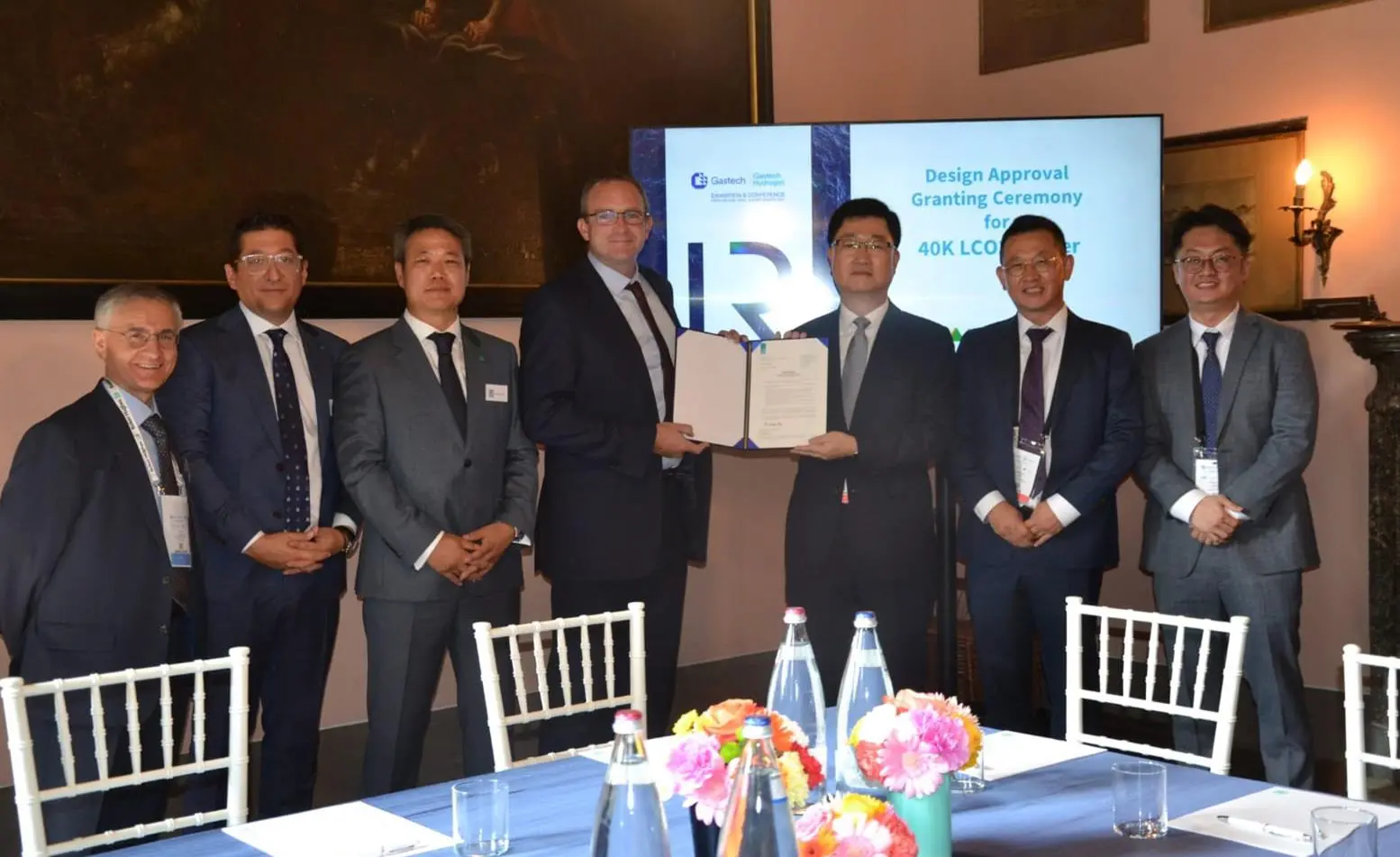
Lloyd’s Register (LR) awarded Design Approval to HHI for the development of the world’s first 40,000 cbm LCO2 carrier. The vessel will be equipped with seven IMO Type C cargo tank that use a new steel design which allows tanks to be constructed with lighter scantlings whilst maintaining structural integrity.
The design achieved Approval in Principle (AiP) from Korean Register (KR) in June. A Type C tank capable of withstanding a high vapor pressure of five atmospheres or more was required for the LCO2 storage design, but this tank type is typically only used for small carriers at present. To secure the economic feasibility of a large tank, a low-temperature and high-tensile steel was included in the design so that the containment system did not become excessively heavy.
HHI is also undertaking the design of what is likely to be the world’s largest LCO2 carrier at 74,000 cbm with ABS, and the Republic of the Marshall Islands (RMI) Maritime Administrator.
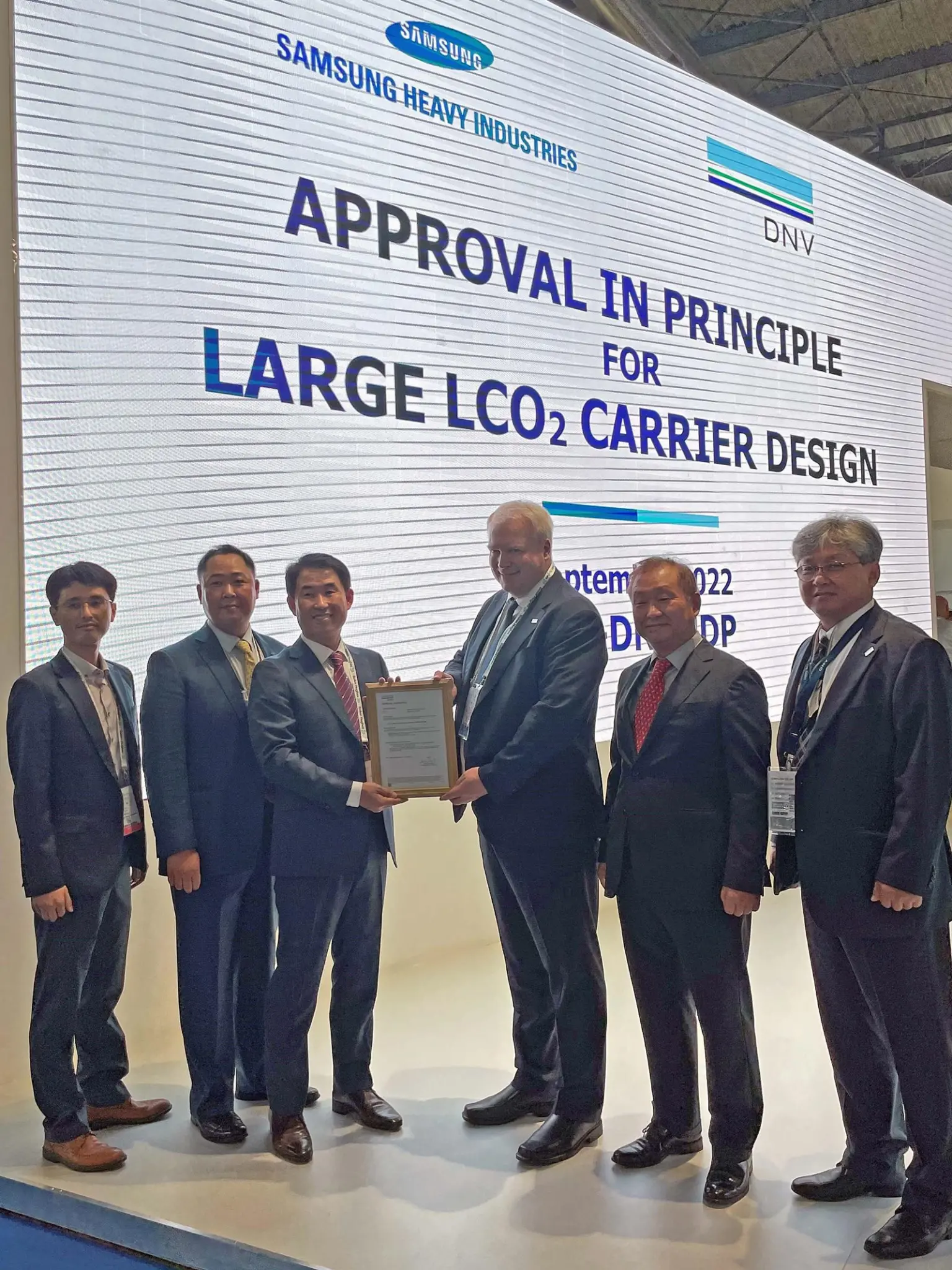
Meanwhile DNV has awarded an AiP to SHI for a new LCO2 carrier design that includes large, bi-lobe IMO Type-C tanks and highly efficient reliquefication technology.
This is a different design to the one that DNV granted AiP earlier this year to Knutsen NYK Carbon Carriers (KNCC), again targeting larger storage capacity. The KNCC PCO2 concept aims to tackle the scaling up challenge by transporting liquefied CO₂ at medium-high (35-45 bar) pressure and temperatures in the range of 0-10°C. The PCO2 concept is based on a cylinder type CO₂ containment system applying principles used in compressed natural gas transportation. The CO₂ is stored in bundles of vertically stacked small-diameter pressure cylinders rather than large cylindrical tanks.
The Motorship notes that the system converts the CO₂ into liquid form at ambient temperatures, rather than the cryogenic temperatures required by alternative solutions. This potentially offers cost savings along the supply chain compared with competing solutions which require cryogenic storage.
Back in 2021, ABS and Daewoo Shipbuilding & Marine Engineering (DSME) announced a joint development project for designs for a 70,000m3 carrier. DSME has previously developed a conceptual design of a 100,000m3 LCO2 carrier, and partners are studying the potential application of various steel as well as existing low-temperature steel for the storage tanks.
Japanese yards have designs underway
Earlier this year, ClassNK granted AiP for a design developed by Mitsubishi Shipbuilding and NYK Line. The AiP was issued for both medium and large capacity vessels. ClassNK has also granted AiP to Mitsui O.S.K. Lines (MOL) for the design of a large-scale carrier.
Mitsubishi Shipbuilding and MOL have introduced a concept study on a design flexible enough to carry either LCO2 or ammonia. The idea is to tap into both the carbon capture and storage market and the growing potential of ammonia as a fuel for decarbonisation. Like the LCO2 carrier, for which a concept study was completed in November 2021, the cargo tank capacity of this carrier is expected to be around 50,000 cbm.
Global orderbook grows
Clarksons recently noted that ship designs for CO₂ carriage are evolving rapidly, with yards exploring various ship sizes and different pressure/temperature capabilities. While only a handful of small vessels have been ordered to date, there are strong indications that demand for CO₂ carriage will grow. Given the diversity of requirements and the costs involved means speculative orders are unlikely, says Clarksons. Instead, vessels are likely to be ordered against firm, long-term projects. “Virtually all the major shipyards in China, South Korea and Japan are working on CO₂ vessel designs. These range from 4,500 CBM right up to 70,000 cbm capacity and are at various stages of advancement.”
Orders for larger vessels are yet to come, and Clarksons says that the market can appear inflated because multiple companies are making inquiries related to the same projects. “Yards are understandably looking to protect their designs by only releasing them under a signed NDA against named projects. For specific sizes of vessels, there may only be three or four yards with designs which are advanced enough to take orders within specific time frames.”
The current orderbook includes a 1,450 cbm carrier for Sanyu Kisen and two 7,500 cbm carriers ordered by the Northern Lights JV from China’s Dalian Shipbuilding Industry. The three vessels are expected to be delivered in 2024.
Related Articles
 ALTERNATIVE FUELS & LUBRICANTS
 GENERAL NEWS
 GENERAL NEWS