



Pockets Of Endeavour In Southern Asia
Shipbuilding has a long tradition in Goa, and the past 15 years or so has seen the local industry consistently raise its profile on the international stage. Having broken into the export market with a 12-ship coaster deal from north European owners in 2005, the shipbuilding division of the mining and industrial group Chowgule has continued to raise its game through a diversified output, combining domestically-honed craft skills and foreign design input.
A further stage of business development has recently been denoted by the extension of a newbuild deal with Swedish interests, entailing an innovative class of diesel-electric hybrid cargo vessels. Having booked six such 90m newbuilds of 5,350dwt from Chowgule & Company in September 2021, the Swedish company AtoB@C Shipping subsequently added a seventh vessel to the programme in June this year before going on to exercise options on five more ships during August, taking the series to 12.
AtoB@C is a subsidiary of Finnish dry bulk specialist ESL Shipping. In conjunction with institutional and private investors, which will own six of the new vessels, ESL will establish a pooling structure within which the class will be deployed. The GreenCoaster pool will be specific to vessels of the energy-efficient, environmentally-considerate standard set by the electrically-driven, nascent generation. It is claimed that the newbuild type’s overall greenhouse gas emissions, including CO2 per cargo unit, will be almost 50% less than existing ships of similar size.
From an Indian shipbuilding perspective, the project award is significant not only in its aggregate value (estimated at around $140m) and scale of serial production, but also as to the technical level involved. Chowgule’s successful execution of the project in line with the stipulations and expectations of Nordic players will undoubtedly strengthen the Indian company’s standing at a time when the global shipping industry is focusing increasingly on decarbonisation pathways and solutions.
The first of the 12 newbuilds is due to be completed during the third quarter of 2023, and the final ship is expected within the second quarter of 2026. Specified to 1A ice class, the design and model testing has been undertaken in conjunction with northern Netherlands-based SMB Naval Architects & Consultants. Bridge and accommodation are arranged forward, leaving an obstruction-free weatherdeck and flush hatch covers accessing a box-shaped hold of 7,650m3 capacity.
An energy storage system and electric drive configuration will enable the ships to enter and leave port solely on battery power, saving fuel and obviating both pollutant emissions and noise. Provision has been made for electrical power to be drawn from ashore when alongside.
The sixth and last of a series of 4,200dwt multi-purpose cargo vessels, Lady Hannah, was handed over by Chowgule to Dutch owner Wijnne Barends in December. The sextet of 98m singledeckers was constructed at the Loutolim yard, where deliveries began in June 2019. Lady Hannah was the 32nd newbuild completed for a European client, and the design featured hull reinforcement to Swedish/Finnish 1A ice class and Wartsila medium-speed propulsion machinery certified to IMO Tier III NOx emission standard.
Chowgule first made its mark in the north European coastal and short-sea community 17 years ago by landing a 12-ship programme involving 4,450dwt cargo vessels for operators in the Netherlands and Germany. The series opened with the Damsterdijk in 2007, and the Indian builder went on to win contracts for 20 more newbuilds in the 4,200-5,650dwt range for Dutch, German and British clients before attracting the initial tranche of orders in the current production run for AtoB@C Shipping.
The shipbuilding activities vested in Chowgule & Company encompass the Loutolim and Rassaim shipyards in Goa, some 7km apart, plus the plate preparation and pipe bending plant at Gadegally. The largest site, Loutolim, features a 220m slipway and two construction berths of 130m and 90m, with supporting equipment including 60t Goliath cranes, 70t overhead crane, 50t transporter and hull block and hatch cover fabrication workshops. Rassaim’s 123m side-launch facility is served by a parallel assembly area extending back for 27m.
The builder has a long track record in the production of vessels for the inland waterway network, not least ore-carrying barges, grab and suction dredgers, tugs and various types of workcraft, plus trawlers, small naval vessels and Coast Guard units.
A new showcase for Indian shipbuilding is the Vikrant, the country’s first aircraft carrier to have been designed and constructed indigenously, previous vessels having been either of British or Russian origin. Completed by Cochin Shipyard (CSL) towards the end of July 2022, followed by induction into Indian Navy service during August, Vikrant is testament to high-end technical capabilities within the industry.
The basic design was drawn up by the Indian Navy and the detailed engineering, construction and system integration was undertaken by the Cochin yard, the publicly-owned enterprise located on the south west coast in Kerala State. The project took the application of comprehensive 3D modelling, and extraction of production drawings from the 3D model, to a new scale in India. With a displacement of some 45,000t, the Vikrant is the largest warship ever built in India, and is powered by four gas turbines in a COGAG (combined gas and gas) propulsion configuration.
Fincantieri, which built two fleet replenishment tankers for the Indian Navy in 2011, forged collaboration with India back in 2004 when contracts were signed relating to engine system design, technology transfer and provision of complementary services for the Indigenous Aircraft Carrier project, realised as the Vikrant.
The Italian international group deepened its commitment to the Indian market in 2020 by signing an understanding for cooperation with CSL in various fields, including design, procurement and local construction of new vessels for the Indian defence sector, and local production and marketing of mechanical equipment such as propellers, shaftlines, stabilisers, steering systems and thrusters, naval automation development and training of Indian personnel.
The Cochin yard is currently building eight anti-submarine warfare, shallow-water craft for the Indian Navy, and recently secured an order for six next-generation missile vessels. Centrepiece of development plans is a new dry dock sized for larger ships than hitherto, including a future, further aircraft carrier.
Recourse by Scandinavian principals to the Indian sub-continent for short-sea tonnage of advanced type is also presently illustrated in the production programme at Sri Lanka’s Colombo Dockyard (CDL). The soon-to-be-delivered, 90m Misje Vita is the first in a series of 5,000dwt dry cargo vessels booked by Kare Misje of Norway and is notable for a hybrid propulsion arrangement and provision for future, zero-emission operation.
CDL’s contract entails six such newbuilds for the shipping group’s Bergen-based division Misje Eco Bulk, which holds options on a further four vessels. The concept and basic design has been prepared by the Norwegian arm of Wartsila Ship Design. A Wartsila 20-type medium-speed engine is complemented by an electric hybrid solution delivering power through a 1,000kWh bank of batteries.
The singledeckers will cater to the range of bulk commodities, including timber and steel products, and will meet IMO Tier III standards through the adoption of selective catalytic reduction (SCR) technology. As well as 100% NOx abatement, it is claimed that the class offers a 47% reduction in both SOx and CO2 emissions relative to comparable, existing tonnage. The energy storage system promises emission-free port entry and departure, while the shore power connection will also reduce environmental impact when alongside and handling cargo.
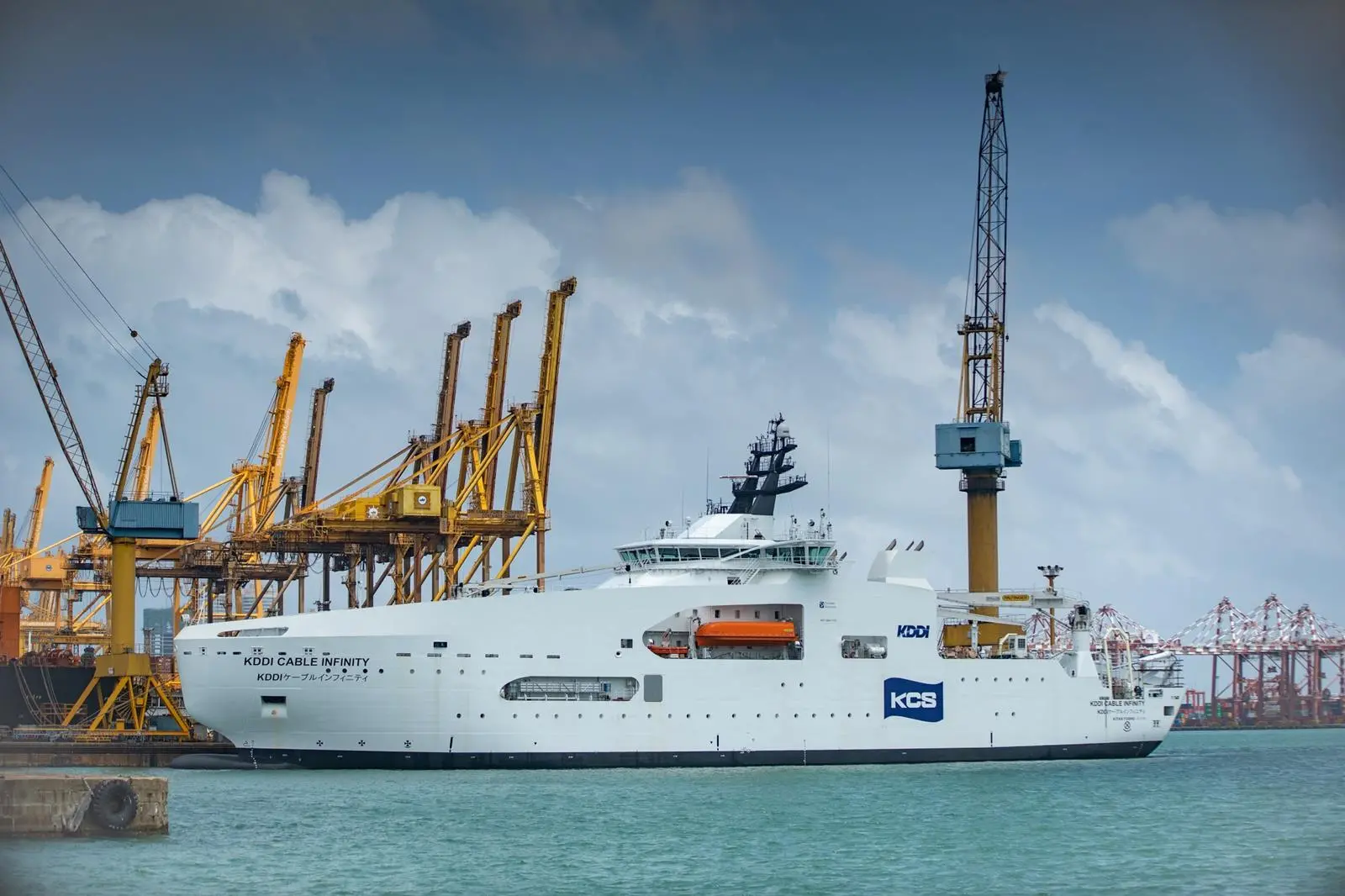
One strand of CDL’s business strategy has been to target the European market, with particular reference to demand for smaller classes of vessels incorporating greater technical sophistication, such as the minibulkers for Norway, plus cable-laying and cable repair ships, and service operation vessels for the offshore energy sector. The Colombo yard showed its mettle in 2019 through the delivery of its longest ship and most valuable contract hitherto, the 113m Japanese ocean cable-layer KDDI Cable Infinity. This accomplishment was followed in 2020 by another export deal calling for a 100m cable-laying and repair ship for Orange Marine of France, to be completed during 2023.
While CDL’s majority shareholder and technical collaborator is Onomichi Dockyard of Japan, Sri Lanka’s Government retains a vested interest through a 35% stake.
The yard has, however, suffered a setback through the cancellation in July this year of contracts with Edda Wind for two commissioning service operation vessels (CSOVs). The Norwegian company attributes the annulment to the detrimental effects of the Sri Lanka’s national economic crisis, which has apparently impinged on the yard’s ability to fulfil the project.
The commanding feature of Pakistan shipbuilding is naval work to domestic account, participation in the international commercial market being negligible. Technical progression in combination with a reliance on technology transfer from overseas specialists is expressed in the current workload at Karachi Shipyard & Engineering Works (KS&EW), which launched a Milgem-class corvette in May this year, part of a $1.5bn deal Pakistan signed with Turkey in 2018. Turkish defence company ASFAT is acting as the main contractor for the four-ship programme, with two vessels being constructed in Istanbul and two by KS&EW.
The Karachi yard is also looking to an extensive Pakistan Navy submarine programme, whereby a total of eight boats are envisaged under a deal with China. Four of the diesel-electric submarines will come from China, and four are to be constructed by KS&EW.
Bangladesh is a longstanding recipient of Dutch know-how in waterway maintenance and dredge technology, and this connection has found new expression in the latest contract award to Royal IHC. Four cutter suction dredgers to be constructed by Karnafuly Ship Builders for the Bangladesh Inland Water Transport Authority (BIWTA) will embody design, engineering and hardware input from the Dutch group. Furthermore, Royal IHC will provide yard assistance for the installation, testing and commissioning of the equipment and the vessels.
Two of the newbuilds will be of 74m and the other pair will be of 54m, and the vessels’ maintenance dredging function will serve both the country’s constant battle against flooding and the need to keep waterways navigable during the dry season.
Royal IHC has supplied numerous Beaver-type, standard modular dredgers and workcraft to the country’s public and private sectors over the past five decades, while a deal completed six years ago saw the delivery of design, engineering and component ‘packages’ plus shipbuilding back-up for the construction of 10 cutter suction dredgers.
Related Articles
 METHANOL
 GENERAL NEWS
 HYDROGEN