



Methane slip reduction technologies ready for 2023 testing
Hans-Philipp Walther, Head of Exhaust Gas Aftertreatment at MAN, spoke about the engine manufacturer’s methane slip reduction efforts for 4-stroke engines. Development of a pre-turbo methane catalyst is underway as part of the IMOKAT II project, and full-scale tests are expected next year. The project has identified a catalyst that does not contain precious metals, as such catalysts typically do, which is therefore much more resilient against suffer sulphur poisoning over time. “You start with a lower conversion rate, but, on the other hand, this material is stable over time,” says Walther.
Other engine-based approaches that have been taken to optimise the oxidation of the methane include adaptive combustion control and skip firing where some cylinders are shut down at low load. That is in addition to within-engine design changes including crevice volume reduction and closed crankcase ventilation.
Benjamin Attumaly, a MAN Energy Solutions secondee to MMMCZCS, spoke about the engine manufacturer’s methane slip reduction efforts for 2-stroke engines, noting that the issue of methane slip has been solved for MAN’s Diesel cycle engines through initiatives such as the reduction of gas pockets inside the combustion chamber and by ensuring that gas is injected into the top centre of the engine.
For low pressure, Otto cycle engines, direct methane slip from the cylinder into the atmosphere via the exhaust valve has also been eliminated. Combustion slip caused by incomplete combustion in lean or cold conditions, such as low load, has been addressed by the inclusion of exhaust gas recirculation systems which reduce methane slip by at least 50%.
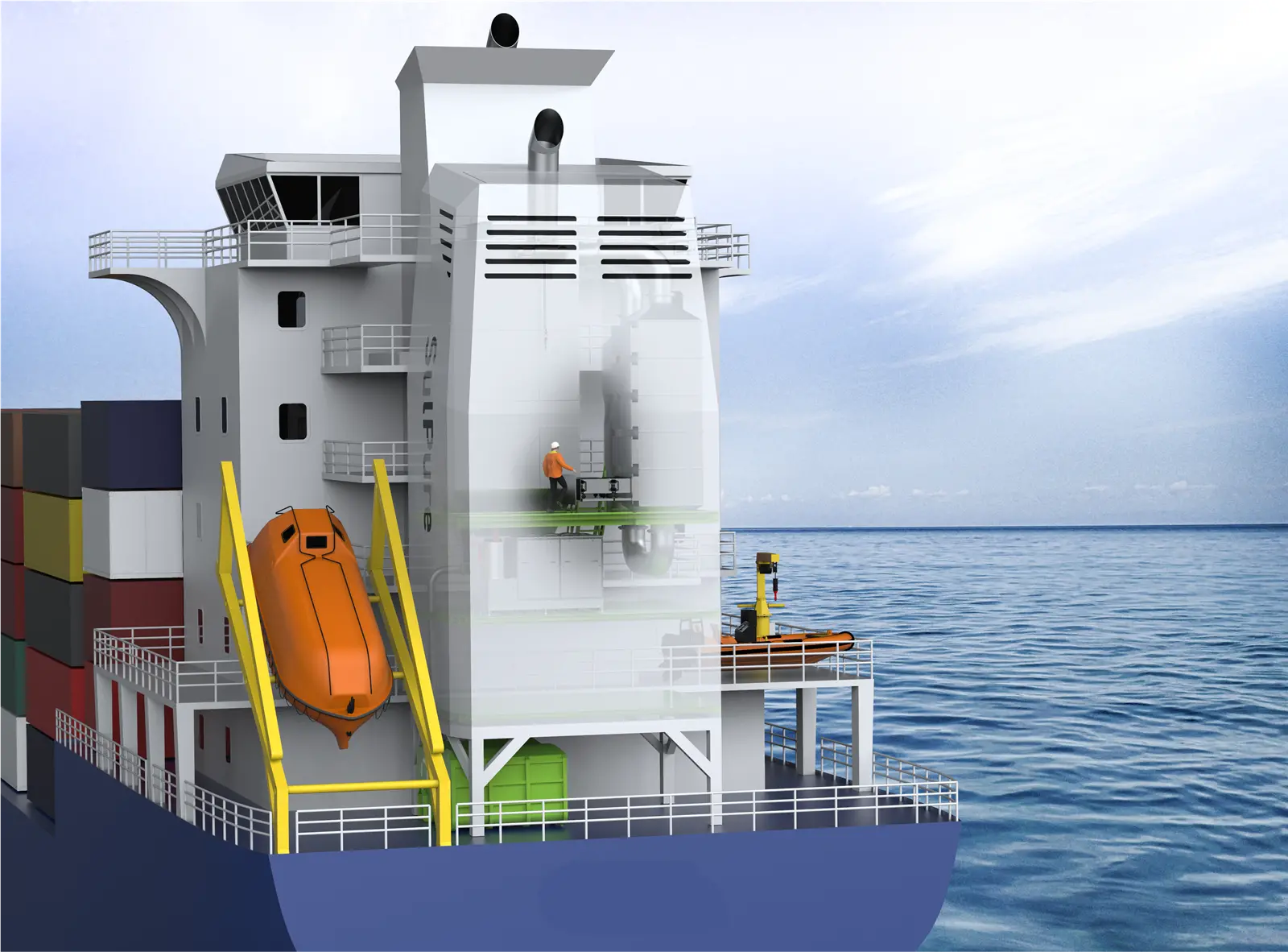
Thomas F. Werner, Chief Product Officer at Daphne Technology, says the company is planning a land-based test of a catalyst-free, electrical system this year on a 700kW gas engine at a test facility in Germany. This will be followed by a pilot installation next year.
The patented SlipPure system converts electrical energy to chemical energy, generating hydroxyl radicals and free electrons which then react to convert the methane to carbon monoxide and water. Methane reduction rates of 78% have been achieved in testing.
The technology is largely temperature independent (catering for exhaust temperatures of between 180oC and 450oC) and is also independent of sulphur content and humidity in the exhaust gas. It is suitable for Otto or Diesel cycle and 2- or 4-stroke engines, and can be installed in several orientations before or after an economiser. Back pressure is within the tolerance of engine manufacturers. Daphne Technology intends to build up a modular system on 1.5MW units to provide a range of up to 220MW.
Janus Emil Münster-Swendsen, a Topsoe secondee to MMMCZCS, says the company is focused on catalyst development for 4-stroke engines and has developed a sulphur tolerant catalyst that is active at lower temperatures. This means the treatment system can be located upstream or downstream of the turbocharger, with a tailpipe solution suitable for retrofits. Sulphur content will still need some control, but the catalyst is suitable for the low sulphur fuels available today. He says Topsoe is ready to conduct demonstration testing after the success of lab-based tests which showed methane can be completely removed.
These technology developments come as the MMMCZCS paper identified liquefied electro- and bio-methane as potential, and popular, low-emission alternative fuel pathways to decarbonisation.
Currently, there are no international regulations on methane emissions from vessels. However, ongoing initiatives and regional guidelines indicate that regulations are highly likely to appear soon. The FuelEU for Maritime regulation, for example, will include methane slip in its CO2-equivalent methodology.
While CO2 is the main source of shipping’s climate impact with over 90% of total greenhouse gas (GHG) emissions, methane has a higher climate impact in terms of global warming potential (GWP). As a result, methane emission reduction can be an efficient way to reduce a vessel’s overall CO2-eq emissions, allowing compliance with upcoming regulations and increasing the viability and competitiveness of methane-based alternative fuel pathways.
A dedicated MMMCZCS working group was established to study reducing methane emissions onboard vessels. Based on its results, the following conclusions were made:
- A vessel’s total methane emissions should be considered: While the main source of onboard vessel methane emissions is methane slip from main and auxiliary internal combustion engines, total methane emissions of a vessel is highly dependent on a vessel’s operations, system dimensioning, machinery configurations and connected technologies. In addition to selecting baseline engine and potential after-treatment technologies, system solutions can significantly reduce onboard vessel methane emissions.
- Cost-efficient onboard vessel methane emission reduction is possible but limited for existing vessels: For the vessels studied, onboard methane emissions can be cost-efficiently reduced by 40-80% for a newbuild and 20-50% for an existing vessel through the selection of baseline engine technologies and the use of after-treatment technologies and system solutions. These reductions translate to onboard methane emissions being reduced from 7-14% of total tank-to-wake (TtW) GHG emissions to 2-8% for a newbuild and 4-12% for an existing vessel. Cost efficiency is considered as being less than the forecasted cost of bio-methane and is associated with CO2-eq abatement cost of less than about $200/tonCO2-eq. The report states that shipowners should carefully consider onboard methane emission reduction at the newbuild phase to avoid potential costly modifications later in the vessel’s lifetime. While it is technically feasible to further reduce onboard vessel methane emissions beyond these levels, utilising other options like the use of low-emission fuels could be more cost-efficient if further GHG emission reductions are required.
- Reducing onboard vessel methane emissions are needed to increase viability of electro- and bio-methane fuel pathways: Reducing onboard vessel methane emissions to these cost-efficient levels increases the longer-term viability of the electro- and bio-methane fuel pathways. However, it is still unclear if upstream well-to-tank fugitive emissions can be reduced to acceptable levels. Using the FuelEU methodology and cost-efficient onboard methane emission reduction measures, GHG WtW emissions can be reduced to 5-9g CO2-eq/MJ using 100% electro-methane and hydrothermal liquefaction Oil as a pilot fuel (a 90-95% decrease relative to heavy fuel oil).
- Proposed FuelEU for Maritime limits are not strict enough to activate onboard vessel methane emission reduction: For the vessels studied, GHG emission levels are already compliant with the 2025 and 2030 FuelEU GHG intensity index limits without introducing any onboard vessel methane emission reduction measures. This is due to LNG’s lower CO2 emission factor used within its 100-year GWP methodology. If a CO2-eq regulation with the proposed FuelEU limits is introduced, no emission reduction actions would be needed until 2035.
- Regulation is required for widespread adoption of onboard vessel methane emission reduction technologies and solutions: Without strong incentives or regulatory requirements to reduce methane emissions, there is limited commitment from shipowners to adopt methane emission reduction technologies and solutions. There are ongoing discussions at the IMO to include methane into its LCA methodology, a CO2-equivalent approach like FuelEU. There is also the possibility that methane is regulated in a more direct way using a vessel’s Technical File like NOx emissions. This type of regulation could more directly target methane slip levels and the need to reduce them onboard the vessel either for newbuilds or existing vessels if retroactive.
To properly assess the viability of methane-based alternative fuel pathways like electro- and bio-methane, the ability to reduce upstream well-to-tank fugitive emissions needs to be fully understood. Upstream fugitive emissions are not covered in this paper but are currently being studied at the MMMCZCS to enable a complete viability assessment of the methane-based fuel pathways. The MMMCZCS also plans to study onboard vessel emissions in operation where factors like dynamics engine loads and sea states can influence methane emission levels.
Despite the slow progress to incentivize or require LNG-fuelled vessels to limit their methane emissions, there is significant international social pressure to reduce emissions of GHGs, particularly methane. From the Global Methane Pledge (COP26) to the US Inflation Reduction Act of 2022, growing worldwide concern is strongly pushing for GHG reductions to limit the increase in the global average temperature to well below 2°C above pre-industrial levels. It is expected that this social pressure will lead to definitive action by stakeholders across all industries.
The report is available here.
Related Articles
 EMISSIONS REDUCTION TECHNOLOGY
 EMISSIONS REDUCTION TECHNOLOGY
 EMISSIONS REDUCTION TECHNOLOGY