



Science-based benchmarking tool developed
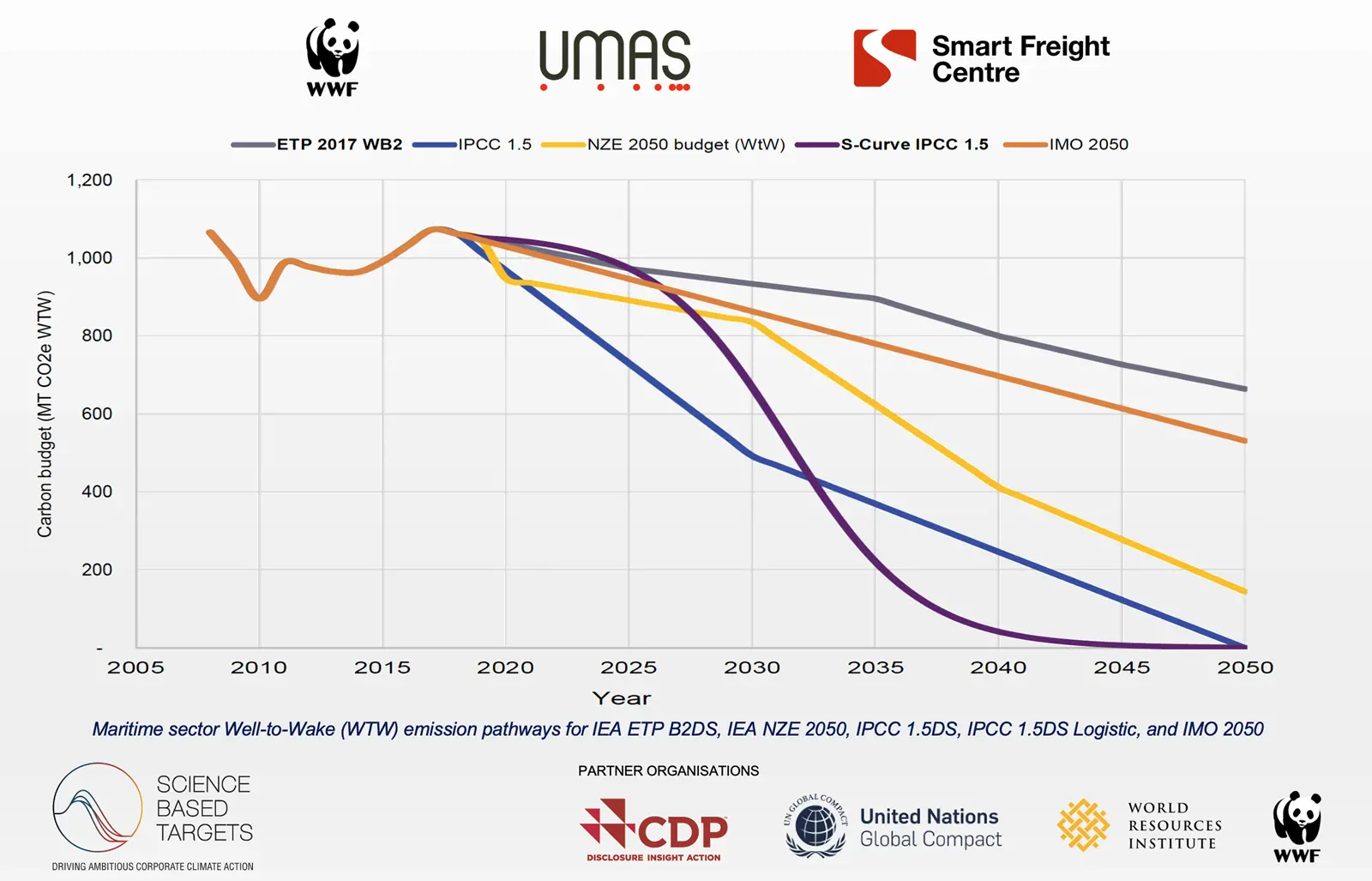
The sector specific tool is the first initiative that provides corporations operating, associated with, or using services from the shipping sector with a concrete way of benchmarking their activity against a 1.5°C target that can guide their short, medium and long term actions.
Developed with support from UMAS and the Smart Freight Centre, the SBTi targets show that alignment with 1.5°C can be expressed by private sector corporations if they adopt strategies to achieve decarbonisation by approximately 2040.
The SBTi tools provide corporations with an approach that can enable and clearly communicate their adoption of a strategy unambiguously aligned with the science from Intergovernmental Panel on Climate Change. It is based on the IPCC’s Special Report “Global warming of 1.5°C” the most recognised and authoritative source of information on the scale of GHG reductions needed.
The SBTi guidance and tools enable the recommendations from the High Level Expert Group on the Net Zero Emissions Commitments of Non-State Entities, released at Sharm el-Sheikh during COP27, which suggest that goals and net-zero alignment should be independently verified by third parties, which includes SBTi among others, to avoid net-zero greenwashing.
Adopting the SBTi targets enables long-term strategy and planning that can protect corporations against the risks of asset-stranding and technology-obsolescence that can arise from policy ambition that ratchets up over time (incremental target setting).
Dr Jean-Marc Bonello, Principal Consultant at UMAS, who provided the technical input to the SBTi maritime tool said; “While the rate at which the carbon intensity of maritime transport needs to decline can feel daunting, this is what the science is dictating. Initiatives such as SBTi are providing a tool for companies to assess their performance and plan ahead to mitigate against costly changes to their operations too far down the line.”
The SBTi includes upstream emissions and all GHG emission species.
The shipping trajectories in the tool take into consideration the rate of diffusion of new technologies and scalable zero emission fuels by basing the trajectory on a S-curve similar to the approach taken by the Getting to Zero Coalition. This means that carbon intensity reduction rates are slower for this decade, as new fuels and technologies emerge, but accelerate sharply in the 2030s, as those technologies scale up, to achieve decarbonisation by the first half of the 2040s.
Many corporations, for example through Cargo Owners for Zero Emission Vessels (coZEV), which includes major retailers such as Amazon and IKEA, have set long-term targets for their maritime freight to be zero emissions by 2040. The new SBTi targets will allow them to benchmark their progress in the short and medium term, including actions that maximise energy efficiency and transparently reporting on their progress against the trajectories.
Related Articles
 ALTERNATIVE FUELS & LUBRICANTS
 GENERAL NEWS
 GENERAL NEWS