



Spanish Yard Books Dutch Research Ship
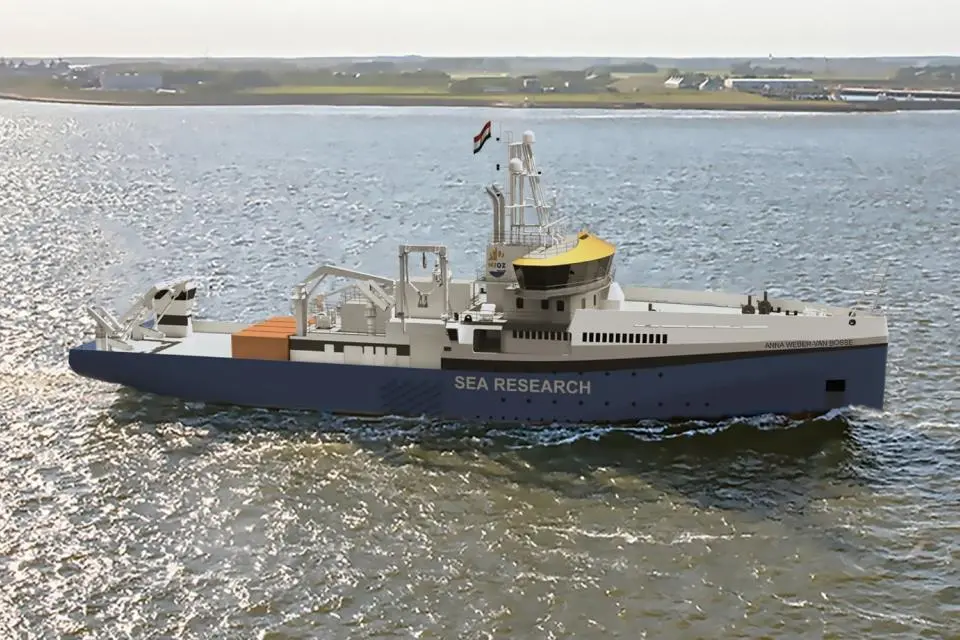
The 80m newbuild for the Royal Netherlands Institute for Sea Research (NIOZ) will be constructed in northern Spain by Astilleros Armon. Earlier indications as to Dutch government policy had led to expectations that such contracts linked to the public sector would provide work for increasingly hard-pressed domestic yards.
However, NIOZ was legally obliged to put the newbuild requirement out to European tender and the Spanish yard, which has extensive experience in producing research ships, landed the deal from a final shortlist of three contenders. The draft design was developed in conjunction with Dutch naval architectural consultancy C-Job.
The vessel is due for delivery in mid-2025 and will bear the name Anna Weber-van Bosse. She will replace NIOZ’s 66m flagship Pelagia, completed in 1990 by Verolme Heusden.
The newbuild has been conceived to be CO2-neutral within 10 years. A signal element in the strategy to achieve this objective is the preparation for the future use of methanol fuel in the ship’s prime movers. Space has been set aside to accommodate methanol storage onboard. The powering arrangements include a battery pack so as to allow hybrid running. Provision has also been made for subsequent installation of solar panels and windfoil fixtures.
Anna Weber-van Bosse will be built to the requisite ice class so as to have the capability to work close to the edge of the ice in the Arctic and Antarctic.
Compared to the existing Pelagia, the new vessel will be fitted with much larger laboratories and will be able to accommodate nearly twice as many researchers. The increase in the number of scientific personnel will make it possible for multiple teams to maintain research work simultaneously around-the-clock.
The newbuild will also differ in being equipped with a DP2 standard of dynamic positioning. The high degree of handling precision consequently afforded is salient to various tasks such as conducting ecology studies in waters encompassed by offshore wind farms. The large after deck offers scope for multiple, modular research containers. The A-frame specified for the aft deck has been sized to facilitate operations with a MeBo seafloor drilling system.
The drop keel makes it possible to use equipment for observations deep in the water column, without obstruction from the boundary layer, and the acoustic outfit includes higher-resolution multibeam technology to enhance measurement precision, especially in shallower waters. The design addresses the requirement for drones, autonomous underwater vehicles (AUVs) and remotely-operated vehicles (ROVs).
The project with Armon constitutes the third stage in the NIOZ fleet modernisation programme. The first stage was realised in July with the completion of the 19m Adriaen Coenen by NG Shipyards at Groningen. The second project entails the 36m Wim Wolff, due for commissioning in the summer of 2023 at Thecla Bodewes’ Harlingen yard, and assembled with sections supplied from yards and fabricators throughout the Netherlands.
Such is Armon’s prolific output in a specialised field that the 2022 completion at Vigo of the 53m Irish ship Tom Crean was the builder’s 10th research vessel completion in as many years. The current workload features contracts for New Zealand and Iceland, plus the recently laid down, 85m Odon de Buen. The latter is set to become Spain’s largest and most advanced research vessel on scheduled handover in 2024.
MAIN PARTICULARS – Anna Weber-van Bosse
|
Length overall |
79.98m |
|
Breadth, moulded |
17.00m |
|
Depth, to main deck |
8.70m |
|
Draught, summer |
5.00m |
|
Draught, scantling |
5.50m |
|
Gross tonnage |
3,481t |
|
Accommodation |
16 crew + 30 researchers |
|
Flag |
Dutch |
Related Articles
 METHANOL
 GENERAL NEWS
 HYDROGEN