



Slew bearings support floating offshore turbine design
A Chinese manufacturer of wind turbines, Ming Yang, has developed a 16.6 MW twin floating offshore wind platform, consisting of two 8.3 MW wind turbines. Their V-shaped downwind rotors have a diameter of 180 metres each. The rotors are mounted on a floating, self-aligning structure, which consists of an anchor buoy, mooring bearing and a steel structure (floating foundation).
Due to a downwind configuration, also known as a lee runner, the wind can be captured from behind to assist the self-alliance of the turbines. The combination of the lee runner, the anchor buoy and the mooring bearing enables the self-alignment itself. The structures are anchored to the seabed by steel cables. An underwater cable transmits the generated electricity to the coast then. This technology opens up the possibility of erecting offshore wind turbines in regions with deeper waters.
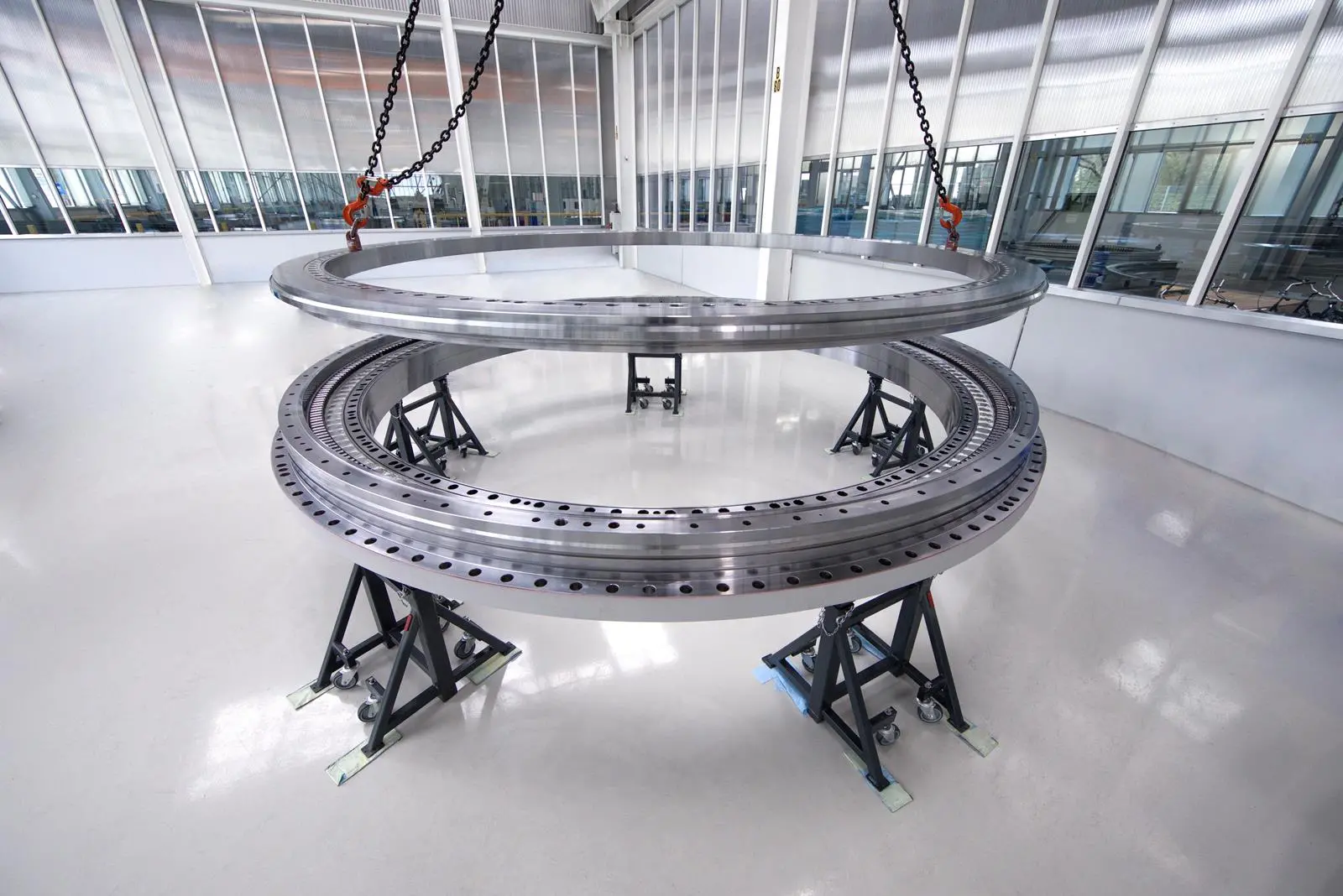
To ensure the self-alignment of these turbines, the Liebherr slewing bearings function as a mooring-system. For this purpose, a 4m diameter bearing is installed as a connecting element between the anchor buoy and the float below the sea surface. Because the slewing bearing has to withstand high pressure and corrosive environmental conditions, some components are made of stainless steel or welded on with stainless steel.
In addition, the bearing has two sensors that can detect the unlikely event of water ingress – for example, when seals wear out – at two measuring points. One is located in the first lower chamber – the second in the second upper chamber of the floating turbine. In this way, Liebherr’s unique smart bearing lubrication monitoring comes into play and shows, whether it is necessary to intervene. In case of maintenance or repair, the float with the turbines can be separated from the anchor buoy and towed to a harbour.
Related Articles
 ALTERNATIVE FUELS & LUBRICANTS
 GENERAL NEWS
 GENERAL NEWS