



New Reefer Boxship Class For Seatrade
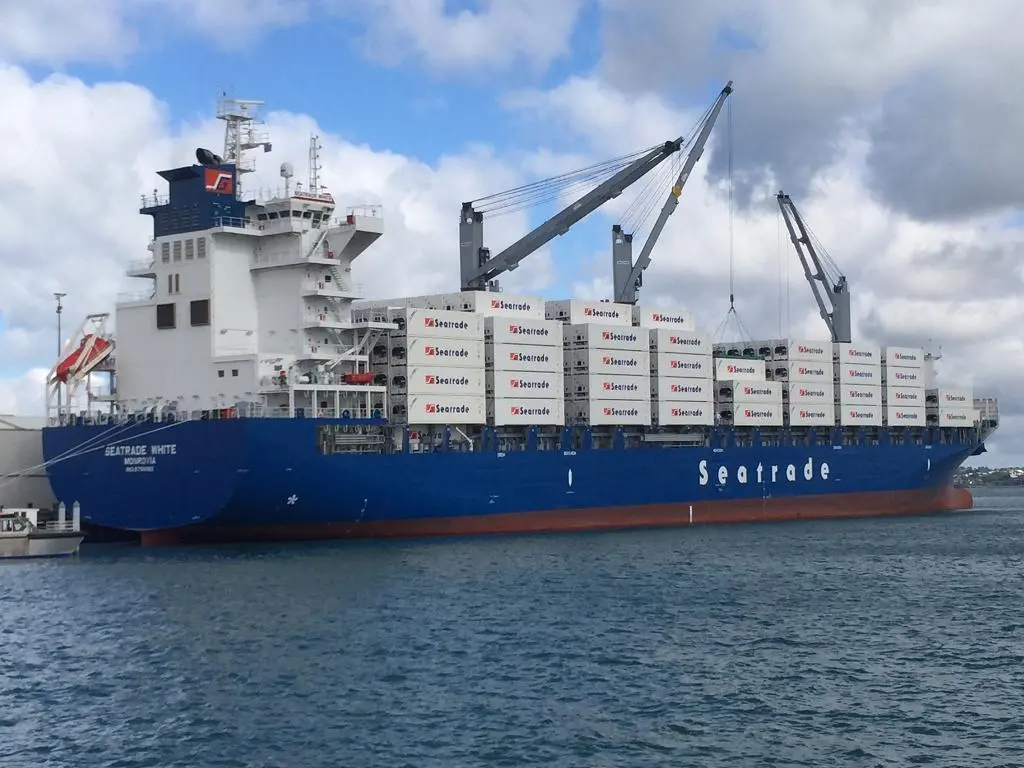
The 172m design employed for a quartet of newbuilds ordered in China will incorporate 639 reefer box sockets, equating to a 1,278TEU temperature-controlled cargo intake potential out of each vessel’s 1,800TEU all-up capacity.
First-of-class Seatrade Chile is expected to be delivered by around November 30 this year, to be followed through 2024 by Seatrade Peru, Seatrade Ecuador and Seatrade Colombia. Dubbed the Country-class, the series from Huanghai Shipbuilding has been customised from the Sealion 1800 Bangkokmax dry boxship type developed by Shanghai Merchant Ship Design & Research Institute (SDARI) and contracted in large numbers by various owners from Chinese yards.
The Seatrade newbuilds will accommodate 20ft, 40ft and 45ft standard and high-cube boxes as well as reefer units, using an arrangement allowing a maximum of 10 rows across the underdeck cellular guide system and an 11-rows on-deck stowage pattern. The reefer capability equates to some 13,000 pallets.
Two-stroke propulsive power has been selected in the shape of a six-cylinder model of the MAN S60ME-C10.5 diesel, certified to IMO Tier III standard by way of proprietary, high-pressure SCR technology. In each case, the engine is being supplied by the licensee at a specified maximum continuous rating (MCR) of 11,800kW and continuous service rating (CSR) of 10,300kW, to drive a fixed-pitch propeller for a speed of 18.7 knots at design draught.
Sized to meet the substantial electrical demands of a vessel orientated to perishable cargo, the auxiliary plant in Seatrade Chile will be based on four gensets each powered by a 1,100kW four-stroke diesel.
The vessels are biofuels-ready, and discussions have been held with the yard and Bureau Veritas (BV) as to a possible upgrade to a methanol-ready notation. In terms of environmental accreditations, the array of BV notations will include Cleanship, Green Passport, and COMF-NOISE3, the latter being adopted specifically in mind of the crew from a habitability perspective.
Prior to the first steel being cut at Huanghai, whose premises are located at Shandong province in the north of China, a model test campaign was conducted at HSVA’s Hamburg facilities to verify efficiency of the bow shape, hull lines, rudder and propeller.
The design provides Seatrade with a high degree of container flexibility while serving the company’s core business in ocean transportation of fresh and frozen produce. A preceding round of investment also undertaken in China, by Yangfan Shipyard, brought the 2,250TEU Seatrade Orange-class of reefer boxships into the fleet from 2016 onwards.
The latest commitment to the box mode by a long-time champion of dedicated reeferships and dedicated reefer services also reflects the unerring shift in deep-sea perishable cargo transportation to containerisation and away from conventional breakbulk.
Related Articles
 METHANOL
 GENERAL NEWS
 HYDROGEN