



MAN ES Forecasts Emergence Of 2-Stroke DF Multi Fuel Market
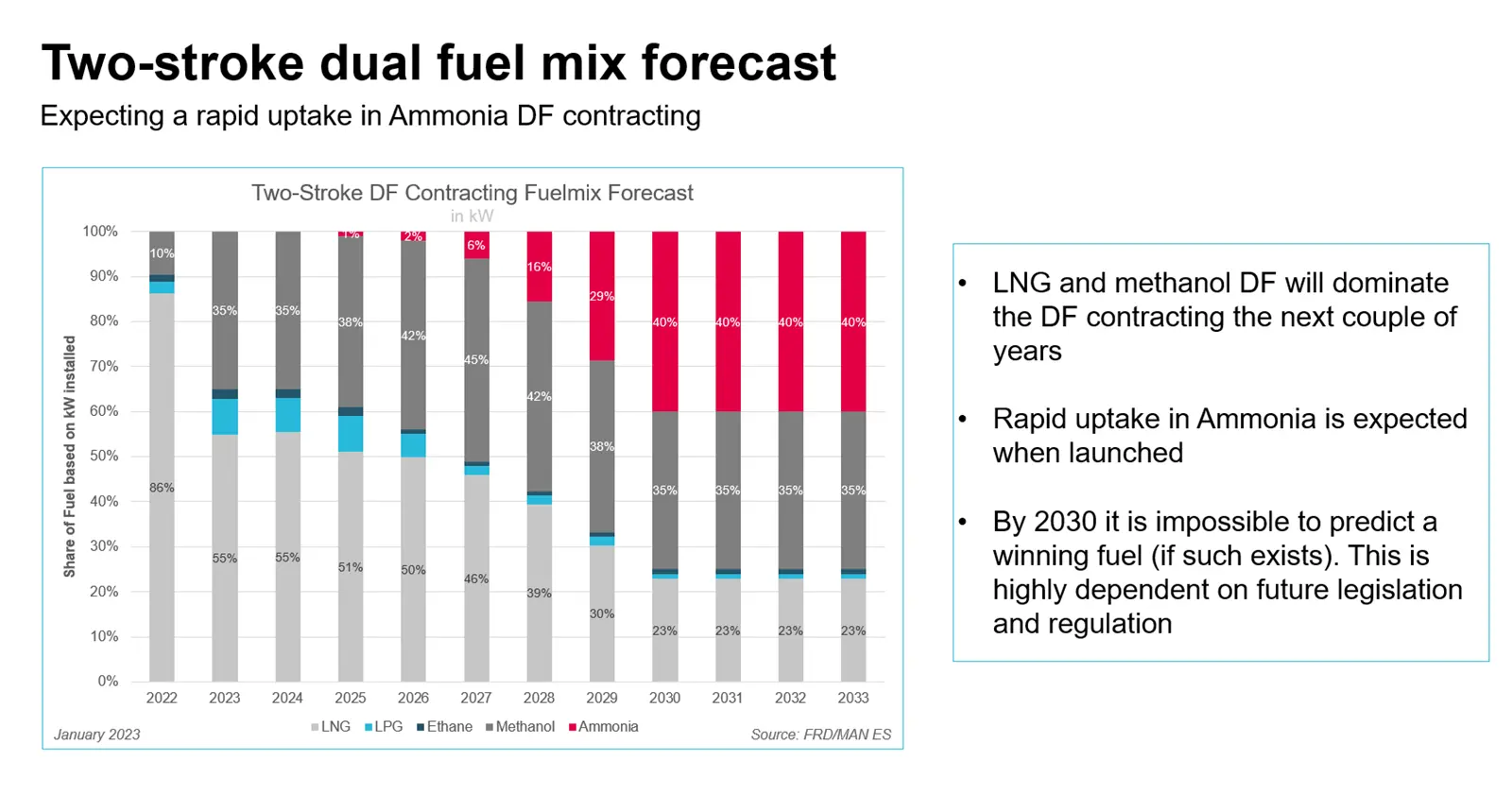
The forecast predicts that the proportion of dual-fuel engines contracted with ammonia will rise from 1% in 2025 to 2% in 2026 before rising to 6% in 2027.
The proportion of NH3 DF engines will rise by over 10 percentage points per year between 2028 and 2030, reaching 40% of contracted dual-fuel engines at the end of the decade.
Although the forecast predicts that ammonia will become the largest fuel type within the two-stroke dual-fuel contracting market by 2030, MAN ES’ internal analysts caution that predictions about the future development of the market are complicated by regulatory and legislative factors.
The Motorship understands that this includes the potential introduction of higher decarbonisation targets by 2050 as well as the possible introduction of a carbon levy, both of which are expected to be discussed at the next meeting of the IMO’s MEPC committee in June 2023.
Methanol share to peak in 2027
The truncated forecast did not include proprietary data about contract volumes and the aggregated data does not split out dual-fuel retrofits from newbuilding orders, so the extent to which ordering cycles in product carrier markets, such as the emerging ammonia carrier market, are expected to contribute to the transformation of the 2-stroke market remains unclear.
Similarly, it is unclear how far the expansion of methanol conversion projects, both from MAN Energy Solutions and from other two-stroke engine suppliers, will contribute to the expansion of the methanol DF market over the coming period.
The forecasts predict that the proportion of DF engines contracted with methanol engines will soar from 10% in 2022 to 35% in 2023, before rising steadily after 2024 to a peak of 45% in 2027. MAN ES notes that the forecast for methanol engine contracting is especially challenging, due to the significant peak in methanol-engine contracting in 2022 and 2023. Therefore methanol-engine contracting may very well end up exceeding this current forecast.
The proportion of engines contracted with specialist alternative fuels, such as LPG and ethane, are both expected to decline over the course of the coming five-year period. The Motorship notes that the retrofit market for the conversion of existing LPG carriers to DF LPG operation is expected to diminish over time, owing to the transition of the entire class of carriers to LPG-fuelled propulsion.
Decline of LNG share
One particularly noteworthy aspect of the forecast is the expected decline of LNG’s share among two-stroke DF engine contracts.
MAN ES’ internal analysts note that LNG will remain the market-leading DF engine type until 2027, but add that the increase in methanol DF contracts and the emergence of ammonia DF contracts will erode LNG’s market share.
DF engines contracted with LNG engines will decline from 55% in 2023 to 51% in 2025, before slipping to 46% in 2027.
2030 and beyond
The forecast expects ammonia to achieve a market share of 40% of two-stroke DF engine contracting by 2030, when it will surpass methanol for the first time. The proportion of engines powered by methanol is expected to decline to 35% in 2030, while LNG DF engines will decline to just 23% of engines. DF engines capable of operating on the three fuel types will account for 98% of the engines contracted.
Uncertainties accumulate after 2030
The two-stroke dual fuel mix forecast has been produced by internal analysts within MAN Energy Solutions’ Two-Stroke business in Copenhagen.
Market forecasts produced by 2-stroke engine designers have tended to be highly accurate over the near to short term, reflecting the longer lead time of commercial ship construction, which can extend to over four years or more from initial customer enquiries.
However, MAN ES has previously identified the development of onshore alternative fuel infrastructure, as well as the emergence of international supply chains as potential brakes on the pace at which alternative fuels can enter the supply chain.
Related Articles
 ALTERNATIVE FUELS & LUBRICANTS
 GENERAL NEWS
 GENERAL NEWS