



Seminal Japanese Delivery For Renewables Sector
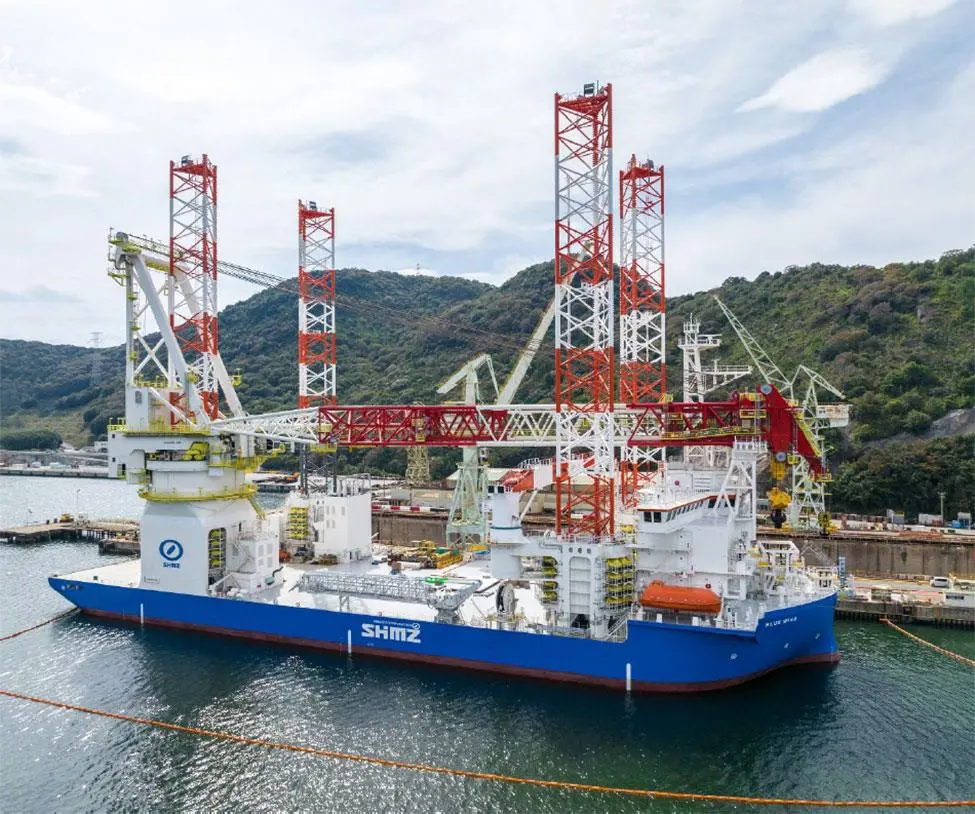
Ranking among the largest and most heavily equipped worldwide, the jack-up was ordered by the Shimizu Corporation, with operational management assigned to Fukada Salvage & Marine Works. The design and key equipment emanates from the Dutch company GustoMSC, and the vessel’s construction was effected at the Aioi yard of JMU Amtec.
The landmark shipbuilding contract, an expression of the country’s determination to expand offshore wind power generation, in keeping with the government’s energy strategy and 2050 Carbon Neutrality Declaration, has also made extensive recourse to ABB’s electro-technical technology. Blue Wind is initially being deployed for wind turbine placement in the Nyuzen-machi development off Toyama in the Sea of Japan, after which she has been assigned to the Ishikari Bay New Port scheme in the north off Hokkaido’s western coast.
Blue Wind has given a considerable boost to Japanese capabilities in marine windfarm construction, providing means for transporting and installing wind turbines up to the 15MW size. By way of a GustoMC telescopic leg crane, the vessel offers a lift capacity of 2,500t at 30m with the boom retracted, or up to 1,250t at 47m with the boom extended. Respective maximum lift heights are 118m and 158m. The move to ever-larger turbines can be expected to gain traction in Japan, as in Europe and the USA, as economies of scale impact on the unit costs of power generation and field development.
The telescopic boom avoids the protrusion of a very long crane boom beyond the dimensions of the hull during transits, enhancing transportation conditions and easing the vessel manoeuvring task in ports. The crane is fitted with the maker’s proprietary rack and pinion jacking system incorporating a variable-speed drive.
When deployed during installation work, the four 92m-long, trussed legs penetrate the seabed, elevating the hull clear of the sea surface and creating a stable platform subject neither to waves nor tidal currents, and promoting productivity and safety. The design is said to be well suited to local Pacific conditions characterised by 10 second-long swells.
Blue Wind has main dimensions of 142m x 50m and is able to carry all elements, including foundations, for seven 8MW or three 12MW wind turbines in a single voyage, with scope to handle units of 14-15MW. Once on the field, the vessel has been designed to effect the installation of seven 8MW units in 10 days, or three 12MW turbines in five days, including preparation time.
ABB has supplied a closed-ring configuration for the vessel’s dynamic positioning operations, so as to give safe and predictable performance with high tolerance in the event of a fault on the diesel-electric power plant. The company’s contract encompassed the delivery and system integration of the generators, high-voltage switchboards, the variable-speed drives and motors for main propulsion and thrusters, and the power and energy management system (PEMS).
A total of six diesel generator aggregates imbue a power concentration of 21,370kW, achieved with four main sets rated at 4,630kW apiece plus two gensets of 1,425kW. The prime movers are of Japanese origin, comprising four eight-cylinder models of the Daihatsu DE-33 type and two six-cylinder examples of the DE-series, all of which produce nominal maximum output at 750rpm. The three main propulsors are 3,850kW azimuth thrusters, supplemented for manoeuvring and position holding by a retractable azimuthing unit of 3,200kW plus two 3,200kW tunnel thrusters in the bow.
Blue Wind is also fitted so as to be able to leverage the ABB Ability remote diagnostic service package. The network uses remote equipment monitoring and data analytics for predictive maintenance, planned interventions and technical assistance, supported from multiple shore-based stations.
Japan has set an ambitious goal of 30-45GW of offshore wind power generation by 2040, with 10GW to be realised by 2030.
While Tokyo-based Shimizu is targeting a major share of the work arising from domestic field development, the vessel’s self-propulsion capability in conjunction with the design’s inherent muscle power opens up opportunities for the company to build a presence in other parts of the world. To that end, a wide-ranging pact with Fred Olsen Windcarrier provides for the Norwegian firm to act as Shimizu’s lead partner installation projects outside Japan.
MAIN PARTICULARS – Blue Wind
| Length overall | 142.8m |
|---|---|
|
Breadth, moulded |
50.0m |
|
Depth |
8.2m |
|
Draught, summer |
6.5m |
|
Gross tonnage |
23,539t |
|
Deadweight |
14,052t |
|
Main crane hoist capacity |
2,500t |
|
Operable water depth |
10-65m |
|
Propulsion system |
Diesel-electric |
|
Generators |
4 x 4,630kW + 2 x 1,425kW |
|
Main azimuth thrusters |
3 x 3,800kW |
|
Retractable azimuth thruster |
1 x 3,200kW |
|
Bow tunnel thrusters |
2 x 3,200kW |
|
Transit speed |
11kts |
|
Class |
ClassNK |
|
Complement |
130 |
|
Registry |
Tokyo, Japan |
Related Articles
 METHANOL
 GENERAL NEWS
 HYDROGEN