



Bespoke Ferry For Isle Of Man Run
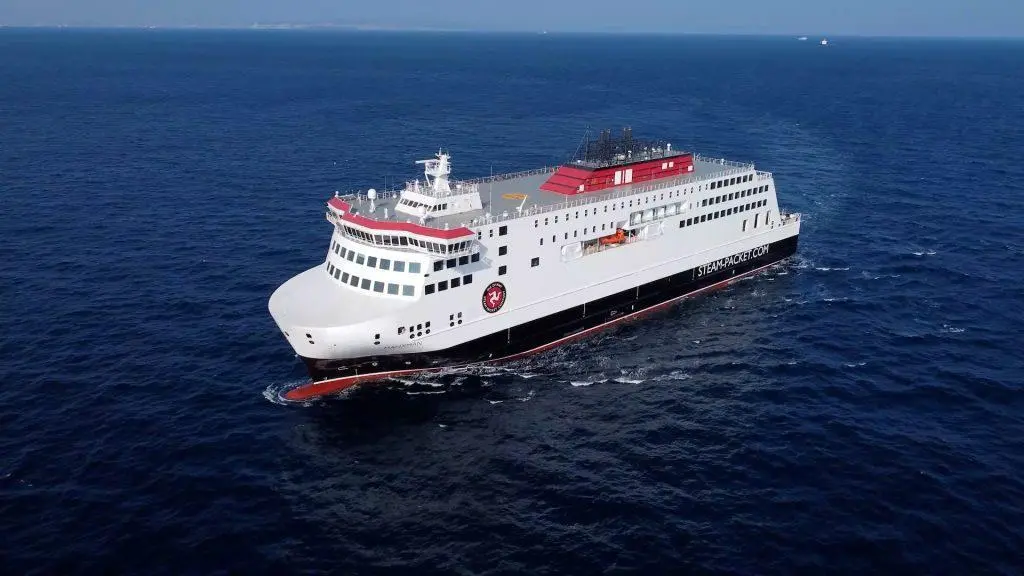
The 133m, twin-screw Manxman is distinguished by a battery/diesel hybrid system, coupled with greater payload capacity than the 25-year old, 125m Ben-my-Chree, the present mainstay of the route linking Douglas with the northwest English port of Heysham. The £78m ($97m) newbuild’s more sophisticated power installation affords a high degree of operating flexibility and economy, and reflects a new environmental standard in relation to her 19-knot predecessor.
The fleet investment project by the Isle of Man Steam Packet Company(IOMSPC) posed several design challenges arising from a significant capacity increase within given operating parameters, notably restrictions at the ports, and the need to ensure year-round service dependability and schedules, along with onboard comfort and habitability, despite often harsh Irish Sea conditions.
Manxman combines a 949-passenger certification, up from the 636 maximum of the Ben-My-Chree, plus nearly 500m2 of additional ro-ro space, amounting to provision for some 1,500 lane-metres of freight and other vehicles, relative to the 1,235 lane-metres of the earlier ship. The newcomer will play a vital economic role in maintaining service continuity and ensuring the safety and competitiveness of the lifeline run between Douglas and mainland UK through the most inclement seasons. The hull lines have been crafted to help achieve smoother motions, while the stabilisers adopted have twice the fin area of those on Ben-My-Chree.
It had been anticipated that Manxman would be ready to make her service debut by the start if the 2023 tourist season, and most especially as regards the annual, two-week Isle of Man TT motorcycle racing programme, beginning this year at the end of May.
However, the planned introduction of the new ship, ordered from South Korean contractor Hyundai Mipo Dockyard(HMD), has been delayed. In January, IOMSPC announced that “Testing carried out by Manxman’s builders during routine sea trials revealed a significant problem in the vessel’s systems.” Reports suggest that the issue related to a mechanical (transmissions) fault, and that the ship’s performance was otherwise positive. Corrective works were put in hand, to be followed by further sea trials.
The bespoke newbuild project has entailed extensive collaboration with specialist organisations. IOMSPC retained UK consultancy Houlder as technical advisor, which offered insights into regulations and compliance, providing pragmatic solutions to the various technical and logistical considerations, and contributing to the dialogue with the shipbuilder throughout the plan approval and build stages.
The shipowner’s fleet operations manager Jim Royston said that Houlder had effectively integrated with the IOMSPC team. “We last worked with Houlder on a newbuild back in the early 1990s and a lot has changed since then in terms of regulations and design standards. Through an in-depth understanding of our operations, Houlder has provided frictionless mediation between ourselves and HMD offering constructive perspectives on challenges faced, and working proactively to minimise delays relating to class society approval. Essentially, it’s a service we didn’t know we needed, but one we’re incredibly grateful to now have access to,” observed Mr Royston.
Hong Kong-based SeaQuest Marine has also been engaged for on-site supervision at the Ulsan yard, and for advising the shipowner’s team on specialist areas of the build including weld inspection, pipe production and test, paint preparation and application, electrical and machinery installation, and further down the line during the testing and trials process.
Wartsila worked closely with IOMSPC to devise a functionally integrated package based on the vessel’s operating profile and customer-specific requirements. Reliability, efficiency and low operating costs were key tenets. Central to the overall solution is the Finnish group’s W31-series medium-speed engine technology, reckoned at the time of ordering as 8% more efficient than other options, exerting a correspondingly beneficial impact on unit exhaust emissions, coupled with the flexibility conferred by a four-engine installation.
Excess electricity generated will be stored by the vessel’s batteries, which will be brought on line during periods of higher load or while the ferry is in port, so as to curb emissions and noise. The solution overall allows various operating permutations and ensures that machinery can be run as close as possible to its sweet spot, or most efficient point, in accordance with the changes in the load profile and demand on the route involved.
The power plant comprises two 10-cylinder and two eight-cylinder models of the W31 four-stroke diesel, yielding around 22,000kW overall. The machinery choice will help the shipowner meet a corporate target of delivering a far more ‘sustainable’, environmentally-friendly operation. Moreover, the type of engine chosen offers the flexibility to take advantage of alternative future fuels as they become available and viable, and can utilise artificial intelligence(AI) and machine learning under a condition-based maintenance regime.
The scope of Wartsila’s supply also embraced the two 1,582kWh banks of batteries, Low Loss Concept(LLC) power distribution, electrical and automation systems, and transverse thrusters. The array of three bow tunnel thrusters, giving twice the output available from the units in Ben-my-Chree, confer the requisite manoeuvrability of the larger ship in the tight confines of the ports at each end of the route.
Wartsila’s stamp on the Manx fleet development includes the Aquarius UV ballast water management plant and NACOS Platinum integrated navigation system incorporating a newly-developed bridge console design.
The Dutch company Heatmaster, which has its own factory in China, supplied the main heating and hot water storage systems, tapping the heat energy in the engine exhaust gases by way of four economisers. Standby capacity plus in-port heating is provided by an electrical heater.
The shipowner’s investment in available technology to attain a safety standard beyond that of regulation is expressed in its nomination of two NAPA onboard systems. NAPA Emergency Computer assesses the vulnerability of an intact ship as well as its survivability in the event of a flooding emergency, while NAPA Loading Computer optimises vessel load while minimising stress and safety risk.
The Finnish software specialist also achieved its first installation at HMD by way of its 3D modelling and design functionalities and hull form optimisation, stability assessment, and initial structural design systems for the Isle of Man contract.
The new vessel has been flagged with the Isle of Man register, extending a longstanding relationship between the two organisations. The registry’s role during the newbuilding process has included liaising with the shipowner, classification society Lloyd’s Register, and the shipyard, and providing input as to international convention compliance in the context of the more novel design features. Once the ferry has taken up regular duties, the registry team will continue to afford technical and regulatory oversight
Ben-my-Chree will be retained as a back-up vessel, enhancing security of IOMSPC’s passenger and freight connections and affording still more capacity during annual traffic peaks around the time of the TT gatherings.
The ferry was a product of the former Van der Giessen de Noord yard in 1998. Powered at 8,640kW by twin MaK medium-speed engines, and designed to meet the constraints of Douglas and Heysham harbours, she was a shortened derivative of two vessels used in the UK/Benelux trade by North Sea Ferries (later P&O Ferries). Ben-my-Chree is regarded as one of the most reliable ships in the company’s history.
Related Articles
 METHANOL
 GENERAL NEWS
 HYDROGEN