



Russia doubles subsidies for domestic civil shipbuilding sector
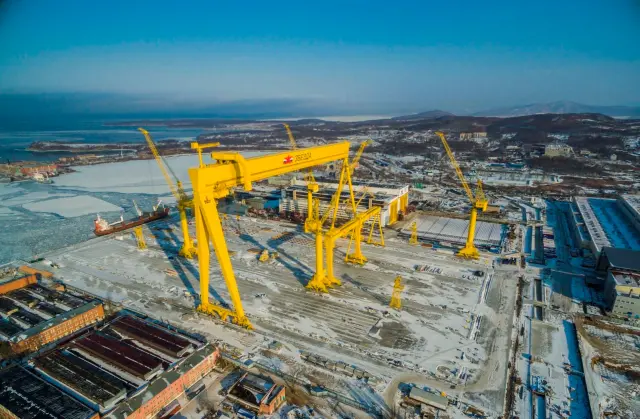
The refusal of foreign partners to honour contracts to deliver various technologies and components required by Russia’s shipbuilding enterprises has created serious problems for the entire sector.
In response, the Russian government has announced plans to double subsidies for civil shipbuilding in 2023, to at least RUB 14 billion (US$182 million). Most of them will be distributed among the leading Russian shipyards.
According to a number of recent statements made by Russia’s Prime Minister Mikhail Mishustin, these funds will be allocated for the development, serial production and modernisation of Russia’s domestic shipbuilding sector. According to him, recipients of subsidies will be able to compensate up to 80% of the costs, while the same funding will be provided for next year.
The subsidies announcement follows on from a government decision to approve zeroing VAT for shipyards in February 2023. The VAT exemption requires shipyards to invest at least 20% of the proceeds into a further development within seven years.
Civil shipbuilding expansion in doubt
The Russian civil shipbuilding sector is continuing to experience serious difficulties. That has recently forced the state to downgrade previously announced domestic civil fleet expansion targets.
According to initial plans of the Ministry of Industry and Trade – a state agency, which is responsible for the development of domestic shipbuilding in the Russian government – by 2035, more than various 1,500 ships were supposed to be built at domestic shipyards, including 60 large-capacity and 93 medium-capacity ones. However, Boris Kabakov, the director of the Ministry’s department of shipbuilding and marine equipment, has stated that these figures will be reduced to at least 985. According to Kabakov, while shipbuilding plans under state orders have not been revised, an interest from private shipowners has declined.
Analysts believe that the revised target of 985 ships by 2035 is unlikely to be attainable. It would require local shipbuilders to increase their productivity by up to 10 times or continue to place part of their orders abroad. Overseas orders are associated with serious problems amid the current conditions.
Alexander Buyanov, deputy general director of the Russian Central Research Institute of the Marine Fleet said over the past ten years, the Russian sea and river civil fleet has been expanded with about 1,000 vessels. A significant part of these ships were built abroad, mainly in South Korea and China. Only the river fleet (484 vessels) is mainly built at domestic shipyards.
Given the absence of many key technologies and shortage of factory capacities for the production of components, further downwad revisions to newbuilding targets are likely.
One-quarter of domestic projects at risk
Dmitry Stoyanov, Deputy General Director for Civil Marine Engineering of JSC Central Research Institute Kurs, one of Russia’s leading research and shipbuilding enterprises, recently told attendees during the “Russian Shipbuilding – 2023” conference that foreign sanctions had affected a significant proportion of components, equipment and technologies purchased by domestic shipbuilders abroad. As a result, according to him, 76 of 324 shipbuilding and marine equipment projects that were at different stages of production at domestic shipyards have a high risk of not being completed.
“Due to suspension of supplies, we have to redesign our ships, looking for new, alternative suppliers,” says Dmitry Stoyanov.
According to the Russian consulting company “RUKON SPGroup”, the Russian shipbuilding and marine equipment sector is by 70% dependent on imported equipment. The remaining 30% is the hull and simple metal structures. Technologically sophisticated equipment (engines, propulsion systems, steering machines, navigation, communications, most deck and crane equipment) are 100% of foreign origin. According to Olga Samovarova, managing partner of RUCON SP Group, after the exodus of many companies from the Russian market, this niche has become empty, and it needs to be filled as soon as possible.
Northern Route LNG carrier project
The problem is that there are very few developments in these areas in Russia. For example, all gas carriers for the transportation of LNG in Russia are foreign-made. According to Pavel Marchenko, director of AEM-Propulsion, a Russian producer of on-board equipment, for several years, the Russian nuclear monopoly Rosatom has been developing its own gas carrier project 10070 for year-round transportation of LNG along the Northern Sea Route. According to him, for this purpose, vessel of the Yamalmax type was taken as the basis. Initially, Rosatom wanted to use Western imported components only for the construction of propulsion (traction) installation and engine as part of the project. It subsequently became clear that a significant part of components will have to be purchased in China, as they are not produced in Russia at present.
According to Russian analysts, almost all of Russian large-tonnage fleet was built abroad. The Zvezda Shipbuilding Complex in the Russian Far East, which was established to develop a local production capacity for commercial vessels, has not yet developed to such an extent as to carry out the construction on full cycle basis. The most complex structures, for example, tanks, aft body, were primarily built in South Korea. However, at present Russian shipowners are unable to place orders in South Korea.
Related Articles
 ALTERNATIVE FUELS & LUBRICANTS
 GENERAL NEWS
 GENERAL NEWS